Your distributor's black box
Learn how to track and reclaim unclaimed mechanical and neighbouring rights from distributors. Audit your catalogue and recover lost royalties now.

Key Takeaways
Most distributors and labels quietly absorb unclaimed mechanical and neighbouring rights from independent catalogues.
You can audit your entire catalogue to identify where royalty income is leaking before it reaches you.
Tracking rights at the song level reveals which splits were never registered with collection societies properly.
Reclaiming lost royalties requires systematic documentation of your ownership chain across every DSP and territory.
Your distributor knows where your missing royalties are. They're just not telling you. This guide walks you through how to audit every corner of your catalogue, reclaim what's yours, and stop funding someone else's quarterly earnings with your unclaimed mechanical and neighbouring rights.
Most independent artists treat distribution like a set-it-and-forget-it utility. Upload the track, check the box for publishing, assume the money flows back clean.
It doesn't.
There's a gap between what you're owed and what you're paid. That gap is often referred to as the black box. It's where mechanical royalties, neighbouring rights, and territorial collections disappear into distributor ledgers, label systems, or collecting societies that don't know how to find you.
This isn't conspiracy. It's structural. The rights infrastructure is fragmented across borders, formats, and royalty types. Your distributor collects one slice. Your PRO collects another. SoundExchange handles a third. If the metadata doesn't match, the money sits. If no one claims it within the statute window, someone else absorbs it.
This article walks you through how to audit your catalogue, identify missing income, and put the systems in place to capture what's already yours.
What the black box actually is
The black box refers to royalties that are collected but not distributed. They sit in limbo because the rightsholder can't be identified, contacted, or matched to the income stream.
These royalties come from three primary sources:
Mechanical royalties. Owed when your composition is reproduced or streamed. In the U.S., mechanical royalties from streaming go through the Mechanical Licensing Collective. Outside the U.S., they flow through local collection societies. If your publisher information is missing, incomplete, or mismatched in the DSP metadata, those royalties don't reach you.
Neighbouring rights. Also called related rights or performer royalties. These are owed to the recording artist and the label for public performance of the master. Neighbouring rights are collected separately from performance royalties. If you're not registered with a neighbouring rights organization like SoundExchange (U.S.), PPL (UK), or your local CMO, that income never arrives.
Territorial royalties. Your music gets streamed, downloaded, or performed in dozens of countries. Each country has its own collection system. If you're not registered in those territories or working with a sub-publisher or rights administrator, the income stays local and eventually gets reclassified as unmatched funds.
Distributors do not automatically claim these on your behalf. Some offer publishing admin add-ons. Some partner with rights organizations. But unless you opt in, configure splits, and supply accurate metadata, those streams produce no royalty payout to you.
Why the gap exists
The rights infrastructure was not built for independent artists releasing globally with no label or publisher. It was designed for catalogue owners with dedicated rights managers, legal teams, and decades of institutional memory.
Here's how the gap forms:
Metadata inconsistencies. Your artist name is spelled one way on Spotify, another way in your ASCAP account, and a third way in the ISRC registry. When the systems try to match and pay, they fail. The money sits.
Missing or incomplete publishing info. If you don't provide an IPI number, publisher name, and split percentages at the distribution level, the mechanical royalties go unclaimed. Some distributors let you skip these fields. That's a mistake.
No neighbouring rights registration. Most independent artists don't know neighbouring rights exist. They assume their PRO handles everything. It doesn't. Neighbouring rights are separate. If you're not signed up with SoundExchange or the equivalent in your country, you're leaving 45% of your master recording income on the table.
Territorial blind spots. You released globally. But you only registered with ASCAP and SoundExchange in the U.S. When your track gets heavy rotation in Germany or Brazil, the local society collects the royalties and waits for someone to claim them. If no one does within three to five years, the funds are redistributed to major rightsholders or absorbed as administrative surplus.
Distributor absorption clauses. Some distribution agreements include language that allows the distributor to retain unclaimed royalties after a set period. Read your terms. If you're using a free or low-cost platform, this is often how they monetize beyond the upload fee.
How to audit your catalogue for missing income
Start with a full rights inventory. This is not a creative exercise. It's operational forensics.
Step one: Pull your distribution metadata
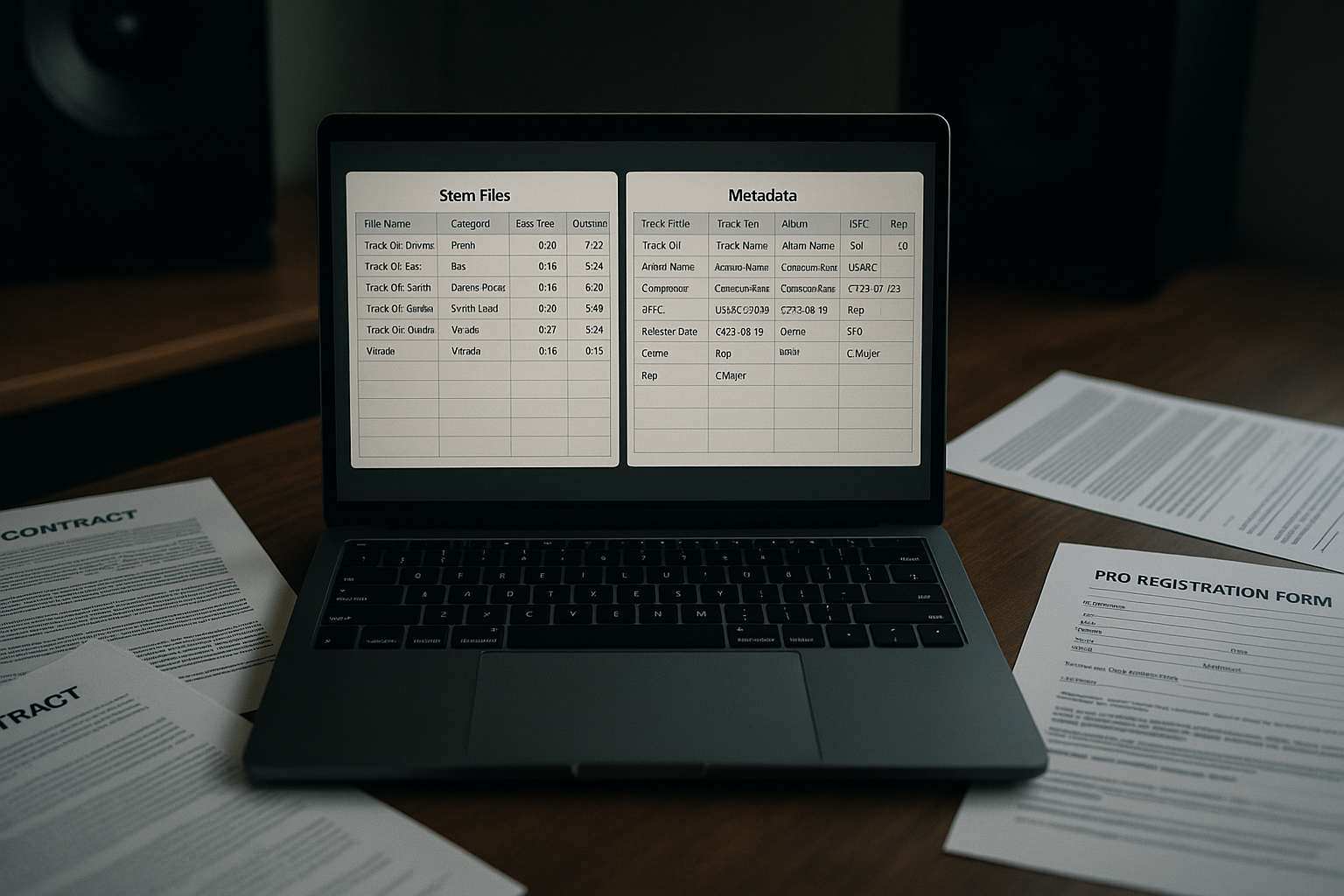
Log into your distributor dashboard. Export the full catalogue metadata for every release. You're checking for the following:
- ISRC codes (unique to each track)
- UPC codes (unique to each release)
- Songwriter and publisher names
- IPI and CAE numbers
- Split percentages for writers and publishers
- Territory selections
If any field is blank, incomplete, or inconsistent across releases, flag it. That's a point of failure.
Step two: Cross-check your pro registration
Log into your performing rights organization account. Confirm that every composition in your catalogue is registered. Check that the title, writer splits, and publisher affiliation match what you submitted to your distributor.
If you co-wrote a track, confirm that all co-writers are listed with correct splits. If the splits don't add up to 100%, the royalties may be held until the discrepancy is resolved.
Step three: Verify neighbouring rights registration
In the U.S., that's SoundExchange. In the UK, it's PPL. In Canada, it's Re:Sound. Every territory has one.
Log in and confirm:
- You're registered as both artist and label (if you own your masters)
- Your legal name, stage name, and any name variants are all on file
- Your ISRC codes are linked to your account
- Your payment info is current
If you've never registered, do it now. SoundExchange alone holds over $300 million in unclaimed royalties. Some of that is yours.
Step four: Check international collection
If you're only registered in your home country, you're missing international income. Use a publishing administrator or rights management service to extend coverage. Services like Songtrust, Sentric, or CD Baby Pro register your works with societies in over 60 countries and handle the claims process on your behalf.
They take a percentage, typically 10% to 15%, but the net recovery far exceeds the fee if your music has any international traction.
Step five: Request historical statements
Email your distributor and request a full accounting breakdown for the last three years. You want to see which income types were reported, which DSPs and territories generated revenue, and where the gaps are.
Compare those statements against your PRO statements and your neighbouring rights statements. The numbers should align. If your distributor shows 500,000 Spotify streams but your MLC statement shows zero mechanical royalties, something broke in the chain.
What to do when you find missing income
Once you identify a gap, act immediately. Statutes of limitation vary by territory and royalty type. In some cases, you have three years to claim. In others, it's shorter.
Claim historical royalties with soundexchange
SoundExchange allows you to backdate your claim up to three years. After that, the funds are forfeited. If you just registered and your music has been streaming on Pandora, SiriusXM, or internet radio for years, file a historical claim immediately.
Update your distributor metadata
Correct every error you flagged in step one. Resubmit the release if needed. Some platforms allow metadata updates without affecting the release date or stats. Others require a takedown and re-upload. Check the policy before you act.
If your distributor doesn't allow full publishing field entry, consider switching. Distributors like DistroKid, Amuse, and Ditto allow detailed splits and publishing info. Others don't. That difference costs you money every quarter.
Register works retroactively with your pro
Most PROs let you register older works. Do it. Even if the release is two years old, future royalties depend on current registration. If the work was already generating income but wasn't registered, contact your PRO directly and request a manual claim review. Provide the ISRC, release date, and distributor name.
File claims with international societies
If you've identified specific territories where your music charted or trended, contact the local collection society directly. Provide proof of ownership (ISRC, UPC, publisher info) and request a review of unclaimed funds. Some societies make this easy. Others require a local representative or administrator. That's where a publishing admin service earns its fee.
Prevention: How to stop future leakage
Once your catalogue is clean, keep it that way. Set up quarterly audits. It takes 20 minutes.
Standardize your metadata
Use the exact same name spelling, publisher name, and IPI across every platform and every release. Save a master metadata template and use it every time. Consistency is how the systems find you.
Register before you release
Don't upload a track and then register it with your PRO two months later. Register first. Give the systems time to sync. The ideal sequence is:
- Register the composition with your PRO
- Get your ISRC and UPC from your distributor or generator
- Upload the track with full splits and publishing info
- Confirm neighbouring rights registration
- Release
Set calendar reminders
Quarterly: Pull and compare statements from your distributor, PRO, and neighbouring rights org.
Annually: Audit your full catalogue metadata and update your registration with any new works, name changes, or publisher updates.
Every three years: File a historical claim check with SoundExchange and any international societies where you have coverage.
Use a publishing administrator
If you're releasing more than four tracks a year, have international traction, or co-write frequently, a publishing admin service is worth the cost. They automate registration, monitor global income, and file claims in territories you'll never track manually.
Sync or Sink walks through how to evaluate publishing services and what to look for in a contract.
What happens to royalties no one claims
After the statute window closes, unclaimed funds are redistributed. How that happens depends on the organization.
SoundExchange redistributes unclaimed royalties to artists and labels with similar usage patterns. If you didn't claim your share, it goes to someone else.
The MLC in the U.S. holds unclaimed mechanical royalties and distributes them proportionally to matched rightsholders after three years. Again, if you're not in the system, your share funds someone else's quarterly payout.
International societies vary. Some hold funds longer. Some allow retroactive claims up to five or six years. Some transfer surplus funds to cultural programs or industry associations.
Distributors with absorption clauses in their terms of service may retain unclaimed publishing or neighbouring rights income if you don't configure your account correctly. That's legal. It's also entirely avoidable.
The bottom line
Your distributor is not your accountant. Your PRO doesn't talk to SoundExchange. SoundExchange doesn't talk to PPL. The MLC doesn't coordinate with GEMA. These systems were not designed to work together.
That's your job.
You are the only person who sees the full picture. You are the only one with the incentive to connect the dots. If you don't audit your catalogue, register your works globally, and track your income across royalty types and territories, the money sits. And eventually, someone else takes it.
This is not about chasing pennies. A catalogue with 100,000 streams per month across three territories can generate $2,000 to $5,000 per year in neighbouring rights and mechanical royalties that never show up in your distributor dashboard. Over three years, that's $6,000 to $15,000 you didn't know you were owed.
Start the audit today. Pull your metadata. Check your registrations. File your claims. This is baseline catalogue management. It's not optional if you're serious about building a sustainable music income.
Your "Independent" Distributor Just Got bought explains what happens to your royalties when your distributor is acquired. The volume gap: Why more streams doesn't mean more income breaks down why stream count alone is a misleading metric.
You own the masters. You wrote the songs. Make sure you're collecting everything they generate.
Ready to streamline your workflow?
Stop piecing together spreadsheets and scattered notes. Join the waitlist for Music Artist Manager and get your entire rollout in one place.
Written By
Gavin Alexander
Senior Marketeer
As the founder of Music Artist Manager, Gavin has spent years at the intersection of music and technology. Seeing firsthand how chaotic release rollouts and split sheets can be, he designed a platform that brings major-label infrastructure to independent artists and their teams. He writes extensively about industry trends, artist leverage, and workflow optimisation.