The volume gap: Why more streams doesn't mean more money in 2026
UK recorded music revenue rose 5% in 2025, but per-stream rates fell as catalogue volume surged - here's how to diversify your income.
Key Takeaways
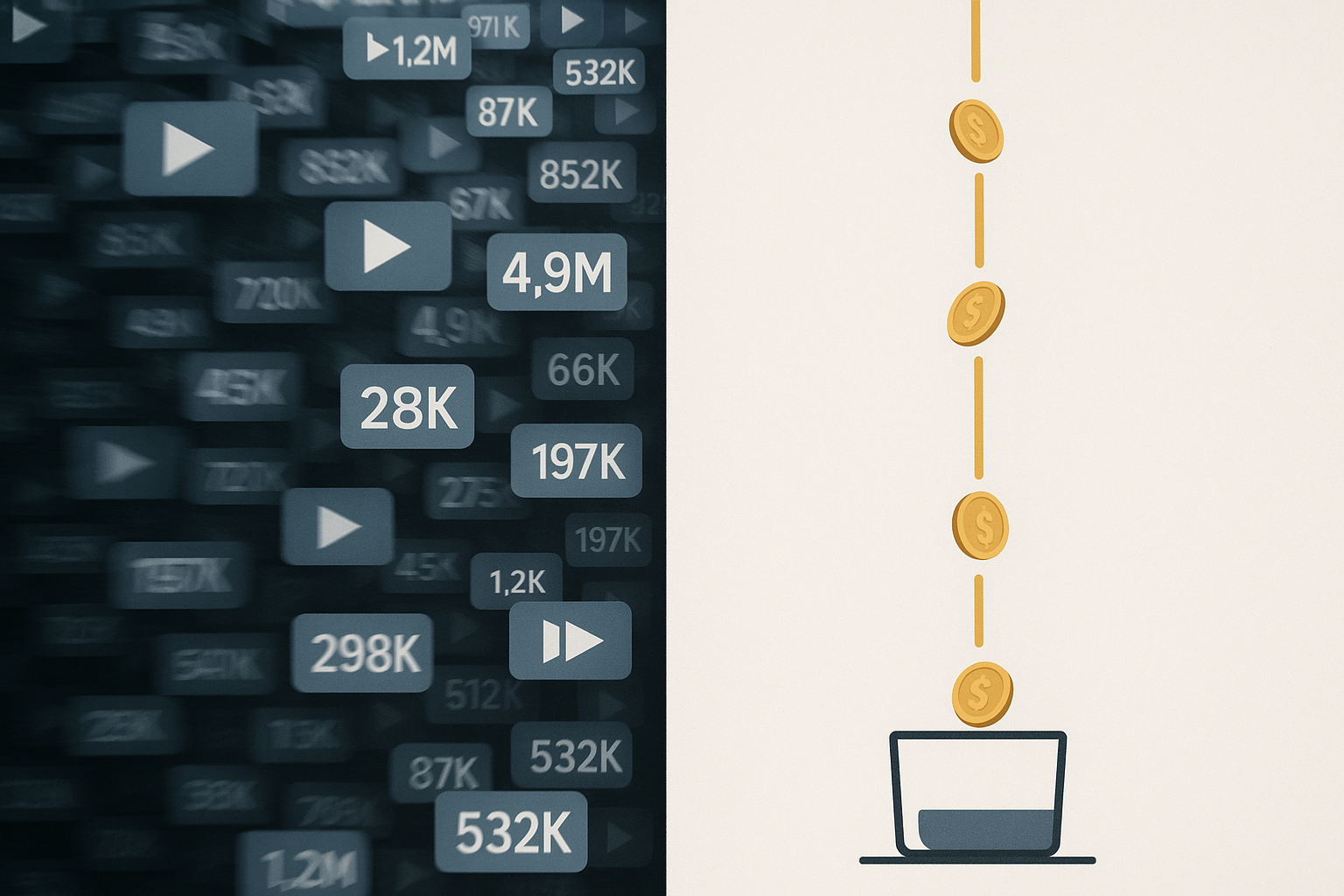
Streaming growth and artist income no longer move together as catalogue volume dilutes per-stream rates.
Most independent artists capture only one revenue stream when four to six are available and unclaimed.
A 300-unit vinyl run can match the income of five to ten million streams at sustainable margins.
Revenue diversification works only when you already have an audience, not as a substitute for building one.
UK recorded music revenue rose 5% in 2025, but per-stream rates fell as catalogue volume surged - here's how to diversify your income.
The BPI's All About The Music 2026 report dropped in March with what looked like positive news: UK recorded music revenue climbed 5% to £1.57bn in 2025. Streaming kept growing. British artists got their moment.
But Ron Pye, CEO of IQ Artist Management, saw something else in the numbers. He posted on LinkedIn: "The gap between volume growth and income growth is what subscription market maturation looks like at the individual artist level."
Here's what that means for you: the industry is expanding, but the money isn't reaching independent artists. Your stream count might be rising. Your actual income is probably flat or losing ground to inflation. These two metrics no longer track together.
The structural problem
Several market forces are colliding right now:
Per-stream rates keep thinning as total catalogue volume explodes. Spotify is approaching 200 million tracks. More music means more competition for the same subscription revenue pool.
Vinyl surged 19.9% in 2025 according to BPI data. This is the biggest physical format growth in decades, but it flows almost entirely to major label artists with distribution infrastructure already in place. Independent artists are watching from the sidelines.
Platform prices went up. Spotify, Apple Music, and Tidal all raised UK subscription prices in 2024–25. But that extra revenue doesn't trickle down proportionally to emerging independent artists. It consolidates at the catalogue top.
The BPI data confirms maturation, not collapse. A maturing streaming market means growth is slowing and algorithms increasingly favour catalogue depth over new releases. Building a back catalogue and monetising it correctly is now a structural advantage.
The artists winning right now aren't the ones with the most streams. They're the ones with the most diversified, systematised revenue pipelines.
How streaming royalties actually work
Streaming royalties are calculated on a pro-rata share of a platform's total royalty pool. As the number of songs on streaming platforms grows, each stream of your song is worth proportionally less, regardless of subscription price increases. This is the volume gap in mechanical terms.
Most independent artists are capturing one revenue stream (digital distribution) and ignoring three to five others completely. This is a systems problem, not a talent problem.
Revenue sources most artists are missing
- Streaming (distribution): Most artists have this. Low capture difficulty.
- PRS/PPL (performance royalties): Often not registered. Low difficulty once set up.
- Mechanical royalties (MCPS): Rarely claimed. Low difficulty once set up.
- Sync licensing: Rarely pursued. Medium difficulty.
- Physical / vinyl: Almost never. Medium difficulty.
- Direct-to-fan (Bandcamp, Patreon): Inconsistent. Medium difficulty.
- Live performance royalties: Underreported. Low difficulty.
If you're only collecting from digital distribution, you're leaving money on the table every single month.
The vinyl opportunity nobody talks about
A micro-run of 100–300 units pressed through a short-run vinyl manufacturer (Vinyl Express, United Record Pressing) and sold via Bandcamp pre-order can generate £1,500–£5,000 for a single release at a price point of £20–£28 per unit.
Streaming would require roughly 5–10 million streams to match that income.
You don't need major label infrastructure to do this. You need a fanbase willing to buy and a release plan that treats physical as a product line, not a nostalgia play.
Who this strategy is for
This isn't for artists releasing their first single with no audience.
The volume gap strategy is most relevant to:
- Artists with a catalogue of 6+ releases and an existing fanbase, even if small
- Artists already generating streaming income but frustrated it doesn't match play growth
- Artists active for 12+ months who haven't set up PRS/PPL/MCPS registrations
- Managers preparing artists for sustainable independent income
If you have fewer than 1,000 monthly listeners, your priority is audience building first. Revenue diversification compounds on an existing fanbase. It doesn't substitute for one.
Close the revenue gaps this quarter
- Run a revenue source audit. List every place you currently receive money from your music. If your list has fewer than four line items, you have structural gaps.
- Register with PRS for Music and PPL immediately if you haven't already. These are separate organisations covering performance and broadcast royalties. Both are free to join. Missing this is one of the most common and most costly oversights for independent UK artists.
- Register all published works with MCPS (now administered through PRS). Every commercial release should have its mechanical rights properly claimed and registered.
- Set up a direct-to-fan revenue channel. Bandcamp is the most frictionless entry point. Even if you only sell 20 albums directly per release at £10–£15 each, you're building margin-rich income and a direct customer relationship no algorithm controls.
- Plan one physical product this year. It doesn't need to be vinyl. A limited cassette run, a hand-stamped 7", or a premium digital download bundle with exclusive artwork serves the same function: a higher price point, a scarcity mechanism, and a reason for fans to engage beyond passive streaming.
- Track your revenue mix weekly, not just stream counts. The metric that matters is: what percentage of my income comes from sources I control? Streams are a vanity metric if they don't translate to diversified income.
- Identify one sync opportunity per quarter. Sync licensing (music placed in film, TV, advertising, games) pays blanket fees and generates ongoing royalties. Platforms like Musicbed, Artlist, or direct agency outreach are accessible to independent artists with a complete, properly registered catalogue.
Build systems before you need them
Lyor Cohen's operating principle is ruthlessly simple: build systems before you need them. The artists who feel the volume gap most acutely are the ones who built a single revenue pipe and assumed it would scale linearly.
The BPI report isn't bad news. It's a map. It shows exactly where the money is going and where independent artists can position themselves to intercept it. Vinyl is surging. Direct-to-fan is growing. Sync demand is at record levels.
The issue is never that the money isn't there. The issue is whether your business has the infrastructure to receive it.
Performers react to the market. CEOs architect their position within it.
- Music Artist Manager's revenue tracking dashboard lets you monitor every income source in one place so you can see exactly where your gaps are and close them systematically.
→ Track your full revenue mix in Music Artist Manager - start free
Related Reading:
- https://www.musicartistmanager.com/blog/sync-ready-before-the-call
- https://www.musicartistmanager.com/blog/streaming-fraud-payment-gatekeeping
- https://www.musicartistmanager.com/blog/masters-sync-advantage-2026
Further Reading:
- *All About The Music 2026* — BPI — https://www.bpi.co.uk/news/13097053
- Ron Pye, "The gap between volume growth and income growth" — LinkedIn / IQ Artist Management — https://www.linkedin.com/posts/ronniepye_the-gap-between-volume-growth-and-income-activity-7464953031852326912-_tm2
- *How to Market Your Music in 2026 Without Wasting Money* — IQ Artist Management — https://iqmgmnt.com/music-marketing-complete-guide-2025-part-1/
- *Independent Artists vs Labels in 2026* — Orion Promotion — https://orionpromotion.com/independent-artists-vs-labels-in-2026/
Ready to streamline your workflow?
Stop piecing together spreadsheets and scattered notes. Join the waitlist for Music Artist Manager and get your entire rollout in one place.
Written By
Gavin Alexander
Senior Marketeer
As the founder of Music Artist Manager, Gavin has spent years at the intersection of music and technology. Seeing firsthand how chaotic release rollouts and split sheets can be, he designed a platform that brings major-label infrastructure to independent artists and their teams. He writes extensively about industry trends, artist leverage, and workflow optimisation.