How to write a strong artist bio for your profile
Your artist bio is the first thing a journalist reads when they are considering covering you. It is what a playlist curator checks when your submission is on the fence. It is what a potential manager reads when your project catches their attention. Most independent artist bios are the weakest thing about their press pack.
Key Takeaways
Write your bio in the third person, factual and specific, not warm and aspirational
Lead with the most interesting or specific thing about you — not your origin story
Include one concrete achievement or data point in the first paragraph
Avoid genre soup: naming fifteen influences does not position you, it obscures you
Your artist bio is the first thing a journalist reads when they are considering covering you. it is what a playlist curator checks when your submission is on the fence. it is what a potential manager reads when your project catches their attention. most independent artists' bios are the weakest part of their press pack.
What a bio is actually for
A bio is for the people you want to write about you, book you, or feature your music. it is not for your existing fans — they already know who you are. it is for professionals who are evaluating whether you are worth their time and platform.
Write it for that reader. what do they need to know to make that decision? what is the most compelling version of your story that is also completely accurate?
The structure that works
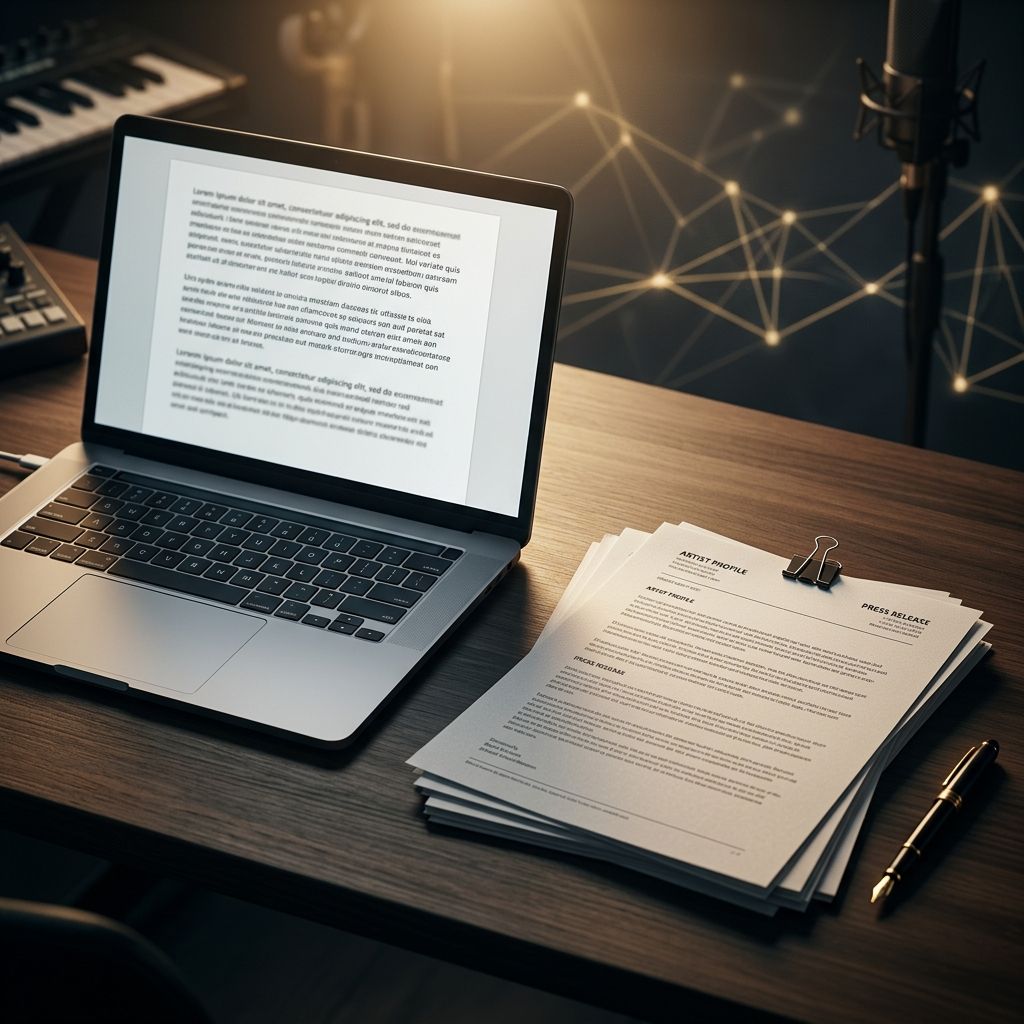
First paragraph — the position and the proof. one or two sentences that tell the reader who you are and why they should care. be specific. "UK rapper from south london, three releases charted in the UK top 40 on bandcamp, known for lyric-forward music with production rooted in '90s new york and contemporary drill" is a position. "passionate artist creating authentic music that blends multiple genres" is not.
Second paragraph — the work. recent releases, notable collaborations, live activity, press coverage, sync placements. concrete, factual, dated. this is where you put the proof for the claims in the first paragraph.
Third paragraph (optional) — the context. where you are from, what is next, any relevant background that adds to the story. this is where nuance goes — but only if it adds something. a third paragraph that says nothing new is worse than no third paragraph.
Things that make bios weaker
Genre soup — "blends hip-hop, R&B, soul, jazz, afrobeats, and alternative into a unique sound" tells the reader nothing about what you actually sound like and signals that you have not made a clear creative decision.
Adjective stacking — "powerful, emotive, authentic, raw, vulnerable" are claims without evidence. replace adjectives with specifics: not "powerful lyrics" but "lyrics that address [specific subject matter]."
The origin story first — starting with where you grew up and how long you have been making music is the least interesting version of your story. lead with the most interesting thing first.
Aspirational future tense — "is set to make a significant impact" tells the reader you have not made one yet. write about what has happened, not what you hope will happen.
Using your artist profile on music artist manager
Your artist profile in music artist manager is the context layer for the collaboration desk — the more complete and accurate it is, the more relevant every AI advisor response becomes.
Fill in your genre, your creative era, your active platforms, and your spotify URL. add a short bio or artist statement in the notes section. this information is read before every session in the collaboration desk, so the advice you receive is grounded in who you actually are, not a generic independent artist template.
When you update your artist profile — after a new release, after a significant live run, after press coverage — the collaboration desk responses update with it.
The bio on your profile versus the bio in your press pack
Keep two versions: a short version (two to three sentences for profile fields, social bios, and quick submissions) and a full version (three paragraphs for press packs, EPKs, and grant applications). both should tell the same story at different lengths — the short version is not a different bio, it is the first paragraph of the long one.
Update both versions after every significant development in your career. an accurate, current bio is a professional signal. an outdated one is the opposite.
Ready to streamline your workflow?
Stop piecing together spreadsheets and scattered notes. Join the waitlist for Music Artist Manager and get your entire rollout in one place.
Written By
Gavin Alexander
Senior Marketeer
As the founder of Music Artist Manager, Gavin has spent years at the intersection of music and technology. Seeing firsthand how chaotic release rollouts and split sheets can be, he designed a platform that brings major-label infrastructure to independent artists and their teams. He writes extensively about industry trends, artist leverage, and workflow optimisation.