The terms of service change. most artists never notice.
Learn how Music Artist Manager alerts you the moment your distributor changes their terms of service, before it affects your releases.

Key Takeaways
Distributor terms of service can change without notice, and you find out when it already affects you.
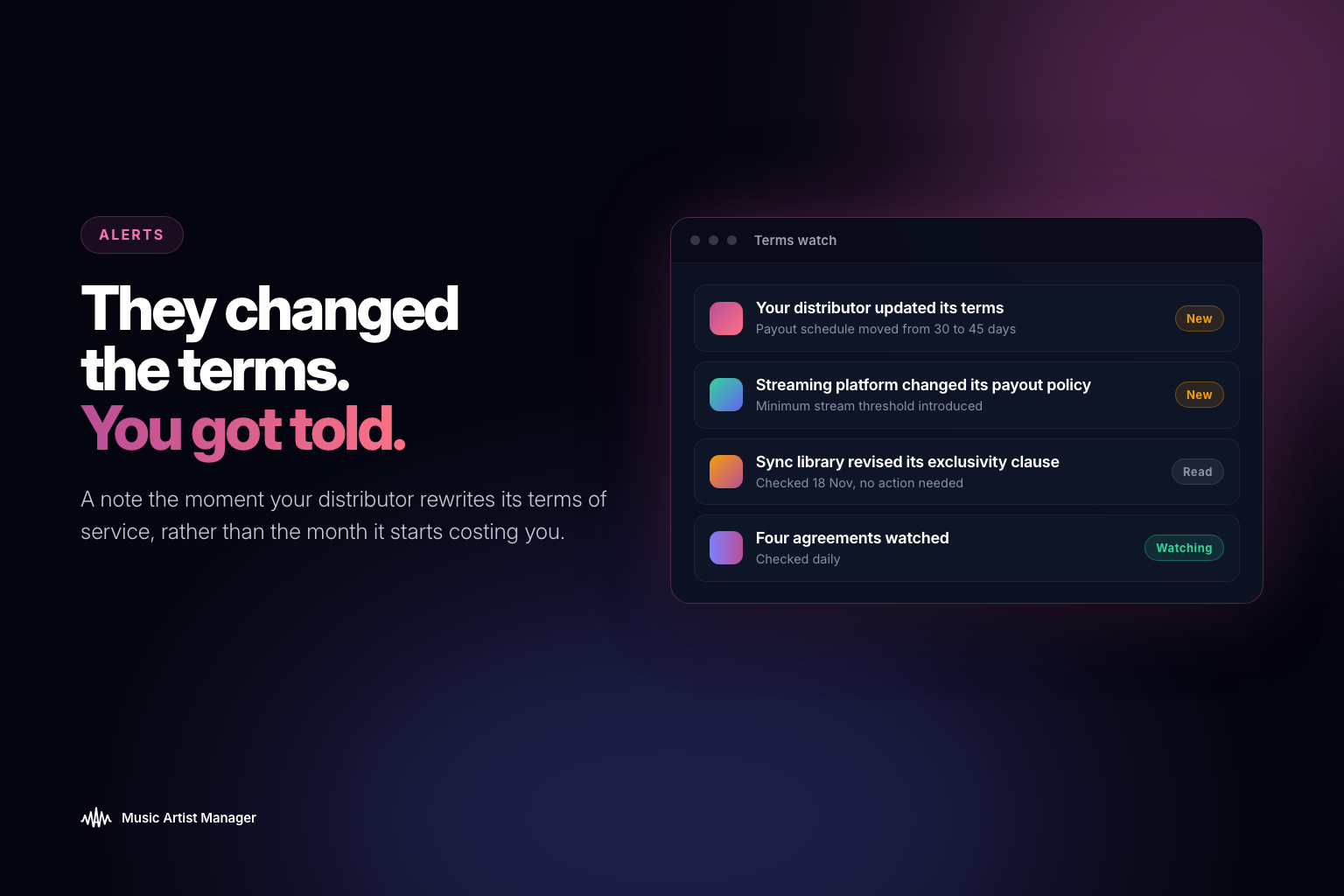
Music Artist Manager tracks your specific distributor's terms and alerts you the moment something shifts.
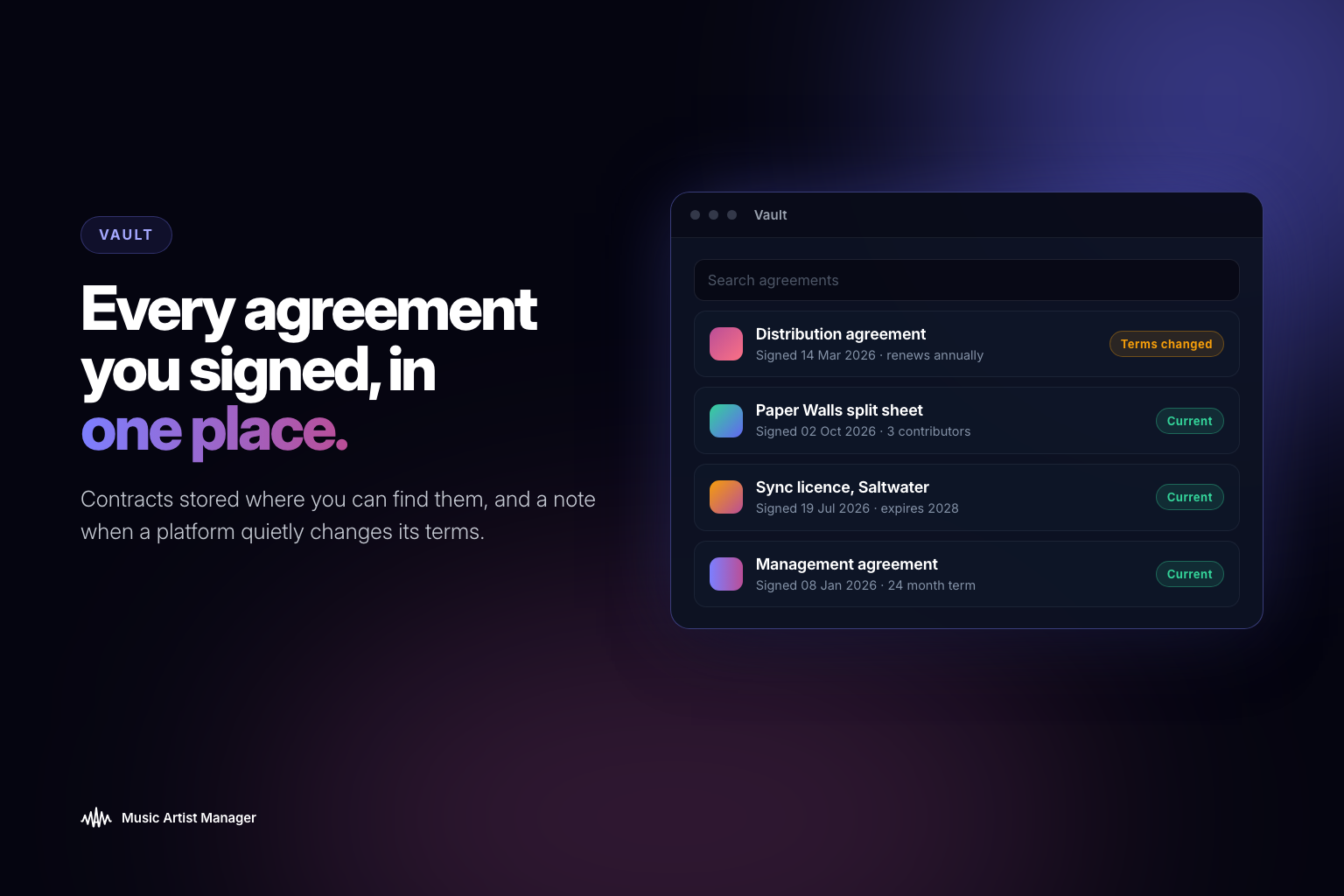
Alerts surface inside Contract Vault, next to the actual agreement the change affects, not a separate inbox.
This closes the gap between a change happening and you knowing about it, the action is still yours.
Your distributor can rewrite their terms without warning. Policy shifts, royalty clauses, rights language. Unless you catch it the day it's published, you find out when it's already affecting your income. Music Artist Manager watches your specific distributor and alerts you the moment terms change, inside the same workspace where your contract lives.
Your distributor can change their terms of service tomorrow morning. The revenue split on streams, the rights they claim to your master, the clause about AI-generated content—they can rewrite any of it. And unless you happen to check their changelog that day, you find out weeks later when a payment doesn't match, or a sync opportunity falls through because a clause shifted.
This isn't hypothetical. DistroKid updated their unlimited plan structure in 2023. Tunecore adjusted territorial rights language. CD Baby rewrote sections on content eligibility. Each time, the notification arrived via email to an inbox you check twice a week, or as a pop-up during login that you clicked through to get to your dashboard.
If you're managing more than a hobby release schedule, that's not a monitoring system. That's luck.
What distributor awareness actually means
Most artist-management tools stop at helping you schedule posts and track streams. They don't watch the commercial relationships that determine whether you get paid correctly, or whether the rights you think you hold are actually enforceable.
Music Artist Manager does. During onboarding, you name your primary distributor. That's what we call Distributor Awareness, and it's the control switch for everything that follows. From that point, the system monitors terms-of-service changes published by that specific distributor. When something shifts, you get an alert inside Contract Vault, next to the actual distribution agreement it affects.
This is not a news roundup. It's not a blog post about "industry trends in distributor policy." It's a named change, from your distributor, flagged the day it's published.
Why terms changes matter more than you think
A distributor terms update can affect:
- Revenue splits. A platform adjusts how they calculate net receipts, or introduces a fee structure that wasn't in the original agreement.
- Territory restrictions. Language around where your music can be monetised shifts, particularly in regions with complex licensing.
- Rights retention. Clauses about what rights the distributor claims to your master during the term, or after termination, get rewritten.
- Content eligibility. New policies on AI-generated content, cover songs, or sampling can disqualify releases retroactively or require new paperwork.
- Payout timing. Changes to payment windows or minimum thresholds that delay when money lands in your account.
You can't negotiate most of these after the fact. The service agreement you clicked through when you signed up almost always includes a clause that says they can amend terms with notice. Notice doesn't mean consent. It means they told you, and if you keep using the service, you've accepted the change.
The gap between "they told you" and "you saw it" is where this falls apart for most independent artists and managers.
How the alert system works in practice
Step one: You name your distributor during onboarding. That's the data point that makes this possible. If you use DistroKid, we're watching DistroKid. If you use TuneCore, we're watching TuneCore.
Step two: We monitor published terms updates from that distributor. When they update their terms of service, user agreement, or content policy, the system raises an alert.
Step three: The alert appears inside Contract Vault. That's where your distribution agreement already lives, alongside your splits, your label services contract, and anything else with a signature on it. So when a change lands, it's sitting next to the document it affects. No separate inbox. No cross-referencing between tools.
Step four: You read the updated terms and decide what to do. The alert closes the information gap. It doesn't interpret the legal impact, and it's not a substitute for a lawyer when something material changes. It tells you the update happened, and it puts the new language in front of you while it's still fresh.
Who this is built for
This is for any artist or manager with a live distribution relationship who doesn't want to be the last person in the room to know the rules changed.
That includes:
- Independent artists distributing through DistroKid, TuneCore, CD Baby, or similar platforms who are treating music as a business, not a side project.
- Artist managers running multiple releases across a roster, where a terms change at one distributor could affect six active campaigns.
- Self-releasing bands with back catalogue still generating income, where a payout-timing change or a territory restriction could quietly erode revenue.
- Anyone who has ever missed a distributor email, logged in to upload a track without reading the pop-up, or found out about a policy shift because a sync partner's lawyer mentioned it in passing.
If you're checking your distributor's changelog manually, you already understand why this matters. If you're not, you're assuming nothing's changed, and that assumption costs money eventually.
What this doesn't do
Worth being precise here. This alerts you when terms change. It doesn't:
- Interpret what the change means for your specific situation.
- Provide legal advice about whether the change is enforceable or worth challenging.
- Automatically flag which of your releases might be affected by a content-eligibility update.
- Replace the need to read the updated terms yourself, or to talk to someone qualified when something material shifts.
The job of this feature is to close the gap between "it changed" and "you know it changed." The judgment about what to do next is still yours. That's not a limitation. That's the design. No feature in Music Artist Manager makes decisions for you. Managers inside Manager Chat give advice. You act.
Why no other tool in this space does this
Most artist-management software is built around content planning and analytics. It helps you schedule a release, track engagement, collect streaming data. That's useful, but it's campaign work, not business infrastructure.
The commercial relationships behind the release—your distributor agreement, your splits, your rights retention—sit in a separate layer. Usually in a folder on your desktop, or in an email thread you have to search for when something goes wrong.
Music Artist Manager treats those agreements as live documents, not static files. Contract Vault isn't just storage. It's the place where your distributor terms, your collaboration splits, and your label services agreement all live, and where alerts about changes surface in context.
That's the operational difference. If a distributor updates a revenue-split clause and you're using a standard analytics dashboard, you won't know until the next payout is short. If you're using Music Artist Manager, you know the day the terms are published, and you're looking at the clause while you still have time to understand what it means for your catalogue.
The reputational cost of being late
You're a week into a release campaign. A sync opportunity comes in. The brief is tight—they need a master-use clearance within 48 hours. You send over your distributor agreement to confirm you hold the rights they need.
Except your distributor updated their terms two months ago, and there's now a clause that restricts sync licensing during the first year of distribution unless you've opted into a different tier. You didn't know, because you didn't see the email, and now the opportunity has moved to another artist while you're on a support call trying to work out if you can still clear the track.
That's not a worst-case scenario. That's a thing that happens, and it's the kind of thing that gets you a reputation for being slow or hard to work with, even though the information gap wasn't your fault.
The same applies to revenue. A distributor changes how they calculate platform fees, and your quarterly payout drops by 8%. You assume the music underperformed. It didn't. The terms changed, and no one flagged it for you.
How to use this if you're managing a roster
If you're managing multiple artists, each with different distributors, this scales in a way that manual monitoring doesn't.
For each artist on your roster, you name their primary distributor during onboarding. From that point, you're watching terms changes across DistroKid, TuneCore, CD Baby, Ditto, Amuse—whoever they're using—without having to visit five different sites or subscribe to five different newsletters.
When an alert comes through, you can assess whether the change affects one artist or all of them. If a distributor updates a clause about AI-generated content and you've got three artists using that platform, you know immediately which releases to review. If a payout-timing change lands, you can recalculate cash flow for the affected artists before the next royalty cycle.
The alternative is waiting until an artist asks why their payment is late, or why a release got flagged, and then working backwards to find out what changed. That's reactive, and it's slow. This is not.
The case for treating agreements as live documents
Most artists file their distributor agreement once: the day they sign up. Then it sits in a folder, and the assumption is it hasn't changed unless someone tells you otherwise.
That assumption is expensive. Distributor terms change, publishing splits get renegotiated, label services agreements have renewal clauses that adjust commission percentages after year two. If you're treating these as static files, you're behind before the conversation even starts.
Contract Vault is built on the principle that your agreements are live. The distributor terms you agreed to in 2022 are not necessarily the terms that apply today, and the alert system makes that visible in real time.
That's not about paranoia. It's about operating with accurate information when it matters—when you're negotiating a split, clearing a sync, or reviewing a royalty statement that doesn't match your expectations.
What to do when an alert lands
When you get a distributor terms alert, here's the sequence:
1. Read the updated terms. The alert links to the new language. Don't skim. Read the section that changed, and read the surrounding clauses for context.
1. Check which releases are affected. If the change is about content eligibility, territory restrictions, or revenue splits, work out whether it applies to your whole catalogue or just new releases.
1. Compare the new terms to your existing splits and agreements. If you've got a collaboration with a producer where the split assumes a certain payout structure from your distributor, and that structure just changed, you need to know before the next royalty cycle.
1. Talk to someone qualified if the change is material. If a clause about rights retention or licensing has shifted, and you're not certain what it means for a live sync deal or a label negotiation, that's a conversation for a lawyer, not a support ticket.
1. Document your response. If you decide to switch distributors, renegotiate a split, or adjust your release strategy, note it in Contract Vault so you've got a record of when the change happened and what you did about it.
This isn't about reacting to every terms update like it's a crisis. Most changes are administrative. But the ones that matter—the ones that affect your revenue, your rights, or your ability to clear a track for a sync—those are the ones where knowing early is the only thing that gives you room to move.
A tool designed for the moment something changes
The most distinctive thing about this feature is timing. It's not a retrospective. It's not a report you read at the end of the quarter when the damage is already done. It's a signal that arrives the day the change is published, while you still have time to understand it and act.
That's rare in artist-management software. Most tools are built around tracking what already happened—streams, engagement, revenue. This is built around watching the systems that determine whether what happens next is on your terms or someone else's.
If you're running a release schedule, managing a roster, or simply treating your music as a business with commercial relationships you need to protect, this is the feature that makes sure you're not the last person to know when those relationships shift.
No other platform in this space does this. Music Artist Manager does, because the gap between "your distributor changed something" and "you found out" is not a gap you should be managing manually.
Ready to plan your next release?
Stop piecing together spreadsheets and scattered notes. Get your free release strategy and keep your whole rollout in one place.
Written By
Gavin Alexander
Senior Marketeer
As the founder of Music Artist Manager, Gavin has spent years at the intersection of music and technology. Seeing firsthand how chaotic release rollouts and split sheets can be, he designed a platform that brings major-label infrastructure to independent artists and their teams. He writes extensively about industry trends, artist leverage, and workflow optimisation.