Contract vault: One place for every agreement you've signed
Learn how to store your contracts in one place and get alerts when platforms change their terms.

Key Takeaways
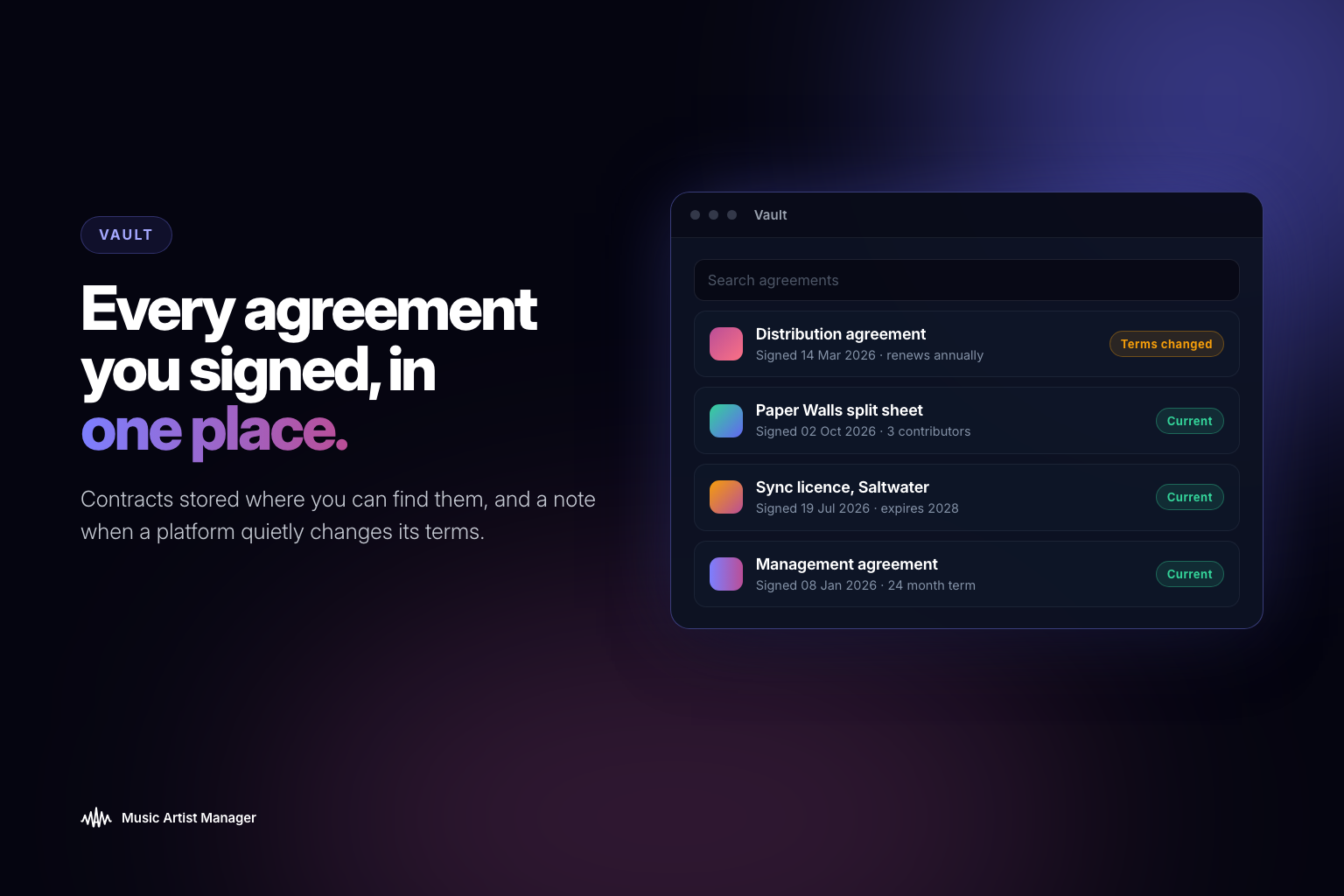
Contract Vault is where every distribution deal, sync license and management agreement lives in one place.
When a platform changes its terms, you get alerted instead of finding out months later.
It stores what you signed and watches for changes, but it is not legal advice.
If you have agreements governing your career, they belong in Contract Vault at /planner/vault.
Most artists have signed at least three agreements that matter to their career. Most can't find two of them right now. Contract Vault is where every distribution deal, sync license and collaboration agreement lives in one place, with alerts when the platforms you're tied to change their terms.
You're on a call with a sync supervisor. They want to license a track from your catalogue for a placement, budget is decent, timeline is tight. They ask if the artist cleared all the samples. You say yes. They ask who owns the master. You say the artist does. Then they ask for the producer split and you realise you don't actually know where that agreement is.
It's not in the shared Drive. It's not in the artist's email. It might be a text thread from eighteen months ago, or it might be a PDF titled "FINAL_v3_REVISED" sitting in someone's downloads folder. The sync falls through because you can't prove what you said was true in the time they needed it.
This is not a workflow problem. It's a contract storage problem, and it costs money.
Why contracts end up everywhere except where you need them
Most artist managers don't start with a system. You start with one artist, maybe two. Early deals get signed over email. PDFs live in threads. The distribution agreement sits in Gmail. The producer split is a WhatsApp screenshot. The management contract is a Google Doc that three people have editing access to.
Then the roster grows. You bring on a second artist. A third. Email becomes unworkable. You move some contracts to Drive, some to Dropbox, some stay in email because you forgot to move them. When someone asks for a document, you search three places and hope.
The bigger problem isn't finding contracts when someone asks. It's not knowing when the terms inside them have changed.
A distribution platform updates its payout schedule. A PRO changes its statement format. A licensing partner shifts its territory restrictions. Unless you're checking terms of service pages manually, you find out when something goes wrong. A royalty statement doesn't match what you expected. A sync license gets rejected because a territory restriction changed six months ago and nobody told you.
By the time you notice, the window to renegotiate or move has closed.
What contract vault actually does
Contract Vault, at /planner/vault inside Music Artist Manager, is where every agreement you've signed should live. Upload a distribution deal, a sync license, a producer split, a management contract. It sits there, attached to your account, not buried in an email thread that'll scroll out of view by next quarter.
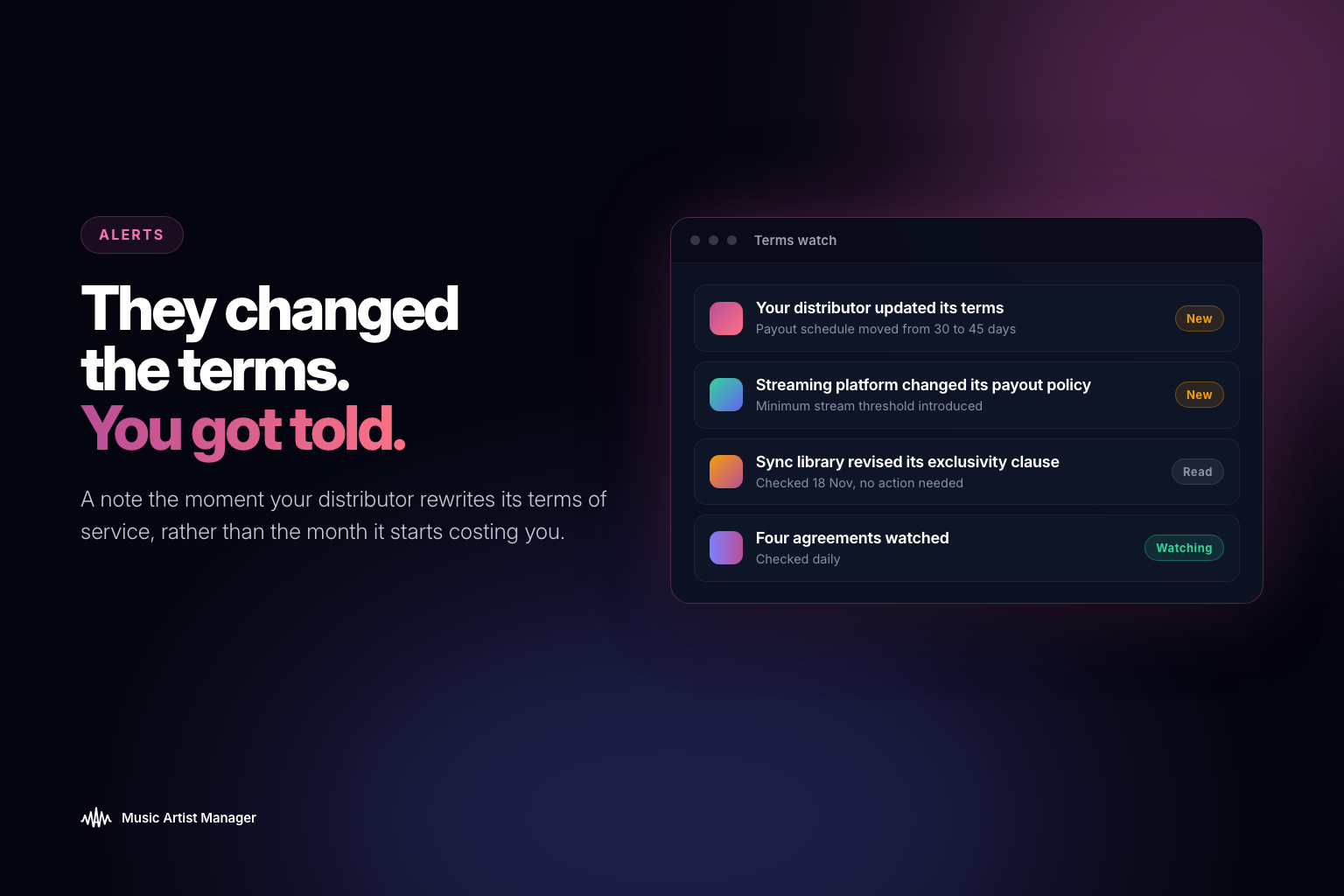
The second part is what separates it from a folder: it watches. When a platform or partner you're contracted with changes its terms, Contract Vault alerts you. You don't find out retrospectively. You get told while there's still time to act.
What belongs in contract vault
If you've signed it and it governs how money moves or who controls something in your catalogue, it belongs here.
Distribution agreements. The contract between you or your artist and the distributor. Payout schedules, recoupment terms, territory restrictions, rights reversions. When a distributor changes its payout window from 45 days to 60 days, you need to know before the first statement arrives late and you're scrambling to work out why.
Producer and writer splits. Split sheets, producer agreements, any paperwork that documents who owns what percentage of a recording or composition. These are the documents that determine whether a sync clears in time or gets stuck because nobody can prove the split.
Management contracts. The agreement between you and the artist. Commission rates, term length, exclusivity clauses, post-term commission. When an artist wants to renegotiate, or when you're calculating what you're owed on a catalogue deal, this is what the conversation references.
Licensing deals. Sync licenses, master use licenses, neighbouring rights agreements. Anything that grants someone else the right to use a recording or composition under specific terms.
Label agreements. If your artist is signed, or if you're managing a label deal on their behalf, the contract lives here. Rights periods, royalty rates, recoupment waterfalls, creative approvals.
Non-disclosure agreements. If you've signed an NDA as part of a pitch, a partnership discussion, or a catalogue acquisition, store it. Breaching an NDA because you forgot it existed is avoidable.
Why alerts matter more than storage
A filing cabinet doesn't tell you when the lease changes. Contract Vault does.
Distribution platforms update terms regularly. Payout schedules shift. Territory restrictions get redrawn. Fee structures change. If you're not checking every partner's terms of service page every month, you're relying on luck.
An alert doesn't make a decision for you. It tells you the ground has shifted and gives you the information to decide what to do next. Renegotiate. Move to a different platform. Adjust your payout forecast. Have a conversation with the artist about what just changed.
The alternative is finding out when a statement arrives and the numbers don't match what you expected, or when a sync license gets rejected because a territory restriction changed and you didn't know.
Who this is for
If you've signed a contract on behalf of an artist, or if you're an artist who has signed anything, Contract Vault is where it should live.
Artist managers running multiple rosters. You're juggling deals across multiple artists, multiple distributors, multiple licensing partners. Email and Drive don't scale. Contract Vault does.
Independent artists managing their own deals. You've signed a distribution deal. Maybe a sync license. Maybe a collaboration agreement with a producer or another artist. When someone asks for the paperwork, you need to find it in seconds, not hours.
Managers handling catalogue deals. If you're negotiating a catalogue acquisition or a label partnership, the contracts that govern that catalogue are the foundation of the negotiation. Missing a document or misremembering a term costs leverage.
What contract vault is not
Contract Vault is not a lawyer. Nothing in it is legal advice. It's a place to keep what you've signed and a way to find out when terms change. What you do with that information is still a conversation with a solicitor, not an app.
It doesn't review contracts for you. It doesn't tell you whether a deal is good or bad. It stores them, it alerts you when terms shift, and it keeps everything in one place so you're not searching when someone asks.
How to actually use it
Upload every contract you've signed. Start with the distribution deal. Then the management contract. Then every split sheet, every licensing agreement, every NDA. If it's signed and it governs money or rights, it goes in.
Name files clearly. "Distribution_ArtistName_Platform_Date" is searchable. "FINAL_v7" is not.
When an alert comes through, read it. Contract Vault tells you what changed. You decide whether it matters. If a distributor shifts its payout schedule by two weeks, that might not be a problem. If it changes recoupment terms or adds a new fee, that's a renegotiation or a move.
Treat Contract Vault as the single source of truth for every agreement in your catalogue. When someone asks for a document, you're not searching three places. You're opening one.
The cost of not having this
You miss a terms change. A distributor extends its payout window by thirty days. You don't notice until the statement arrives late. By then, you've already told the artist when to expect payment, and now you're explaining why the app didn't flag it. Except there was no app. You were supposed to be checking manually, and you didn't.
A sync opportunity falls through because you can't prove the producer split in the time the supervisor needs it. The document exists. You just don't know where.
A catalogue deal stalls because the buyer asks for every contract in the catalogue and you're scrambling to compile them from email, Drive, and three different artist inboxes.
These aren't edge cases. They're recurring costs of not having a system.
Why this matters now
The number of platforms an independent artist works with has grown. Distribution, publishing admin, neighbouring rights, sync licensing, playlist pitching, metadata management. Each one has terms. Each one changes those terms periodically. You're either tracking that manually or you're not tracking it at all.
Contract Vault is the system. Upload what you've signed, get told when terms change, and stop searching for paperwork when someone needs it.
Contract Vault is live at /planner/vault inside Music Artist Manager. Upload a contract, attach it to your account, and get alerted when terms change.
Ready to plan your next release?
Stop piecing together spreadsheets and scattered notes. Get your free release strategy and keep your whole rollout in one place.
Written By
Gavin Alexander
Senior Marketeer
As the founder of Music Artist Manager, Gavin has spent years at the intersection of music and technology. Seeing firsthand how chaotic release rollouts and split sheets can be, he designed a platform that brings major-label infrastructure to independent artists and their teams. He writes extensively about industry trends, artist leverage, and workflow optimisation.