Why music supervisors now prefer independent artists - and how
Music supervisors now choose independent artists for sync placements because they control both master and publishing rights, cutting clearance time from weeks to hours.

Key Takeaways
Music supervisors choose artists who can clear both master and composition rights in one conversation.
Independent artists who control both licences keep the full sync fee instead of splitting it 50/50.
Broadcast-quality WAVs, instrumentals, stems, and clear ownership documentation win placements before major labels reply.
Your back catalogue becomes a revenue pipeline when rights are registered, packaged, and pitch-ready in under an hour.
Music supervisors now choose independent artists for sync placements because they control both master and publishing rights, cutting clearance time from weeks to hours.
The speed advantage independent artists actually have
Music supervisors are under constant production deadlines. A Facebook post from industry outlet IQ (April 2026) put it bluntly: "An independent artist can confirm rights and deliver files within hours. Music supervisors operating under production deadlines choose the path of least resistance."
The path of least resistance is, increasingly, the independent artist.
This isn't sentimentality. It's structural. When a supervisor attempts to license a major-label track, they must negotiate separately with the label (master rights) and the publisher (sync/composition rights), often involving two entirely separate legal teams, two approval chains, and turnaround times measured in weeks. An independent artist who controls both sides can respond within the same day, attach the instrumental, the stems, and the clearance confirmation, and win the deal before the major-label A&R has even forwarded the email.
This is a systems advantage. Most independent artists have it. Almost none have set their operational infrastructure up to use it.
The market reality: What sync actually pays in 2026
Sync licensing fees in 2026 range from £500 for a short-ad placement to £50,000+ for a major television series cue (IQ Artist Management, January 2026). The UK advertising market alone continues to expand demand for cleared, broadcast-ready music, particularly as brand campaigns pivot toward authentic, story-led music that larger catalogue libraries struggle to supply efficiently.
The Most Favoured Nation (MFN) clause, standard in UK and US sync contracts, means that when the sync licence (composition) and master licence are held by the same person, there is no splitting the fee between a publisher and a label. The independent artist collects the full negotiated amount.
On a £10,000 placement, a signed artist splits that 50/50: £5,000 to the label, £5,000 to the publisher. The independent artist who owns both keeps £10,000, minus any agent commission.
What's shifting: the volume of content being produced (streaming originals, brand content, gaming, social video) has increased demand for sync-ready music far beyond what established licensing libraries can supply. The bottleneck is no longer discovery. It is clearance speed. This is the gap independent artists can fill right now.
Understanding the two licences required for every sync placement
Two licences are required for every sync placement:
- Synchronisation (sync) licence – covers the composition (melody + lyrics). Controlled by the publisher, or the songwriter directly if unpublished.
- Master use licence – covers the specific recording. Controlled by whoever owns the master: the record label, or the artist themselves.
For a major-label act, these are two entirely separate negotiations. For an independent artist who self-releases and has not signed a publishing deal, they hold both. That means a single conversation clears the entire track.
Most Favoured Nation (MFN) clauses exist specifically to ensure parity between these two sides. When both sides are held by the same party, MFN becomes irrelevant and the artist captures the full fee.
What music supervisors actually require for a pitch to be viable
Music supervisors need the following for a pitch to be considered:
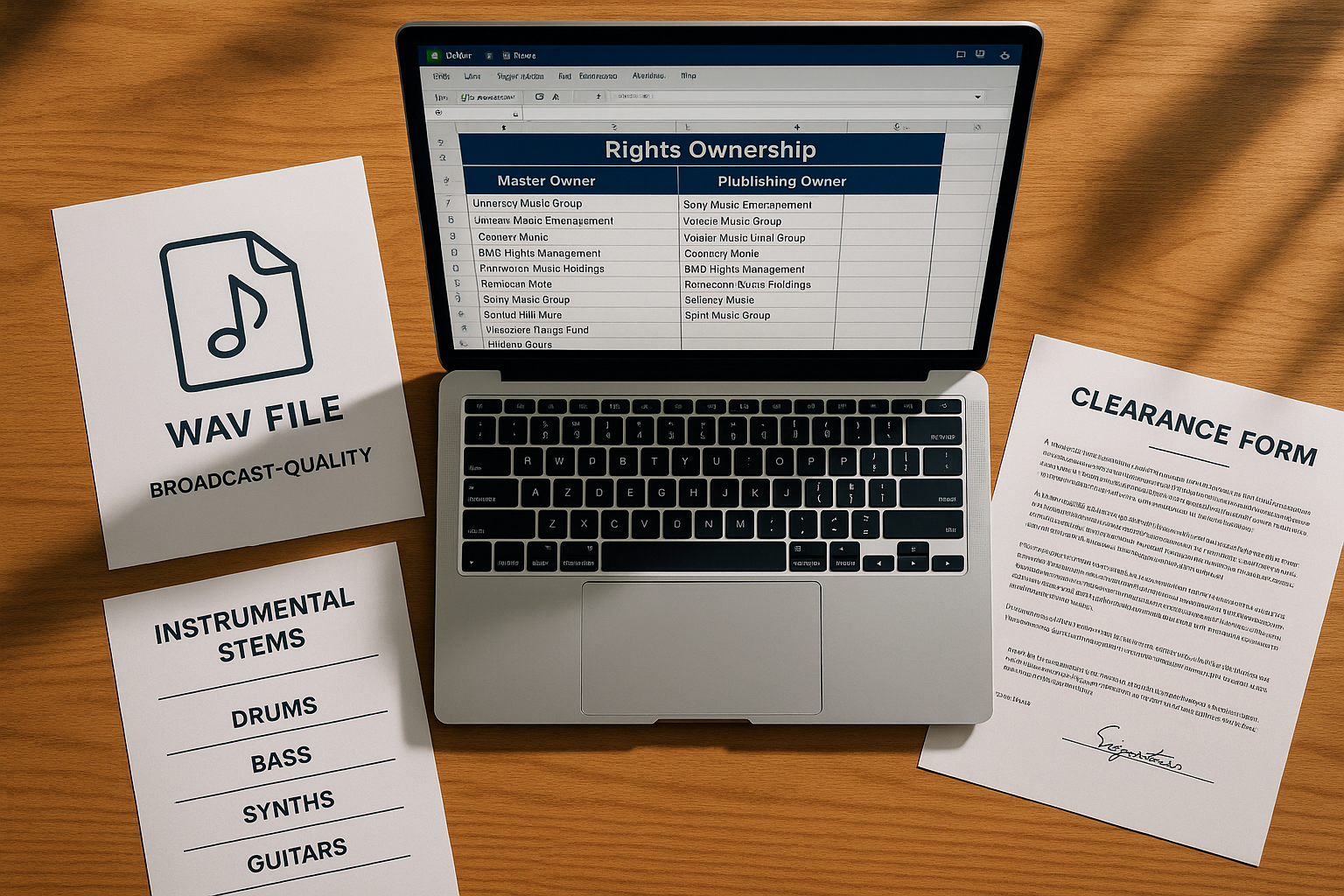
- Broadcast-quality stereo master (WAV, minimum 24-bit/48kHz)
- Instrumental version
- Stems (optional but highly valued)
- Written confirmation of clear ownership of master and composition
- ISRC and ISWC codes (proving registration)
- PRO affiliation confirmed (PRS for Music in the UK)
Artists who have all of this packaged and ready to send within an hour are demonstrably more likely to land the placement.
Who this strategy works for (and who it doesn't)
This strategy is most powerful for artists who:
- Own their masters outright (self-released, no label deal, or have fully recouped)
- Have not signed away publishing rights to a sub-publisher or music publisher
- Can produce high-quality instrumentals and stems from their session files
- Are willing to register properly with their PRO and obtain ISWCs for compositions
It is less immediately accessible to:
- Artists whose masters are owned by a label, even an indie label
- Artists who have assigned publishing rights without retaining sync approval
- Artists producing exclusively live-recorded music without multi-track session files
Even artists with a label deal often retain some catalogue (earlier EPs, demos, side projects) that they fully control. That catalogue is a sync asset.
Seven steps to make your catalogue Sync-Ready this month
1. audit your rights
For every track in your catalogue, document clearly: who owns the master, who owns the composition, whether you have a publishing agreement in place, and what sync approval rights you hold. Do this in a spreadsheet or your Music Artist Manager rights vault.
2. register everything with your PRO
Every composition must be registered with PRS for Music (UK) and have an ISWC assigned. Supervisors verify this. Unregistered compositions are considered high-risk.
3. create a sync-ready asset pack for your top 10 tracks
For each: a broadcast-quality stereo WAV, a clean instrumental, stems if possible, and a one-page rights confirmation document that states you own both master and composition and can clear the licence immediately.
4. write your sync biography
This is a one-paragraph document stating your ownership structure: "I own 100% of the master recording and 100% of the composition for all original works. As an independent artist, I can clear both licences with a single agreement. Turnaround: same business day." This differentiates you at point of pitch.
5. identify target placement categories
Review your catalogue against common sync use-cases: television drama, advertising, gaming, trailers, documentary. Flag which tracks fit which mood. Supervisors search by emotion and tempo, not artist name.
6. submit to three sync libraries this month
Music Gateway, Musicbed, and Artlist accept independent submissions. Ensure your metadata is complete and your rights confirmation is attached.
7. follow up systematically
Sync is a relationship business. Track your pitches, follow up within 2–3 weeks, and note supervisor preferences for future submissions.
The infrastructure advantage you already have
The major label model built a wall between artists and commercial opportunity. That wall was administrative: layers of approval, competing rights holders, slow-moving legal teams. The independent artist, operating with full ownership and a professional operational setup, does not have that wall.
The gap is not talent. It is infrastructure.
The CEO artist does not wait for a manager to land a sync deal and take 20%. They understand their asset (the recording), register it, package it, and put it in front of buyers efficiently. Speed and clarity of ownership are the product in the sync market. Build the system once, and your back catalogue becomes a pipeline that earns without requiring a new creative project.
- Music Artist Manager – Rights Vault & Catalogue Manager
Track master and publishing ownership, store broadcast-ready assets, and manage sync pitch history in one place. Never miss a placement because your rights documentation wasn't ready.
→ Organise your catalogue with Music Artist Manager
Related Reading:
- https://www.musicartistmanager.com/blog/sync-ready-before-the-call
- https://www.musicartistmanager.com/blog/masters-sync-advantage-2026
- https://www.musicartistmanager.com/blog/major-label-indie-infrastructure-consolidation
Further Reading:
- Music supervisors actively prefer working with independent artists — https://www.musicgateway.com/blog/sync-licensing/sync-licensing-in-2026-your-golden-ticket-to-actually-getting-paid-and-heard — Music Gateway — https://www.musicgateway.com/blog/sync-licensing/sync-licensing-in-2026-your-golden-ticket-to-actually-getting-paid-and-heard
- UK Sync Licensing Rates 2026: What TV, Film & Advertising Actually Pay — https://iqmgmnt.com/uk-sync-licensing-rates-explained/ — IQ Artist Management — https://iqmgmnt.com/uk-sync-licensing-rates-explained/
- Most Favoured Nations in sync contracts explained — https://edwardslaw.ca/blog/canadian-music-law-most-favoured-nations/ — Edwards Creative Law — https://edwardslaw.ca/blog/canadian-music-law-most-favoured-nations/
- Publishing and Master Rights in Sync Licensing Contracts — https://thatpitch.com/blog/publishing-and-master-rights-in-sync-licensing-contracts/ — That Pitch — https://thatpitch.com/blog/publishing-and-master-rights-in-sync-licensing-contracts/
- Sync Licensing for Independent Artists 2026: Pitch and Get Paid — https://www.chartlex.com/blog/money/music-sync-licensing-guide-independent-artists-2026 — Chartlex — https://www.chartlex.com/blog/money/music-sync-licensing-guide-independent-artists-2026
Ready to streamline your workflow?
Stop piecing together spreadsheets and scattered notes. Join the waitlist for Music Artist Manager and get your entire rollout in one place.
Written By
Gavin Alexander
Senior Marketeer
As the founder of Music Artist Manager, Gavin has spent years at the intersection of music and technology. Seeing firsthand how chaotic release rollouts and split sheets can be, he designed a platform that brings major-label infrastructure to independent artists and their teams. He writes extensively about industry trends, artist leverage, and workflow optimisation.