Pre-tour budgeting strategies that protect live profit margins
Learn how to audit booking contracts, negotiate better promoter splits, and catch hidden venue charges before your tour begins.

Key Takeaways
A pre-tour audit catches the contract terms that kill your margin before you step on stage.
Settlement sheets hide venue charges that promoters assume you won't challenge or even notice.
Negotiating your artist split happens before the deposit clears, not after the house is sold.
Profitability is built in the contract phase, not salvaged at settlement.
Most independent tours lose money because the damage is done before soundcheck. Booking contracts favour promoters by default, settlement sheets bury costs in vague line items, and artists sign without reading the fine print. This guide shows you how to audit every deal, negotiate better splits, and catch hidden charges before they drain your tour budget.
Most artists treat tour planning like packing for a road trip. You confirm the dates, book the hotels, load the gear, and hope the door splits work out. By the time you realize they won't, you're three weeks into a run that's bleeding money every night.
Tour profit is not made on stage. It's made in the weeks before you leave, when you audit every contract, map every promoter deal, and build a settlement process that catches overcharges before they hit your payout. This is the work of a pre-tour architect, and it's the difference between breaking even and coming home with actual money in the bank.
This is not route planning. This is financial design.
What a pre-tour architect actually does
A pre-tour architect audits the business structure of your tour before the first show goes on sale. They review booking contracts for split terms, backend percentages, and expense caps. They cross-check settlement sheets against rider terms to catch inflated sound charges, phantom security costs, and misreported ticket counts. They negotiate promoter deals that protect your guarantees and ensure you participate in upside when a show sells well.
This role does not replace your booking agent. It supports them by bringing financial rigor to the deals they close. Agents book the rooms. Architects make sure the rooms pay correctly.
If you are self-booking, you are both. That means every deal you accept needs the same level of scrutiny a manager would apply if they were reviewing it on your behalf.
Audit every booking contract before you sign
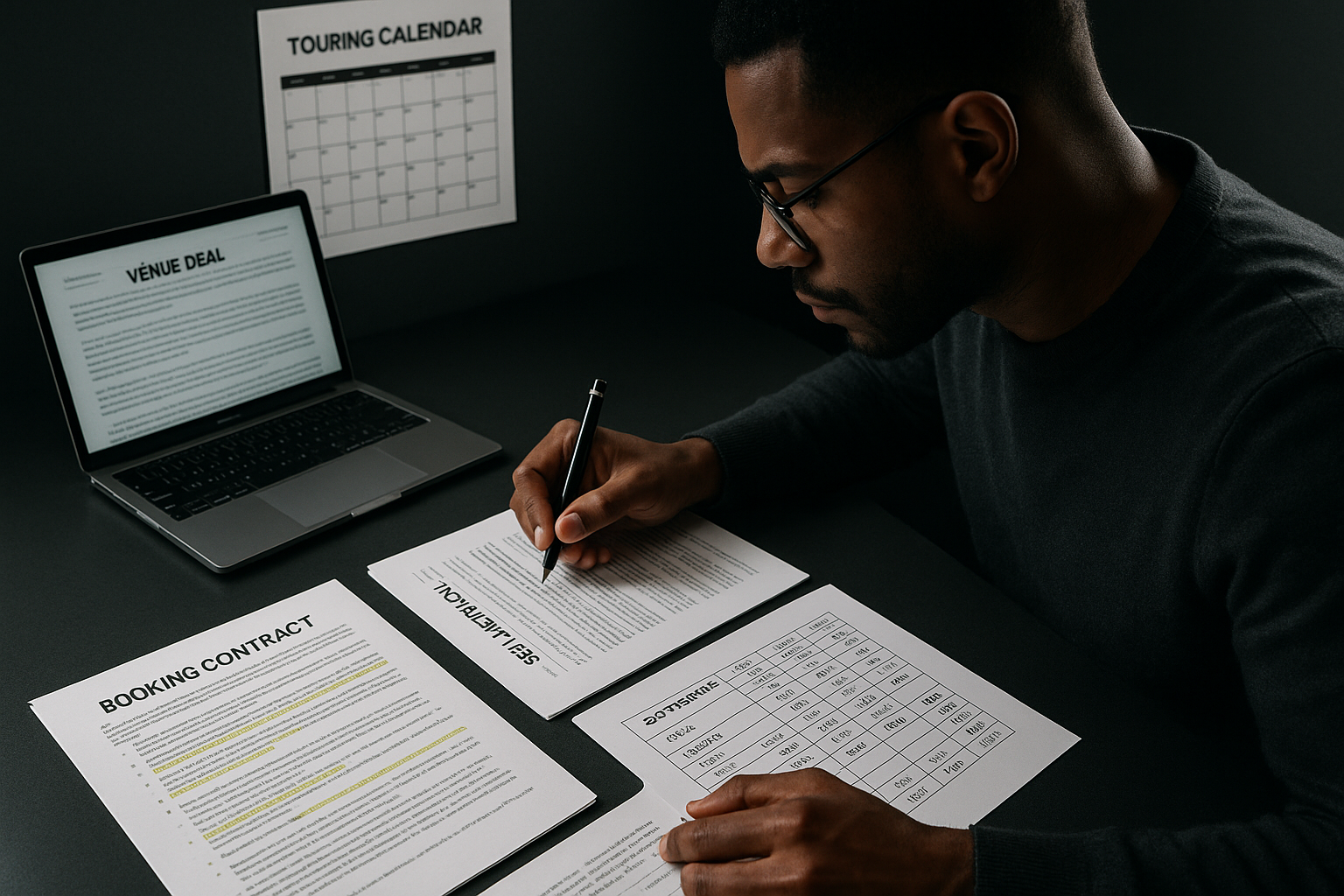
Booking contracts are not neutral documents. They are written by promoters to protect promoter margins. Your job is to read every term and negotiate the ones that don't serve you.
Start with the guarantee. Is it a flat fee, or is it a versus deal where you take a percentage of net after expenses? If it's a versus deal, what counts as an expense? Does the contract cap production costs, or can the promoter deduct unlimited sound, lights, and backline charges? If there's no cap, your backend is at risk.
Check the ticket count reporting. Does the contract require the promoter to share a nightly box office statement, or do you settle based on their word? If you don't have documented ticket counts, you can't verify your split.
Look at ancillary revenue. Does the contract give you a cut of merch sales, or does the venue take a percentage off the top? Some rooms charge 25% or more on merch. If that's not disclosed in the contract, you'll find out at settlement when your merch income is suddenly 25% lighter.
Review payment terms. When do you get paid? Night of show, or net 30? If payment is delayed and the promoter or venue goes under, your guarantee goes with it.
These are not edge cases. These are standard deal points that determine whether your tour makes money. If you don't audit them before you sign, you have no leverage to fix them later.
Why Your Tour Got Great Reviews and Still covers exactly how to structure deals that protect your income and build in upside when shows perform.
Negotiate promoter deals that protect your guarantee and backend
Promoters will offer you the deal that works best for them. Your job is to counter with the structure that works best for you.
If a promoter offers a low guarantee with a high backend percentage, ask what their expense cap is. If they won't commit to a cap, the backend is theoretical. Production costs can erase your share entirely, and you'll walk away with the guarantee only.
If a promoter offers a flat fee with no backend, ask for a percentage of gross after a reasonable breakeven. A 70/30 split after costs is common. An 80/20 split in your favor is possible if you have draw or leverage.
If a promoter wants an option for a second show, make sure the option window is time-limited and that the terms for the second date are pre-negotiated. You don't want to sell out a room and then have to renegotiate your deal when you have no leverage left.
Strong promoter relationships are built on fair splits and clear terms. You're not squeezing anyone. You're building a deal where both sides win if the show performs.
The live tour promoter settlement playbook walks through exactly how to model these deals and run settlement night of show so nothing is left to memory.
Build a settlement process that catches overcharges before payout
Settlement is where profit leaks. Promoters and venues do not intentionally steal from you, but their accounting is built to recover their costs first. If you don't check the math, you'll pay for expenses you didn't incur and miss income you're owed.
Bring a settlement sheet to every show. This is a one-page document that lists your guarantee, your backend percentage, the ticket count, the gross revenue, and the allowable expenses. Cross-check every line item on the promoter's statement against your rider and contract.
Common overcharges include:
- Sound and lights billed at retail rates when your rider specifies house systems at cost.
- Security costs that exceed the number of guards actually present.
- Hospitality buyouts charged at full rider price when cheaper local options were used.
- Ticket counts that don't match scanner data or box office reports.
If a charge doesn't match your contract, question it. If the promoter can't provide backup, remove it from the settlement. This is not adversarial. This is standard accounting.
Do not leave the venue without your payout and a signed settlement sheet. Once you walk out, your leverage drops to zero.
The Silent Saboteur details exactly which venue charges to audit and how to structure your rider to prevent them.
Map your tour P&L before you commit to the routing
A tour does not make money because you played a lot of shows. It makes money because the shows you played generated more income than the cost of playing them. That math happens before you confirm the routing.
Build a tour P&L that includes your nightly guarantee, your expected backend, your travel costs, your lodging, your per diems, and your crew. Add in merch cost of goods and any production expenses not covered by the promoter. Subtract all costs from your projected gross income. What's left is your tour profit.
If the number is negative, the routing doesn't work. If the number is marginal, you need to renegotiate guarantees or cut costs. If the number is strong, you have a tour that pays.
Most artists skip this step and hope the door splits average out. They don't. Touring is expensive, and small losses compound quickly. By the time you're halfway through the run, you're in a hole you can't climb out of.
Map your P&L before you commit. Adjust your routing based on the numbers. Confirm that every date contributes positively to the total. This is how you build a profitable tour.
You are the architect of your own tour economics
No one cares about your tour profit as much as you do. Not your agent, not your promoter, not your venue. They all want you to succeed, but their incentives are not perfectly aligned with yours. Your job is to build the financial structure that protects your income and ensures that every show contributes to your long-term sustainability as a working artist.
That work happens before you load the van. It happens when you audit contracts, negotiate splits, build settlement processes, and map your P&L. It happens when you treat your tour like the business operation it is, not like a creative experiment you hope breaks even.
You are not just the artist. You are the CEO of your own creative enterprise. Start acting like it.
Ready to streamline your workflow?
Stop piecing together spreadsheets and scattered notes. Join the waitlist for Music Artist Manager and get your entire rollout in one place.
Written By
Gavin Alexander
Senior Marketeer
As the founder of Music Artist Manager, Gavin has spent years at the intersection of music and technology. Seeing firsthand how chaotic release rollouts and split sheets can be, he designed a platform that brings major-label infrastructure to independent artists and their teams. He writes extensively about industry trends, artist leverage, and workflow optimisation.