The silent saboteur: How unaudited venue charges erode tour profits
Learn how to audit venue settlement sheets, spot inflated charges, and negotiate back the earnings you're owed on tour.

Key Takeaways
Venues bury charges in settlement sheets that can cut your tour profit by 20% or more.
Most artists sign contracts without locking in expense caps, then lose hundreds per show to inflated house costs.
Real-time tracking of every charge during load-in and performance stops surprise deductions at settlement.
Negotiating back illegitimate line items requires receipts, contract language, and the willingness to push back before you load out.
Audit venue charges and protect your tour profits
You played the show. The crowd showed up. Your merch sold. But when you sit down with the promoter at 2 a.m. to review the settlement sheet, your guarantee somehow shrank by 30%.
This is not a mistake. This is standard operating procedure at venues that know most artists won't audit the numbers.
Settlement sheets are where tour profit lives or dies. They are also where venues bury costs that should never touch your bottom line. If you are not reviewing these sheets line by line before you sign, you are writing checks to people who did not earn them.
This guide will show you which charges to flag, how to audit them in real time, and what to negotiate before you ever load in.
What is a settlement sheet
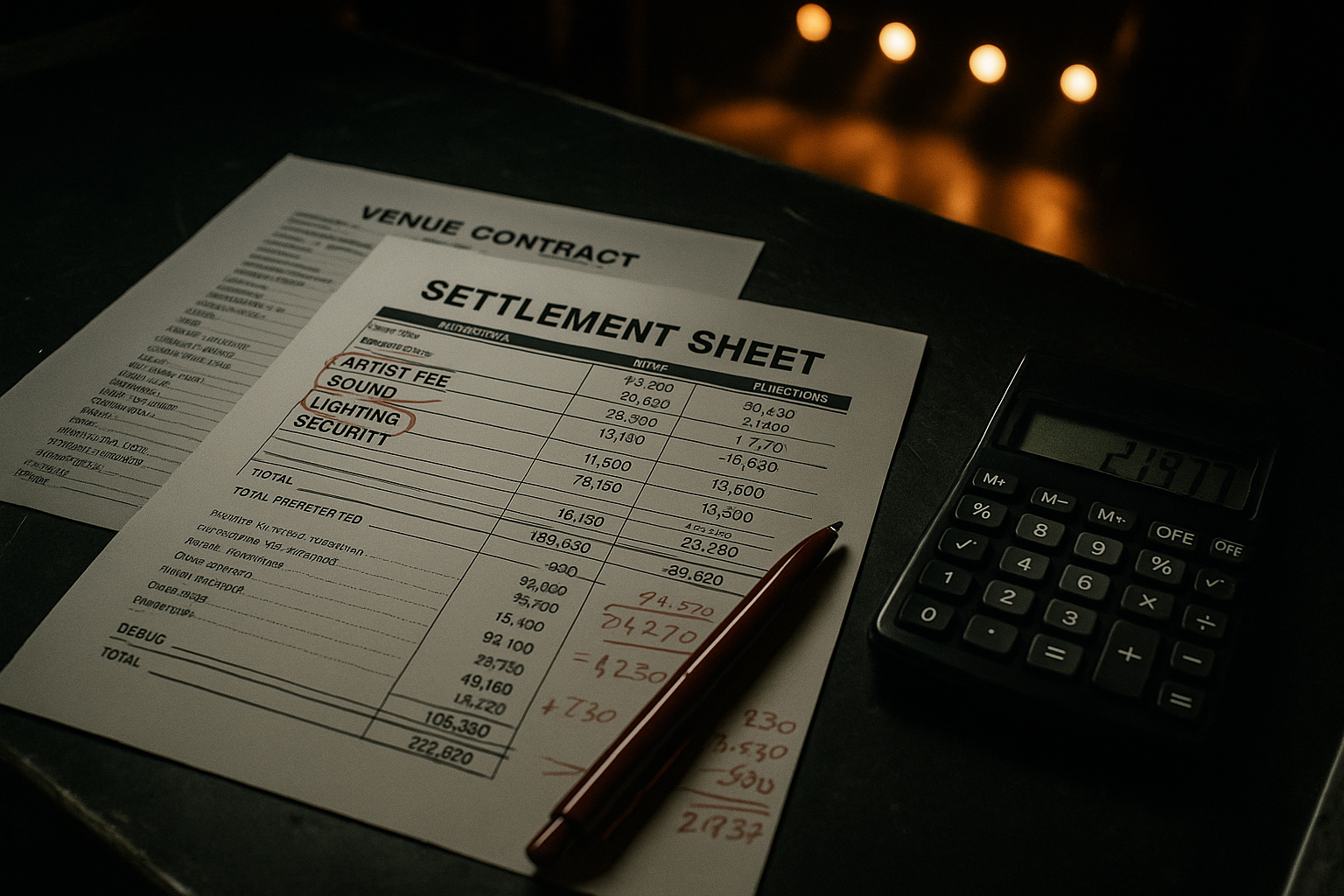
A settlement sheet is the final accounting document produced after your show. It lists your guarantee or door deal terms, gross ticket sales, ancillary income like bar or merch, and every deduction the venue is taking before they hand you a check.
It is a contract being executed after the fact. That makes it dangerous.
Most artists see it once, after the show, when they are tired and the promoter is holding payment hostage until you sign. That is by design. The time to protect yourself is not at settlement. It is when you are negotiating the deal and again during load-in.
The most common hidden charges on settlement sheets
Production costs you did not request
Venues will often add line items for lighting upgrades, additional monitors, or stage hands you never asked for. If it is not in your rider and you did not approve it in writing, you should not be paying for it.
Before you sign anything, cross-reference the settlement sheet with your signed performance agreement. If a cost appears that was not negotiated upfront, flag it immediately.
Inflated ticketing fees
Some promoters will charge you a percentage of gross ticket sales that includes the service fees buyers paid, not just the face value. This inflates their cut and reduces yours.
Your deal should specify whether percentages are calculated on gross or net ticket revenue. If the contract says net, make sure fees paid to Eventbrite or the box office are deducted before your split is calculated.
Backline and gear rental markups
Venues that provide backline often charge 2x or 3x the market rate. A bass amp that rents for $40 might appear on your sheet at $120.
Get backline pricing in writing before the show. Better yet, bring your own gear or rent directly from a local supplier and have the invoice ready.
Catering and hospitality overages
If your rider includes a buyout or specific hospitality items, some venues will provide exactly what you asked for and then charge you for extras you did not order.
Take photos of your green room when you arrive. If settlement includes $200 in catering overages and your rider was a $75 buyout, you have documentation to dispute it.
Marketing and promotional costs
Venues will sometimes deduct money for Facebook ads, posters, or street team costs without showing you receipts or proving the spend happened.
Your contract should state whether marketing is the promoter's responsibility or a shared cost. If it is shared, request a cap and require receipts before settlement.
Union labor and load-in fees
Some venues are union houses. That means mandatory stage hands, often at rates north of $50/hour. If you are playing a union venue and this was not disclosed upfront, you are about to lose hundreds of dollars you did not budget for.
Ask if the venue is union during deal negotiation. If it is, get an estimate of load-in and strike costs in writing.
How to audit a settlement sheet in real time
Do not wait until 2 a.m. to see the numbers. Start your audit during the day of show.
Step 1: Bring your signed contract and rider
Have a printed or digital copy on hand. Every deduction on the settlement sheet should trace back to a line in your agreement. If it does not, it is negotiable.
Step 2: Request a draft settlement sheet before doors
Ask the promoter or venue manager for a draft settlement sheet when you arrive for load-in. This gives you hours to review it instead of minutes.
If they hesitate, explain that you review all costs before performance as standard practice. Professionals respect process.
Step 3: Verify ticket counts and sales data
Get a final ticket count from the box office or ticketing platform. Compare it to what the settlement sheet shows. If the numbers do not match, ask why.
Some venues will claim walkups or comps that never happened to shrink your door deal percentage.
Step 4: Photograph receipts and invoices
If the venue is charging you for backline, catering, or marketing, ask to see receipts. Photograph them. If they cannot produce receipts, the charge is not legitimate.
Step 5: Calculate your own settlement
Bring a calculator or use a notes app. Run your own numbers based on your contract terms and the ticket data. If your math does not match theirs, sit down and reconcile it before you sign anything.
What to negotiate before you ever play the show
Settlement protection starts at the contract stage.
Cap all production and marketing costs
If the venue is responsible for sound, lights, or promo, set a dollar cap in the contract. If they exceed it, that is on them.
Define what counts as a deductible expense
List acceptable deductions in your performance agreement. If it is not on the list, it does not come out of your settlement.
Require same-night payment
Some promoters will delay payment for days or weeks, using cash flow as leverage. Your contract should state that settlement happens immediately after the show and payment is made that night.
If they cannot pay same-night, require a deposit that covers your guarantee so you are never walking away empty-handed.
Build in a merch protection clause
Many venues will try to take 20% to 30% of your merch sales. This is often negotiable, especially if you are bringing your own seller and table.
Push for 0% merch cut or cap it at 10%. Merch is your highest-margin income on the road. Protect it.
What to do if the venue refuses to adjust the settlement
If you have flagged illegitimate costs and the promoter will not budge, you have a few options.
Refuse to sign and document everything
You are not legally required to sign a settlement sheet that includes fraudulent charges. Refuse to sign, document the disputed items in writing, and send a follow-up email outlining what you are owed.
This creates a paper trail you can use if you need to pursue payment through small claims or an industry union.
Escalate to the venue owner or booking agent
If you are working with a promoter who reports to a venue owner or a regional booking agent, escalate. Most venue owners do not want a reputation for shorting artists.
Accept partial payment and move on strategically
Sometimes the cost of fighting over $200 is not worth it, especially if you are on a multi-city run and cannot afford to sit in one market for days.
If you take partial payment, document everything and add that venue to your internal blacklist. Do not play there again, and let your network know.
How to track expenses across an entire tour
If you are playing more than five shows, you need a tour expense tracker.
Use a shared spreadsheet that logs every show's guarantee, ticket counts, actual settlement, and any disputed costs. This gives you a historical record you can use to identify patterns and bad actors.
Include columns for:
- Date and venue
- Agreed guarantee or door deal terms
- Actual ticket sales
- Total deductions
- Final payout
- Disputed charges
- Notes
Review this weekly with your tour manager or business partner. If you see the same bogus charges appearing across multiple venues, you know it is time to update your contract template.
Final thoughts
Settlement sheets are not suggestions. They are financial documents that determine whether your tour makes money or bleeds it.
Most venues are operating in good faith. But some are not. Your job is to know the difference and protect your money with the same intensity you bring to your performance.
Read every line. Question every charge. Get everything in writing. And never sign a settlement sheet you have not audited yourself.
Your tour profit depends on it.
Related Reading:
Ready to streamline your workflow?
Stop piecing together spreadsheets and scattered notes. Join the waitlist for Music Artist Manager and get your entire rollout in one place.
Written By
Gavin Alexander
Senior Marketeer
As the founder of Music Artist Manager, Gavin has spent years at the intersection of music and technology. Seeing firsthand how chaotic release rollouts and split sheets can be, he designed a platform that brings major-label infrastructure to independent artists and their teams. He writes extensively about industry trends, artist leverage, and workflow optimisation.