Blog idea: The 1,000-Stream line: How Spotify created two artist markets
Learn how Spotify's 1,000-stream threshold split the artist market in two and what it means for your next release.
Key Takeaways
Spotify's 1,000-stream threshold means 87% of all tracks on the platform earn zero artist royalties.
The threshold requires unique listeners, not total plays, so bot streams and repeat manipulation don't work.
Crossing 1,000 streams now requires coordinated release marketing, not organic discovery or passive fan growth.
Treating the threshold as a known marketing cost changes how you budget, sequence releases, and allocate promotional spend.
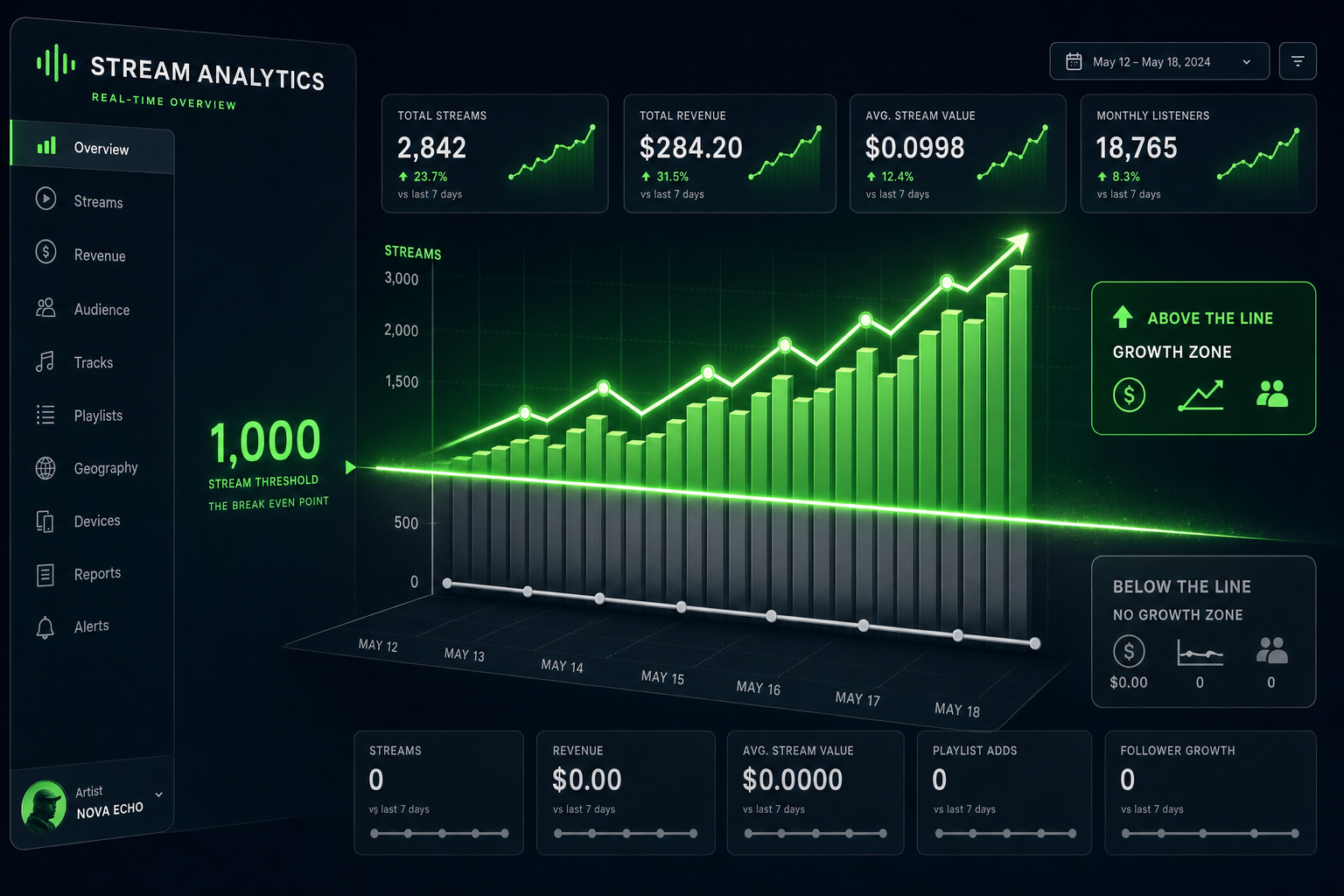
On April 1, 2024, Spotify implemented a 1,000-stream annual threshold for artist monetization. If your track doesn't hit that number from enough unique listeners in a rolling 12-month window, you earn exactly £0 in royalties. This policy affects 87% of all tracks on the platform and has fundamentally changed how independent artists need to plan and execute releases.
87% of the 202 million songs on Spotify earn exactly $0 in artist royalties. Your track could have 500 genuine fans streaming it regularly and still generate zero payment. Here's why Spotify built this system, and what it means for how you release music.
On April 1, 2024, Spotify implemented a 1,000-stream annual threshold for monetization eligibility. A track must hit at least 1,000 streams from a minimum number of unique listeners within a 12-month rolling window to earn any royalties. The stated rationale: reduce noise, prevent fraud, improve platform economics.
What actually happened: Spotify created a hard split in the artist market. An estimated 87% of the 202M+ tracks on Spotify fall below this threshold and generate zero recorded-music royalties. That's not filtering noise. That's a market structure shift with profound strategic implications.
What changed
The "anti-spam" threshold has become the primary gating mechanism for artist monetization. It's not about preventing fraud anymore. It's about operational simplification and risk management. Spotify pays out roughly $11B annually. Processing micropayments for 87M non-threshold tracks would cost infrastructure money and create accounting complexity.
Two years post-implementation, the data is clear: the threshold is permanent, not a temporary policy. Artists are now planning releases around this binary outcome: cross 1,000 streams or generate $0. This is changing artist behavior in real time. It's consolidating release strategy, incentivizing playlist focus, and making organic discovery less valuable.
For independent artists, this inverts the traditional music industry model. Historically, artists built audiences through exposure: playing gigs, radio play, streaming visibility. Now, visibility is decoupled from monetization. An artist can accumulate meaningful listeners across multiple territories and earn nothing until they cross a precise algorithmic gate.
The lesson: compensation is now based on threshold achievement, not on audience size or listener quality. This favors artists with existing marketing infrastructure, label backing, or fan bases ready to converge on release dates. For organic growth, it's a penalty.
What you need to understand
The threshold mechanics
Not 1,000 total streams. 1,000 streams from a minimum number of unique listeners. Spotify doesn't publish the exact threshold. This means bot streams and replay manipulation don't work. It requires actual, distinct listener engagement.
The binary outcome
Below threshold = $0. Above threshold = eligible for pro-rata share. There's no sliding scale. 999 streams = $0. 1,001 streams = potentially $1–3, depending on listener geography and platform splits.
The time window
Rolling 12-month window per track. A track can fall out of monetization if it dips below 1,000 in any 12-month period. This is rare for evergreen content, but it happens.
The geography confound
Listener geography affects both threshold achievement and per-stream payout. A stream from Sweden is counted the same for the threshold but pays roughly 2x the rate of a stream from India.
Who this applies to
Directly: New artists with 0–1M cumulative streams. Artists in niche genres with small but loyal audiences. Artists not coordinating release marketing. Bedroom producers with low external reach.
Partially: Mid-tier artists with multiple back-catalog tracks. Artists releasing frequently without promotional support. Artists in emerging markets, where higher listener counts are needed to cross the threshold due to per-stream geography weighting.
Not affected: Artists with existing label support. Mega-indie artists with marketing teams. Artists with active fan bases ready to stream on release day. Artists with playlist curator relationships.
Reality: If you're an independent artist without marketing reach, the 1,000-stream threshold is functionally a $500–2,000 barrier to monetization. That's external spend to acquire listeners. Most artists don't spend that to cross it.
How to work within the system
Assess your release history
Pull analytics for your last 5 releases. For each:
- Current total streams
- Streams in last 12 months
- Unique listener count (if available via Spotify for Artists dashboard)
- Current monetization status
Count how many fall above or below 1,000 streams in the rolling 12-month window.
Classify your catalog
A-tier (above 1,000 / 12mo): Generating royalties. Monitor quarterly to ensure they stay above threshold.
B-tier (500–999 / 12mo): Close but non-monetized. These are potential wins. Calculate how many listener acquisitions you need to cross the threshold. If you have 700 streams from roughly 200 listeners, you need 100–200 more unique listeners to hit 1,000.
C-tier (below 500 / 12mo): Strategic assessments only. Don't invest marketing to cross threshold unless it's a strategic single with fan momentum.
Create a release strategy aligned to the threshold
Instead of organic discovery, plan for convergence marketing.
Release coordinated: Pick a specific release date. Promote across all channels (email, socials, TikTok, Discord) targeting max listener reach in week 1.
Target: 1,500–2,000 unique listeners in first 30 days. Overshoot the 1,000 threshold with buffer.
Channel allocation: 40% email/direct, 30% social paid, 20% playlist pitching, 10% organic.
The 1,000 threshold is an operational gate, not an artistic one. Treat it as a marketing project.
Monitor evergreen content decay
Quarterly, audit your monetized catalog. If any A-tier track dips below 1,000 streams in a trailing 12-month window, trigger a re-release campaign: remaster, remix, or feature collaboration to reset listener count.
Rethink deep catalog releases
Traditional strategy: release full albums with 12+ tracks, each building on listeners.
New strategy: release 1–3 singles with targeted marketing, separate from album releases. Each single crosses the threshold independently. Then bundle as album 6 months later. This staggers monetization start dates and reduces listener dilution across too many tracks.
Case study: How one artist crossed the threshold with intentional marketing
Artist X released a single in March 2025. After 90 days, it had 800 streams from roughly 250 unique listeners. All organic. All earned through social content and word of mouth. Total royalties: $0.
For her next release, she redesigned the strategy around the threshold as a known benchmark.
Release date: locked 6 weeks out. Email list promotion started 3 weeks before release. TikTok teaser campaign started 2 weeks out. She coordinated with 5 playlist curators in her genre and pitched the track directly.
Week 1 results: 1,200 streams from 400+ unique listeners.
Week 4 results: 1,850 streams.
Total first-month marketing spend: $320 (social ads, playlist submission service).
Result: track crossed monetization threshold within 30 days. Estimated annual royalty value (assuming stream trajectory holds): $18–25.
The math doesn't look great on paper. But it's not just about this track. She now has one more monetized asset in her catalog. And she proved out a playbook she can replicate for every future release.
That's the shift. The 1,000-stream threshold is not a bug in the streaming economy. It's a feature. Spotify has optimized for transaction cost reduction and risk management at the expense of artist accessibility. This is structural, not policy.
What matters now is recognizing the threshold as a known cost and planning releases accordingly. The artists who thrive post-threshold are not those who stumble across 1,000 streams organically. They're the ones who intentionally design marketing to hit it.
If you're releasing music, the 1,000-stream threshold is as real as the cost of a music video. Budget for it.
Ready to ensure your releases cross the threshold? Use the MAM Release Checklist: a step-by-step guide to planning, marketing, and monitoring releases to hit Spotify's 1,000-stream gate. Plus: a listener-acquisition ROI calculator to determine if it's worth the spend.
Ready to plan your next release?
Stop piecing together spreadsheets and scattered notes. Get your free release strategy and keep your whole rollout in one place.
Written By
Gavin Alexander
Senior Marketeer
As the founder of Music Artist Manager, Gavin has spent years at the intersection of music and technology. Seeing firsthand how chaotic release rollouts and split sheets can be, he designed a platform that brings major-label infrastructure to independent artists and their teams. He writes extensively about industry trends, artist leverage, and workflow optimisation.