Why smart managers are moving ad spend to YouTube
Learn why managers like Barreto are shifting artist ad spend from Spotify to YouTube, and how to calculate which platform actually pays you back.
Key Takeaways
YouTube pays per view and monetises your promotional spend. Spotify does not.
The same pound spent on YouTube generates revenue, builds live demand, and educates potential ticket buyers simultaneously.
Most independent artists are still running 2019 playbooks, burning budgets on platforms that do not pay back.
A CEO funds marketing channels based on unit economics, not on where it feels like the music should live.
At the Music Managers: The New Power panel in 2026, manager Barreto made a case that most independent artists are burning their promotional budgets on the wrong platform. His argument: stop routing ad spend to Spotify, and route it to YouTube instead. The reason is structural, not aesthetic. It changes the maths of artist development entirely.
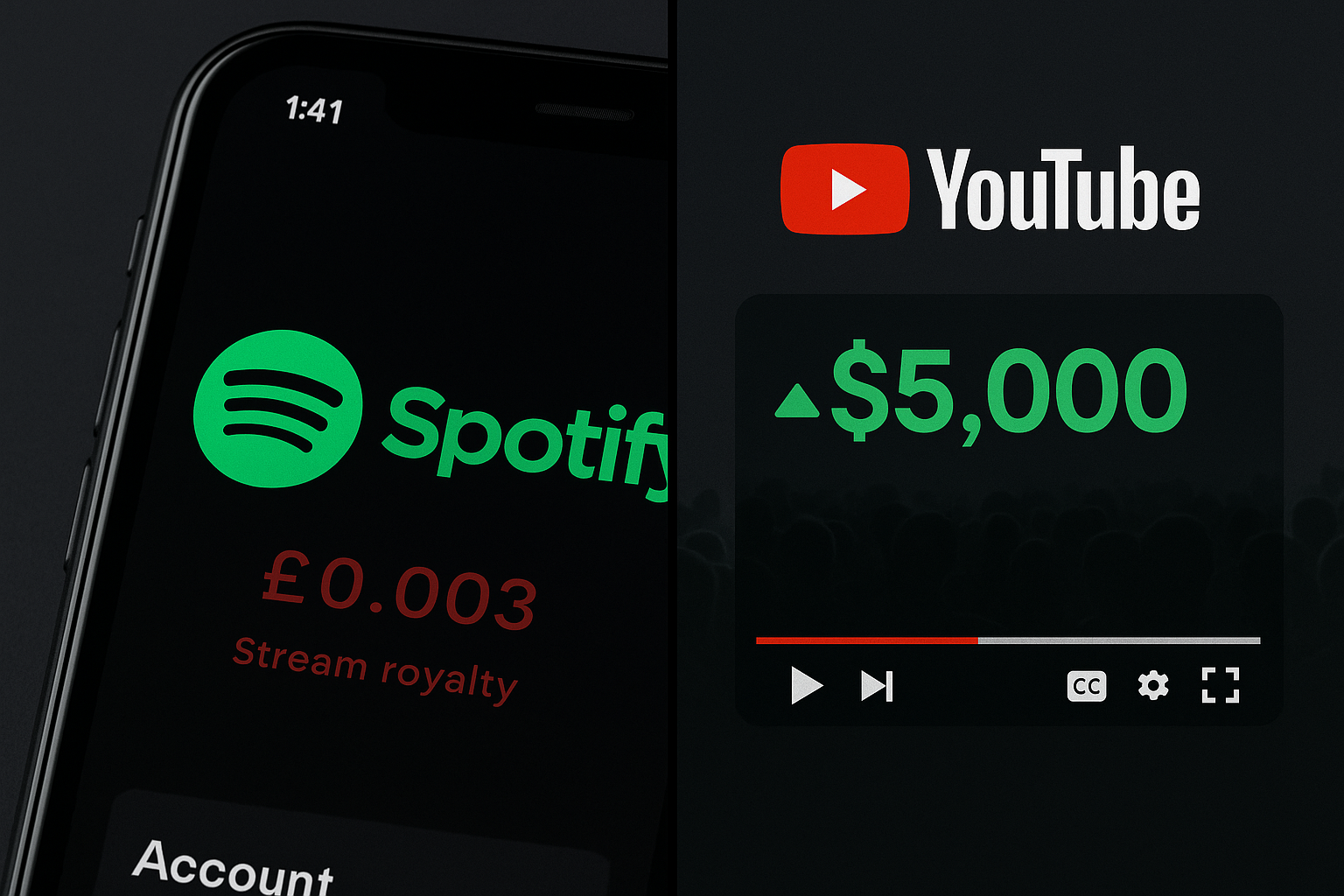
Spotify pays fractions of a penny per stream and offers virtually no direct monetisation for promotional spend. YouTube, by contrast, pays per view and functions as a live performance preview window for potential concertgoers. The same pound spent promoting a music video on YouTube generates revenue, builds audience comprehension of the live show, and seeds touring demand simultaneously. That's three return vectors from one campaign budget. No streaming-first strategy can match that ratio.
Market context
Independent artists in 2026 are operating with tighter margins and no label war chests behind them. With live music revenue now exceeding pre-pandemic levels globally and streaming royalty rates remaining stubbornly low, the economics of artist development have fundamentally shifted. Live income is the engine. Streaming is the catalogue.
Yet most indie artist promotional playbooks were written in 2019, when Spotify playlist placement felt like the only game worth playing. Industry managers attending high-level panels this year are explicitly recalibrating. Platforms that pay per unit of attention (YouTube, TikTok creator funds in select markets) are being prioritised over platforms that pay per passive stream.
The shift is not about abandoning Spotify. It's about recognising that Spotify is a catalogue library, not a discovery amplifier for artists without algorithmic momentum. For independent artists with limited budgets, this distinction is career-defining.
What actually pays you
Platform monetisation architecture matters. Here's what you need to understand:
Spotify: Per-stream royalty (~£0.002–£0.004). Ad spend doesn't earn back. Promotional ROI is low.
YouTube: Per-view ad revenue plus memberships. Views monetise directly. Promotional ROI is medium to high.
TikTok: Creator fund (limited) plus brand deals. Returns are variable and virality-dependent.
Instagram/Meta: No direct music payout. Brand awareness only. Promotional ROI is low.
Why YouTube compounds differently
Monetised views. Every promoted view generates ad revenue back to the artist.
Long-form discovery. Music videos, live clips, and behind-the-scenes content educate audiences on what the artist sounds and looks like live.
Search durability. YouTube content ranks in Google search. A Spotify playlist placement does not.
Live conversion. YouTube is the number one platform audiences use to preview an artist before buying a ticket. Multiple touring industry surveys confirm this.
The ad spend maths
A £500 Spotify campaign driving streams generates roughly £1–£3 in royalties back. The same £500 on a YouTube video campaign, if the video monetises at £2 CPM, returns approximately £50–£100 in ad revenue whilst also building an audience that buys tickets. The ROI differential is not marginal. It's structural.
Eligibility
This strategy is not for artists who have no video content. You need at minimum a music video, a live session clip, or a well-produced lyric video to make YouTube ad campaigns viable.
This is best suited for:
- Artists with an active gigging or touring calendar (live conversion is the core thesis)
- Artists who have already released 3+ tracks and have a defined visual identity
- Artists willing to invest in video production as a core budget line, not an afterthought
This is not a silver bullet for catalogue building or algorithmic Spotify growth. It is a deliberate reallocation decision for artists who are trying to build live audience demand with limited promotional funds.
Action plan
1. Audit your current promotional spend. List every pound spent on music promotion in the last 90 days. Categorise it by platform. Calculate what came back in royalties or measurable audience growth.
2. Identify your best video asset. Choose the one piece of video content (music video, live clip, studio session) that best represents what your live show feels like. This is your YouTube campaign anchor.
3. Set up YouTube Content ID and AdSense. Ensure your channel is monetised before you run paid promotion. Every promoted view should generate revenue. If you are distributed through a distributor that manages Content ID, confirm your videos are correctly claimed.
4. Create a YouTube campaign via Google Ads. Use "Video" campaign type. Target by interest (music genres, artist interests) and geography (your touring markets). Set a modest test budget (£150–£200) before scaling.
5. Track live conversion signals. Monitor: (a) spike in YouTube watch time, (b) increase in ticket link clicks from your video description, (c) growth in email list sign-ups driven by video CTA. These are your leading indicators, not view count alone.
6. Maintain Spotify presence passively. Continue pitching playlists via Spotify for Artists editorial and releasing consistently. But do not spend paid promotional budget here until you have the streaming momentum to justify it (i.e., 20K+ monthly listeners with organic growth).
7. Reassess quarterly. Compare revenue generated by YouTube campaign spend vs. previous Spotify campaign spend. Adjust the split based on actual data.
Operator mindset
The instinct to "promote on Spotify" is understandable. It feels like where the music lives. But a CEO doesn't fund a marketing channel because it feels right. They fund it because the unit economics work.
YouTube is not just a video platform. For an independent artist, it is simultaneously a monetised media asset, a search-indexed discovery tool, and a live show trailer. All in one. When you shift even a portion of your promotional budget there, you stop treating your music as content to be streamed and start treating it as intellectual property that earns across multiple channels at once.
That is the operator mindset. Spend where the return compounds. Measure everything. Reallocate ruthlessly.
**
Related Reading:
Ready to streamline your workflow?
Stop piecing together spreadsheets and scattered notes. Join the waitlist for Music Artist Manager and get your entire rollout in one place.
Written By
Gavin Alexander
Senior Marketeer
As the founder of Music Artist Manager, Gavin has spent years at the intersection of music and technology. Seeing firsthand how chaotic release rollouts and split sheets can be, he designed a platform that brings major-label infrastructure to independent artists and their teams. He writes extensively about industry trends, artist leverage, and workflow optimisation.