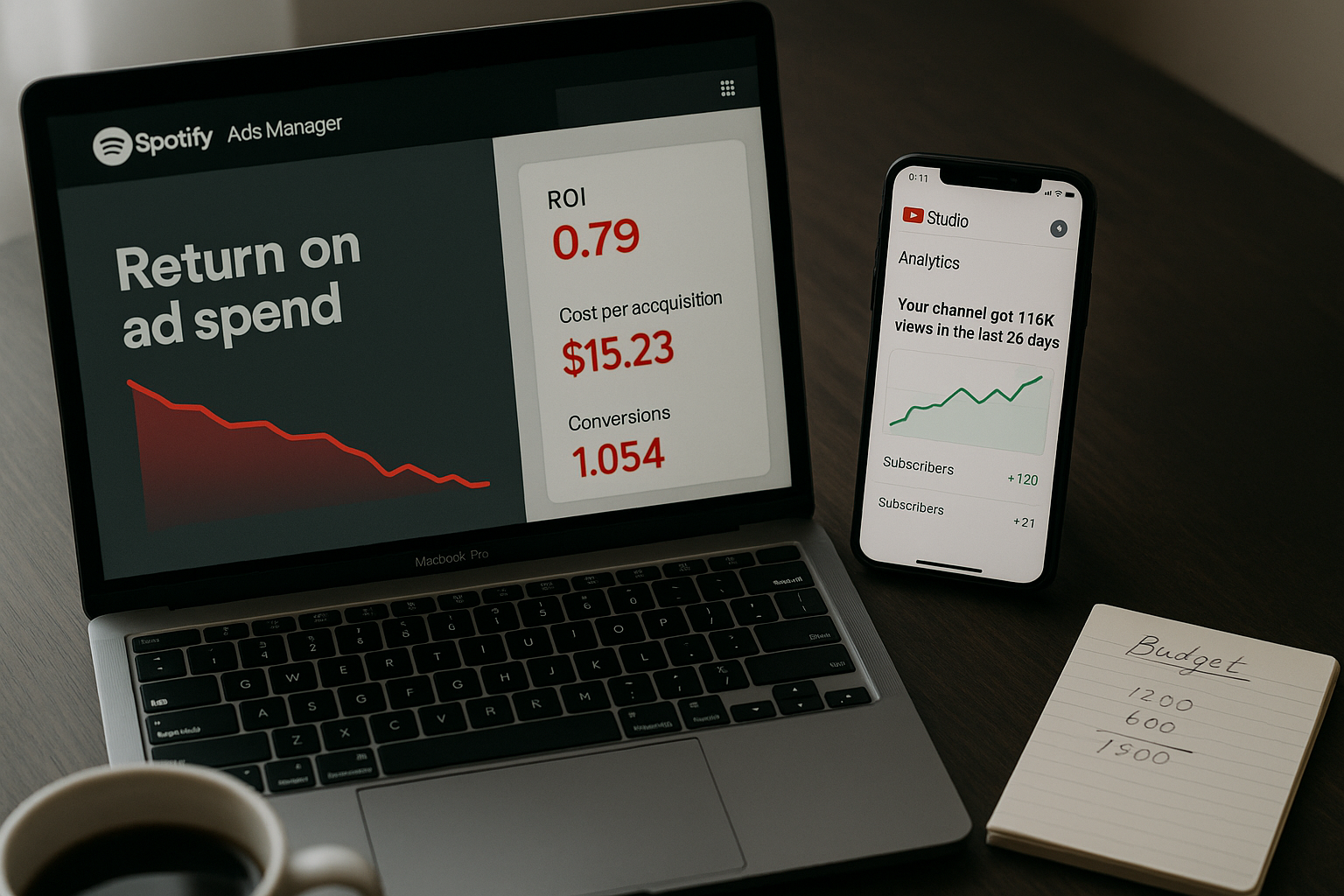
Your promotional budget is on the wrong platform
Spotify ads drain budgets without building assets. YouTube ads convert watch-time into ticket buyers. Here's how to reallocate your promotional spend correctly.
Key Takeaways
Spotify ad spend rarely returns positive ROI at independent artist budgets.
YouTube monetises through AdSense, indexes in search, and converts viewers to ticket buyers.
Video content accelerates the trust cycle that turns casual listeners into paying fans.
Every pound spent on advertising should build a durable asset, not a temporary spike.
At a May 2026 panel, artist manager Barreto told a room full of industry peers to stop spending promotional budgets on Spotify and shift them to YouTube instead. Julie Klein, COO of C3 Management, agreed: YouTube is where artists actually monetise, and where video content converts casual listeners into ticket buyers. This is not opinion, it is platform economics.
At a May 2026 industry conference, Barreto - a working artist manager - made a pointed argument in front of a room full of peers: stop spending your promotional budget on Spotify. Shift it to YouTube.
Julie Klein, COO of C3 Management, backed the logic: YouTube is where the artist actually monetises, and where video content gives potential fans a preview of what to expect at a live show.
This is not a contrarian hot take. It is a systems-level observation about where money flows back to the artist versus where it disappears into a platform's discovery algorithm with zero return.
The economics no longer support Spotify advertising
Independent artists have been conditioned - largely through third-party distributor marketing - to treat Spotify plays as the primary metric of traction. The promotional logic followed: if Spotify is the scoreboard, advertise towards it.
But in 2026, the economics no longer support this.
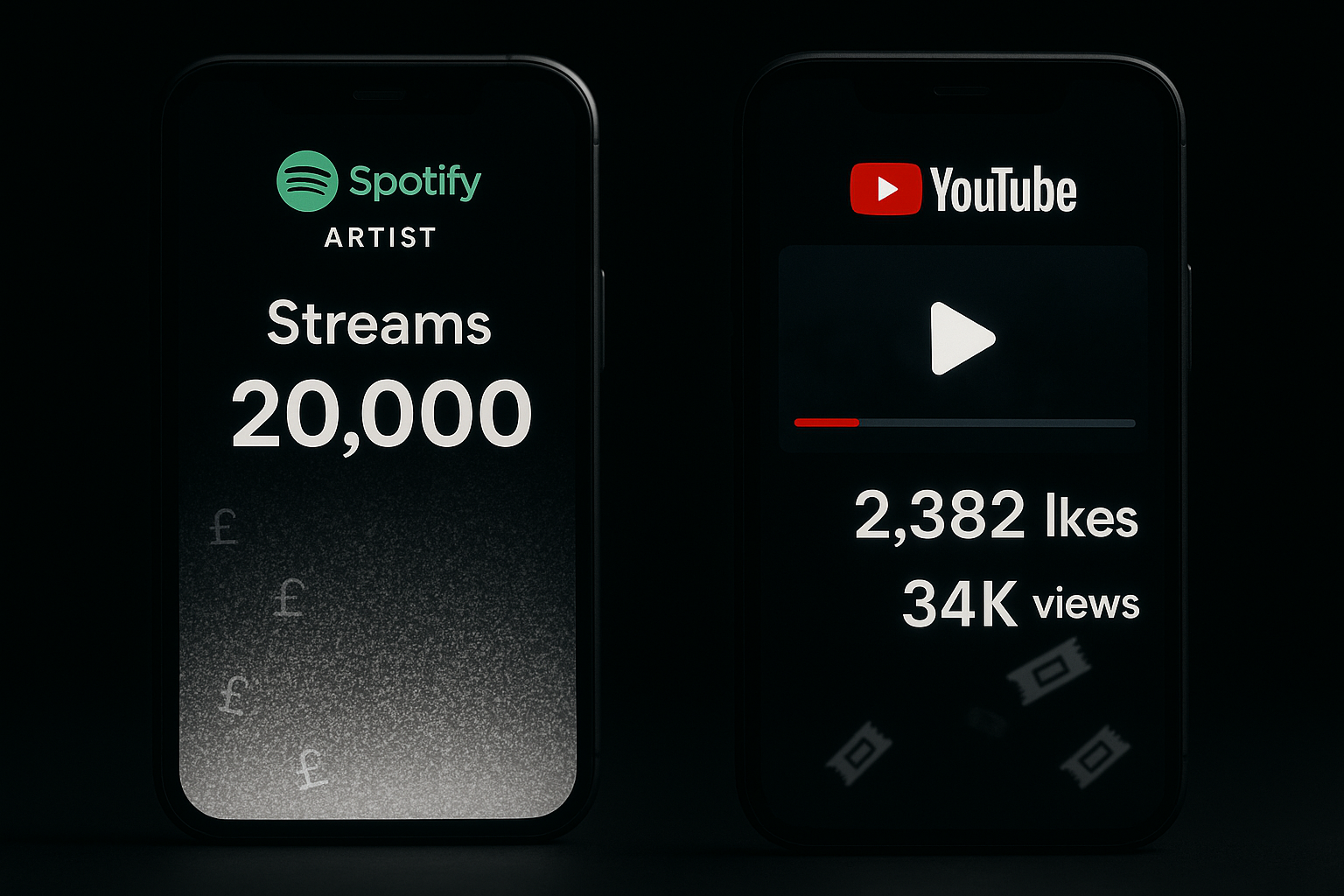
Spotify's royalty model pays fractions of a penny per stream (£0.003–£0.005), and paid advertising to drive streams rarely yields a positive return on spend - especially at the budgets most independent artists operate with.
YouTube, by contrast, pays through AdSense and YouTube Premium revenue, compound-grows through the algorithm if watch-time is strong, indexes in Google Search, and critically, converts to live ticket buyers.
A potential fan who watches a three-minute performance video sits closer to a ticket purchase than a listener who passively streamed a track on shuffle.
Managers who understand platform economics at the systems level are beginning to reroute budgets accordingly.
What your promotional budget is actually buying
When an artist spends money on platform advertising, they are purchasing one of two things: data (who responded and how) or outcomes (streams, saves, follows, ticket sales).
Spotify advertising primarily generates streams - a vanity-adjacent metric that does not reliably compound into long-term fan relationships or direct revenue.
YouTube advertising, by contrast, can be optimised for:
- Watch-time (which feeds the recommendation algorithm)
- Channel subscribers (which create a direct notification relationship)
- Click-throughs to tickets or merch
This is a structural difference, not a preference.
The monetisation stack comparison
- Spotify stream:
- £0.003–£0.005 per stream
- No video
- No search indexability
- Discovery dependent on playlist placement (largely out of artist control at early stages)
- YouTube view (monetised):
- Variable CPM-based revenue
- Search discoverability
- Algorithmic recommendation potential
- Permanent URL asset
- Embeddable across the web
- Connected to Google's advertising ecosystem
The live conversion signal
Managers operating at the C3 level (whose roster includes major touring artists) understand that a live business is the most durable part of an independent artist's revenue stack.
Video content - live performances, acoustic sessions, tour vlogs - accelerates the trust cycle that converts a casual listener into a ticket buyer.
This is the core logic behind the YouTube allocation: it is not just about streaming revenue, it is about building a fan who will pay for proximity to the artist.
Reality check: Eligibility requirements
This strategy is not for every artist at every stage. It requires:
- A minimum level of video content worth advertising (a well-shot live session or music video)
- A YouTube channel that is set up correctly: channel art, about section, consistent upload history, and monetisation enabled if eligible
- A budget of at least £200–£500/month to run tests with statistical validity
- The patience to optimise for watch-time and subscriber growth, not overnight virality
Artists who have no video content, or whose video quality would undermine their brand, should invest first in one strong video asset before shifting ad spend.
Running poor-quality video ads at scale can damage perception faster than no advertising at all.
How to reallocate your promotional budget to YouTube
- Step 1: Audit your last six months of ad spend
What did you spend on Spotify ads, playlist pitching services, or Facebook/Instagram ads pointed at streaming links? What was the measurable return in revenue or attributable fan growth?
- Step 2: Identify your one strongest video asset
This is the content you will advertise first. If you do not have one, plan and shoot a live performance video before running a single ad.
- Step 3: Set up YouTube channel infrastructure correctly
Channel art, keyword-rich about section, consistent upload cadence, end screens with subscribe CTAs on all videos.
- Step 4: Create a YouTube Ads account and link it to your channel
Run your first campaign as a skippable in-stream ad targeting music fans in your genre and geography, optimised for view-through rate, not clicks.
- Step 5: Set a 30-day test budget of £200–£300
Track: watch-time growth, subscriber adds, and any downstream ticket/merch conversions via link tracking.
- Step 6: Compare cost-per-engaged-fan
Compare your previous Spotify spend and your YouTube test. Define an engaged fan as someone who watched >50% of the video or subscribed. Use this data to make the case for continued reallocation.
- Step 7: Log your campaign data
Use Music Artist Manager's release planning and analytics tools to log your campaign spend, outcomes, and CPM benchmarks - so that every release cycle you are building compound knowledge about your audience, not starting from zero.
The CEO mindset shift
A performer asks: how many people listened?
A CEO asks: what did each listener cost me, and what will they generate over their lifetime?
Lyor Cohen built systems at Def Jam and Warner that tracked where money went and what it produced. His model was never about volume - it was about building machines that converted spend into durable assets.
Every £1 you spend on advertising is infrastructure spend. The question is whether it builds something that outlasts the campaign.
A YouTube video with strong organic watch-time will serve your growth for years. A Spotify ad campaign that ends on Monday is invisible by Tuesday.
Build assets, not events.
Track every release campaign in one place
Music Artist Manager's Projects lets you log budget allocations, link external campaign analytics, and compare performance across release cycles - so your promotional decisions are data-driven, not instinct-driven.
Related Reading:
- https://www.musicartistmanager.com/blog/streaming-pool-compression
Further Reading:
- *How to be an Artist Manager in 2026* — Artist For Artist — https://www.artistforartist.com/post/how-to-be-an-artist-manager-in-2026
- *Music Marketing Strategy for Independent Artists in 2026* — ViewManiac — https://viewmaniac.com/music-marketing-strategy-for-independent-artists-in-2026/
- *Music Industry Trends in 2026* — Music24 — https://music24.com/blog/music-industry-trends-2026
Ready to streamline your workflow?
Stop piecing together spreadsheets and scattered notes. Join the waitlist for Music Artist Manager and get your entire rollout in one place.
Written By
Gavin Alexander
Senior Marketeer
As the founder of Music Artist Manager, Gavin has spent years at the intersection of music and technology. Seeing firsthand how chaotic release rollouts and split sheets can be, he designed a platform that brings major-label infrastructure to independent artists and their teams. He writes extensively about industry trends, artist leverage, and workflow optimisation.