Building long-term value from short-form content as an independent artist
How to convert short-form views into catalogue streams, repeat listeners and real revenue beyond the viral spike.
Key Takeaways
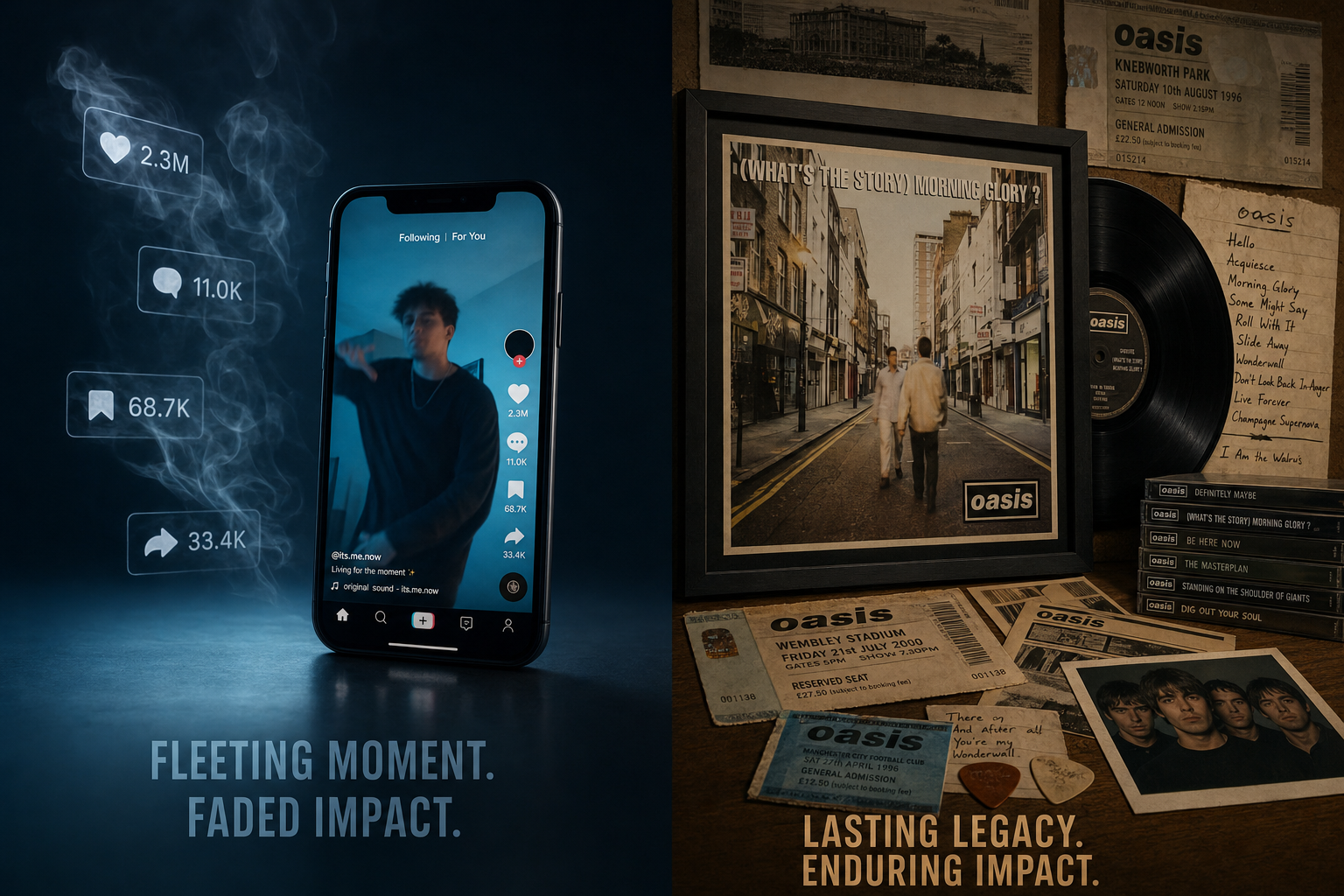
Viral moments are only valuable if you route them back to your catalogue and narrative.
Short-form content drives attention but long-term fans come from consistent story and identity.
Every viral clip should contain a clear path to your release schedule and artist brand.
Ephemeral engagement converts to loyalty when the next release reinforces what the viral moment promised.
Viral content puts you in front of people. It does not turn them into fans. This article shows you how to route short-form engagement into catalogue streams, mailing list sign-ups and repeat listens, using release windows and narrative sequencing that survive the algorithm reset.
You can go viral three times in six months and still play to 15 people. That's not a failure of your content. It's what happens when you treat TikTok or Instagram Reels as the destination instead of the introduction.
Short-form content works. It drives discovery, widens reach and signals cultural relevance faster than a press campaign or a playlist placement. But the moment you mistake visibility for value, you end up working for the algorithm and not for yourself.
This article is for independent artists and their managers who understand how to make a hook land in nine seconds, but want to know what comes after the view count drops. We're talking about conversion strategy. The tactical steps that turn a viral moment into catalogue streams, ticket sales and actual income.
The attention economy pays in a currency you can't spend
Here's the problem: platforms pay you in impressions. A video hits 500,000 views, the follower count jumps by 2,000, and you're checking notifications for 48 hours straight. Then it stops.
That attention doesn't transfer automatically. Someone who double-taps a video at 11pm doesn't become a fan by default. They become a fan when you give them a next step and a reason to take it.
Most artists skip this part. They post, they engage in the comments, they post again. No link strategy. No funnel. No catalogue sequencing. That's why the views and the income don't match.
The gap between seen and remembered
Cultural capital is what people remember about you after the scroll. It's the reason they come back. It's built through repetition, specificity and narrative consistency, not through isolated moments of virality.
If every piece of content is optimised for the platform's current trend cycle, you're legible to the algorithm but not to a human. The artist persona becomes generic. The music becomes secondary. And when the trend shifts, so does the audience.
Here's the fix: anchor every short-form piece to something permanent. A release. A live date. A visual identity. A recurring format that tells people who you are and what you're building, not just what you're reacting to.
What to do before you post
Start with the outcome. What do you want someone to do after they see this? If the answer is "follow me", that's not specific enough.
A better outcome looks like this:
- Stream the new single on Spotify
- Watch the full music video on YouTube
- Sign up to the mailing list for ticket pre-sale
- Save the album release date
- Share the track to their own story
Now reverse-engineer the content. If the goal is streams, the video needs to include the song in a recognisable form, not just a trending sound. If the goal is sign-ups, the caption or link-in-bio needs to explain the value clearly. No guesswork, no "link in bio" with 17 options.
This is basic funnel work, but most artists either skip it or bury the ask under a wall of hashtags.
Link every viral moment to your catalogue
A song trends on TikTok. Views spike. Followers arrive. Then what?
If the trending track is two years old and your profile only promotes the new release, you've just wasted the traffic. The person who came for the old song can't find it, doesn't recognise the new material and leaves.
Catalogue sequencing matters here. When a track gets traction, lean into it. Update your profile to feature that song. Add it to the pinned post. Use it in the next three videos. Drive the traffic to the streaming link while the moment is live.
Then bridge to the new material. Post a video explaining why fans of the viral track will like the new one. Run a "if you liked X, you'll like Y" caption. Give people a path, not a pivot.
The same applies to live shows. If a song is trending, play it. Don't decide it's too old or off-brand. The audience is showing you what works. Use it.
Create a recurring content format that isn't trend-dependent
Trends change every two weeks. You can't build an identity on them. What you can do is develop a repeatable content format that works regardless of the trending audio.
Examples that work:
- A weekly studio vlog with a consistent structure (beat breakdown, writing session, mixing update)
- A recurring visual style that makes your content recognisable in three frames
- A series that ties directly to the music (track-by-track commentary, writing story, collaborator interviews)
The format becomes the hook. People come back for the structure, not just the moment. That's how you build a subscription mindset on a platform designed for browsing.
This doesn't mean ignoring trends. It means your trend participation sits inside a broader content strategy that isn't hostage to what's popular this week.
How to convert platform followers into owned audience
Platform followers are rented. The algorithm decides who sees your post. The platform changes the rules. Your account could be restricted, shadowbanned or deleted, and you lose the entire list.
An owned audience lives on your mailing list, your SMS list or your Discord. You control the access. You control the message. You don't pay per post.
The conversion mechanic is simple: offer something valuable in exchange for the contact. Not "join my mailing list for updates". That's not valuable. This is:
- Early ticket access for the next tour
- A free download of an unreleased track
- A monthly behind-the-scenes update with tour stories, demo snippets or writing notes
- Access to a private listening session or Q&A
Put the sign-up link in bio, in captions and in video overlays. Mention it in the first three seconds of a video. Test language. "Get early tickets" converts better than "sign up for my newsletter".
Then use the list. Email when you have something to say, not just when you're releasing. The open rate depends on whether people remember why they signed up.
Plan content around release windows, not around virality
A release window is the eight-week period around a single or album launch. That's when content strategy matters most, because that's when you're asking people to take an action with commercial value.
Here's a basic content structure for a single release:
Weeks – 4 to – 2 (pre-announcement)
- Tease the visual world (location, collaborators, mood)
- Build anticipation without revealing the song
- Seed recurring language or imagery that will appear in the campaign
Weeks – 2 to 0 (announcement to release)
- Announce the release date and pre-save link
- Post clips of the track in context (studio, rehearsal, writing session)
- Explain what the song is about in plain language
- Drive pre-saves daily
Week 0 (release week)
- Post the official music video or visualiser
- Share the streaming link in every post
- Encourage fans to add the track to playlists or share to stories
- Go live and play the song
Weeks 1 to 4 (post-release)
- Share fan content and playlist adds
- Post performance videos or alternate versions
- Tie the song to upcoming live dates
This structure works because it gives every post a job. No filler. No random content that doesn't serve the release. Every video, every caption, every story either builds anticipation or drives action.
Measure what matters, not what's visible
View count is not the metric. Neither is follower growth. Both are signals, but neither one tells you if the content is working commercially.
The metrics that matter:
- Click-through rate from bio link to streaming or sign-up page. If 10,000 people see the post and 50 click, the content isn't converting.
- Pre-save to follower ratio. If you have 20,000 followers and 150 pre-saves, the content isn't landing with your existing audience.
- Mailing list growth per post. Which posts actually drive sign-ups? Do more of that.
- Traffic source in Spotify for Artists. Is TikTok sending listeners? Which posts drove the spike?
- Ticket conversion from announcement post. How many people who saw the tour post bought a ticket?
Track these monthly. Adjust the content strategy based on what moves the number, not what feels good to post.
When to stop chasing virality and start building a base
Virality is not a strategy. It's a tactic that sometimes works and usually doesn't. If you're three years into a career and still optimising every post for maximum reach, you're not building, you're gambling.
The shift happens when you decide that 5,000 people who actually care is worth more than 500,000 who scroll past. That's not a motivational claim. It's a revenue model.
Five thousand people on a mailing list, with a 30% open rate and a 10% conversion rate on ticket or merch offers, is 150 buyers per campaign. That funds a tour. That covers recording costs. That pays you.
Five hundred thousand views with no conversion path is a number on a screen.
Build the base first. Use short-form content to feed it, not replace it. Viral moments will still happen. When they do, you'll have somewhere to send the traffic.
Ready to plan your next release?
Stop piecing together spreadsheets and scattered notes. Get your free release strategy and keep your whole rollout in one place.
Written By
Gavin Alexander
Senior Marketeer
As the founder of Music Artist Manager, Gavin has spent years at the intersection of music and technology. Seeing firsthand how chaotic release rollouts and split sheets can be, he designed a platform that brings major-label infrastructure to independent artists and their teams. He writes extensively about industry trends, artist leverage, and workflow optimisation.