The cultural engineer: How an 'always-on' content cadence builds enduring fan loyalty, not just fleeting streams
How to build a three-phase content rollout that replaces panic posting with a planned calendar your fans actually follow.
Key Takeaways
Sporadic posting kills momentum. A structured rollout builds narrative and compounds attention over weeks, not days.
The tease, launch, sustain model gives your release a shape fans can follow and your team can execute without burnout.
Daily content tasks remove decision fatigue. A detailed calendar means you show up consistently without scrambling for ideas at midnight.
Loyalty comes from sustained presence, not viral moments. Fans invest in artists who feed the story between releases.
Most independent artists post once when a track drops, then disappear until the next release. That approach kills momentum, confuses your audience, and leaves streaming platforms with no signal to push your music. This guide shows you how to build a structured, always-on content system that drives consistent fan engagement without burning you out.
Most independent artists post when they feel like it, then wonder why their audience doesn't show up when it matters. That is not a content strategy. That is hope with a caption.
If you want consistent fan attention, you need consistent output. Not random. Not reactive. Structured.
This is how you build an always-on content cadence that moves people from casual listeners to daily engagers, and how you execute it without burning out.
What 'always-on' actually means
Always-on does not mean posting every hour. It means your audience never goes more than a few days without hearing from you in a way that adds value, builds narrative, or deepens connection.
It is the difference between showing up only when you need something and showing up because you are running a real campaign with a real throughline.
Labels do this by default. They have release schedules, content calendars, and entire teams keeping the story moving. You can do the same thing solo or with a two-person team if you structure it right.
The three-phase rollout structure
Every release should move through three phases. Each phase has different content goals, different emotional tones, and different calls to action.
Phase one: Tease
This is pre-release. You are building curiosity, not selling anything yet.
Your job here is to make people ask questions. What is this? When does it drop? What does it sound like?
Content types:
- Studio clips with no context
- Lyric screenshots
- Behind-the-scenes process shots
- Collaborator tags
- Countdown graphics (used sparingly)
Cadence: three to five posts per week across platforms for two to four weeks before release, depending on your catalogue size and existing momentum.
Do not over-explain. Let the work speak in fragments. Fans should feel like they are getting early access, not a press release.
Phase two: Launch
Release week. You are driving streams, saves, shares, and playlist adds.
This is where most artists think the campaign starts. It does not. If you did phase one right, this is where momentum converts.
Content types:
- Official announcement post with pre-save or stream link
- Visualizer or lyric video
- Reaction video from your team or close fans
- Breakdown of the song (production, writing process, or story)
- Playlist placement announcements
- Press or blog coverage shares
Cadence: one to two posts per day for the first 72 hours, then three to four posts for the rest of the week.
Your call to action should be specific. Not "check it out." Say "add this to your Friday playlist" or "send this to someone who needs to hear it."
Phase three: Sustain
This is post-release. You are keeping the song alive in the algorithm and in your audience's rotation.
Most artists ghost after week one. That is when the real work starts. Sustained content is what separates a single from a moment.
Content types:
- Fan-generated content (reposts, reactions, covers)
- Performance clips (live, acoustic, or lo-fi versions)
- Lyric breakdowns or song meaning explainers
- Playlist update posts
- Milestone celebrations (streams, saves, playlist adds)
- Integration into your next tease cycle
Cadence: two to three posts per week for four to six weeks, then one post per week as you build into your next release.
The goal is to make the song feel like it is still moving, even when you are teasing what is next. The cultural compounding effect explains why this matters more than you think.
How to map a content calendar without losing your mind
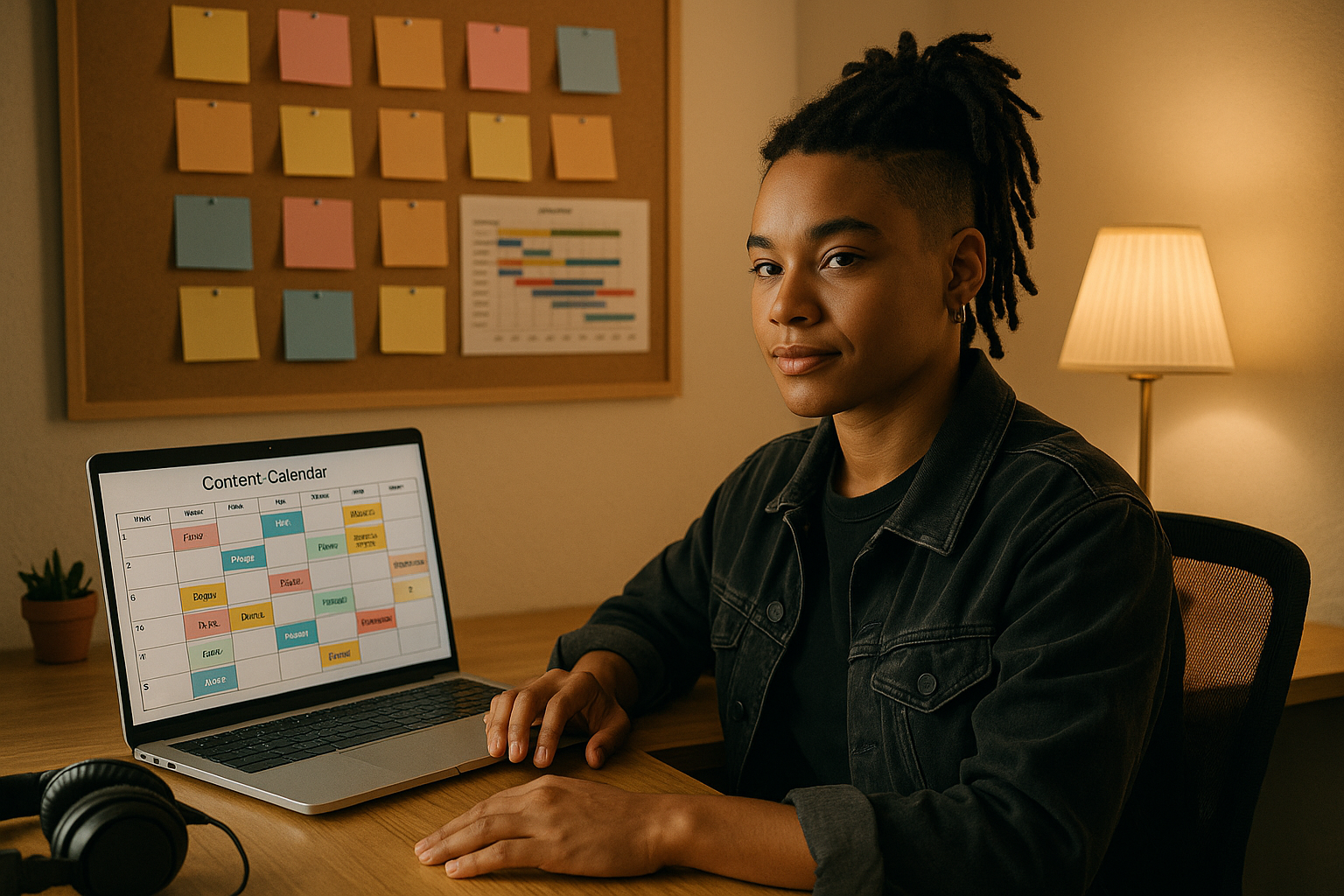
A content calendar is not busy work. It is the tool that removes daily decision fatigue and keeps you from scrambling.
Here is how to build one.
Step one: Lock your release dates
You cannot plan content if you do not know when your music drops. Set your release calendar for the next six months. Singles, EPs, features, loosies. Get it on paper.
Step two: Assign phases to each release
For every song, mark when tease starts, when launch happens, and how long sustain runs. These windows should not overlap unless you are managing a multi-single rollout with staggered timelines.
Step three: Theme your weeks
Each week in your calendar should have a content theme that ladders up to the current phase.
Examples:
- Tease week one: process and craft
- Tease week two: collaborators and influences
- Launch week: song story and call to action
- Sustain week one: fan content and performance
- Sustain week two: integrations and milestones
Themes keep your content cohesive and make batch creation easier.
Step four: Batch your content creation
Set aside one or two days per month to shoot, write, and edit everything for the next two to four weeks. This is non-negotiable if you want to stay consistent.
Your content library should include:
- 10 to 15 short-form videos
- 5 to 7 static images or graphics
- 3 to 5 longer-form pieces (YouTube, blog, email)
You are not creating every day. You are posting every day from a backlog you already built.
Step five: Automate posting where possible
Use a scheduling tool. Later, Buffer, Hootsuite, or even Meta Business Suite. Load your content in advance so you are not glued to your phone every morning.
Leave room for real-time posts (reactions, news, spontaneous moments), but your baseline should already be locked in.
How to maintain cadence when nothing is releasing
You should never go silent, even between releases. Always-on does not pause.
Content to run during off-cycle windows:
- Archive dives (old sessions, unreleased demos, throwbacks)
- Playlist building (share what you are listening to and why)
- Industry commentary (react to news, trends, or other releases)
- Skill-sharing (production tips, writing process, gear breakdowns)
- Fan spotlights (share covers, reaction videos, or DMs)
Your audience does not just care about your music. They care about how you see the world, how you work, and what you value. Give them that.
Your mailing list is worth more than your follower count — here's why. Use your off-cycle content to grow your list and deepen relationships on a platform you actually own.
What daily execution looks like
Once your calendar is built, your daily routine should take 15 to 30 minutes unless you are shooting new content.
Morning routine:
- Check your schedule
- Post what is queued for the day
- Respond to comments and DMs from the last 24 hours
- Monitor performance (saves, shares, story replies)
Evening check-in:
- Engage with fan content or relevant posts in your niche
- Adjust tomorrow's post if needed based on today's performance
- Flag any real-time opportunities (trending sounds, playlist adds, press mentions)
That is it. You are not reinventing the strategy every day. You are executing what you already planned.
How to measure if it is working
Vanity metrics do not matter here. Likes and views are not loyalty indicators.
Track these instead:
- Story replies and DM volume (shows real engagement)
- Saves and playlist adds (signals intent to return)
- Email list growth rate (owned audience expansion)
- Repeat engagers (same usernames showing up consistently)
- Conversion from content to streams (use link tracking)
If your always-on cadence is working, you will see these numbers climb even when you are not in launch mode. That is the signal. The emotional ROI breaks down why these metrics matter more than top-line follower counts.
Common mistakes that kill cadence
Posting without strategy
Random content feels random. Audiences tune out when there is no throughline. Every post should ladder up to a larger narrative or phase.
Over-relying on 'out now' posts
If every post is a call to action, none of them work. Your audience needs value, context, and story before they will care about your ask.
Ignoring platform-specific formats
What works on TikTok does not work on Instagram. What works on Instagram does not work in an email. Adapt your content for each channel or it will underperform.
Burning out because you are doing too much
Always-on is not about volume. It is about consistency. Three posts a week that are strategically placed will outperform ten posts that are thrown up randomly.
Disappearing between releases
Your fans do not go away when you stop releasing music. If you do, they will forget you exist. Stay visible even when you are not in campaign mode.
Final note
An always-on content cadence is not about being everywhere all the time. It is about being present, intentional, and consistent enough that your audience never wonders if you are still working.
You are training your fans to expect value from you on a regular basis. Once that expectation is set, showing up becomes the default. That is when you stop chasing attention and start receiving it.
Build the calendar. Batch the content. Execute daily. Repeat.
That is how you turn casual listeners into people who show up every single time you drop.
Ready to streamline your workflow?
Stop piecing together spreadsheets and scattered notes. Join the waitlist for Music Artist Manager and get your entire rollout in one place.
Written By
Gavin Alexander
Senior Marketeer
As the founder of Music Artist Manager, Gavin has spent years at the intersection of music and technology. Seeing firsthand how chaotic release rollouts and split sheets can be, he designed a platform that brings major-label infrastructure to independent artists and their teams. He writes extensively about industry trends, artist leverage, and workflow optimisation.