Your content calendar is your cash flow forecast
Learn how to turn your content calendar into a predictable cash flow tool by mapping tease, launch, and sustain phases to real revenue.
Key Takeaways
Your content calendar is a cash flow forecast, not a posting schedule.
Consistent rollout across tease, launch, and sustain phases builds predictable revenue over time.
Viral chasing kills cash predictability, but strategic sequencing creates reliable income streams.
Map every content piece to a revenue outcome before you hit publish.
Your content calendar is a revenue forecast. Every post, story, and reel you publish either builds predictable income or burns time you won't get back. This article shows you how to map your content rollout to actual cash flow, so you stop chasing virality and start building a sustainable catalogue income stream.
Most independent artists treat their content calendar like a social media to-do list. Post three times a week. Share some behind-the-scenes. Drop a Story. Hope something hits.
That approach leaves money on the table.
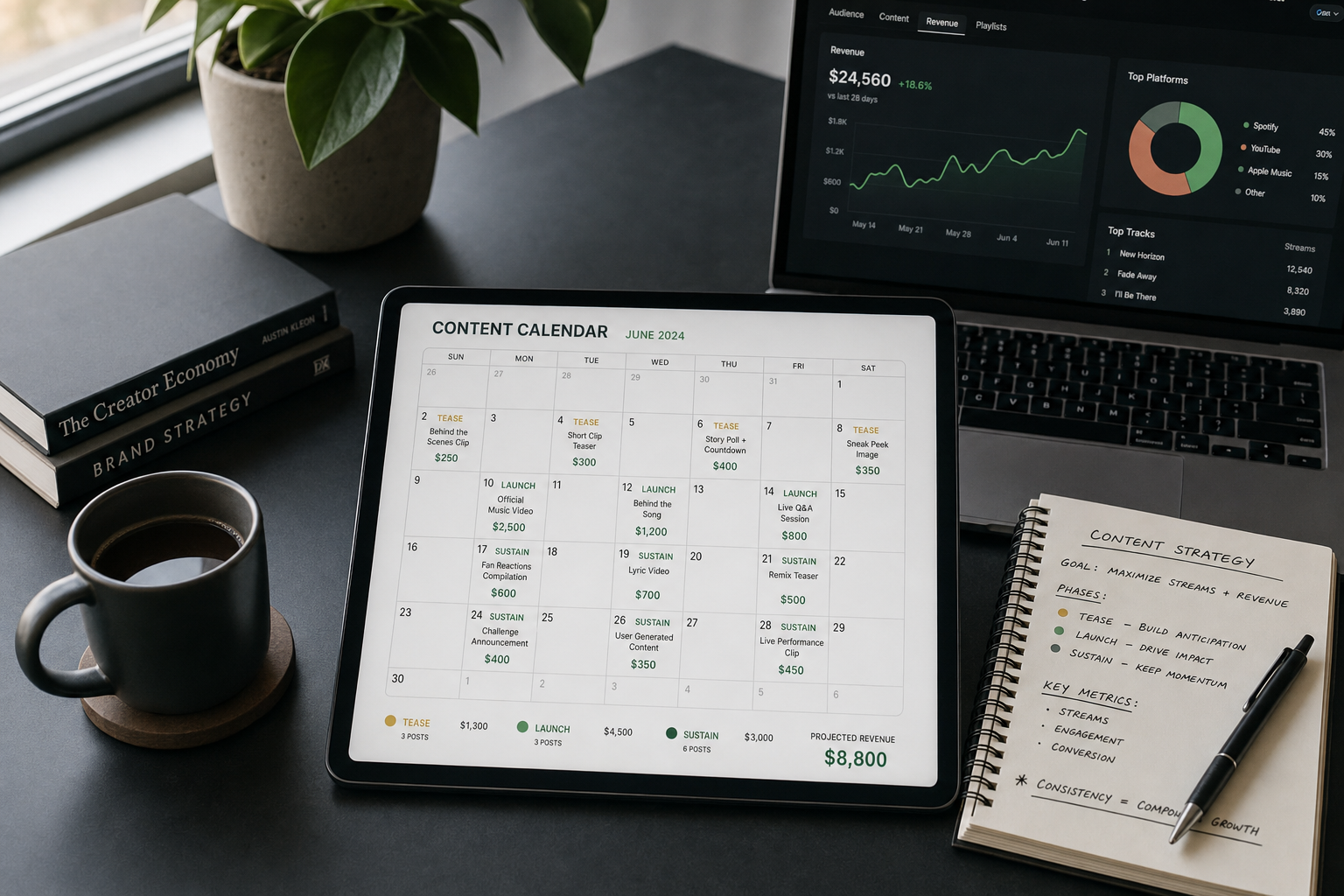
Your content calendar isn't a posting schedule. It's a revenue map. Every piece of content you plan should correspond to a specific stage in your cash flow cycle. If you can't trace a direct line from what you're posting to how money moves into your account, you're guessing.
This article breaks down how to structure your content calendar around the three phases that actually generate income: tease, launch, and sustain. Then it shows you how to forecast revenue based on that structure.
Why content equals cash flow
Streaming income doesn't appear randomly. It follows patterns. Those patterns are created by how you move your audience through awareness, action, and retention.
Content is the mechanism that drives each stage. A teaser video builds awareness and primes your audience to act on release day. A launch day post converts that awareness into streams, saves, and playlist adds. Sustain-phase content keeps people coming back to your catalogue after the first week ends.
If your content calendar doesn't reflect these stages, your revenue won't either. You'll see spikes and then silence. You'll chase viral moments instead of building recurring income.
The shift happens when you start planning content with cash flow in mind. Not "what should I post today?" but "what stage of the revenue cycle am I activating right now?"
The three phases of a revenue-driven content calendar
Break your calendar into three zones: tease, launch, and sustain. Each phase has a different job. Each phase generates a different type of revenue outcome.
Tease phase: Build the pipeline
This is the pre-release window. Typically four to six weeks before your drop date. Your job here is to create demand before the product exists.
Content in this phase should:
- Introduce the song or project without giving it away
- Build anticipation through story, not spoilers
- Prime your audience to act on day one
Example content types:
- Studio session clips with no audio
- Lyric screenshots with context
- Collaborator reveals
- Pre-save link posts (once, strategically placed)
Revenue outcome: pre-save volume and day-one stream velocity. The bigger your tease phase, the harder your launch hits. A strong launch day signals to DSP algorithms that this track deserves playlist consideration. That's where long-term streaming income starts.
If you skip the tease phase or treat it like an afterthought, you're betting on spontaneous discovery. That rarely works.
Launch phase: Convert awareness into action
This is release week. Your content job is to convert every person who saw your tease-phase content into a measurable action: stream, save, share, or playlist add.
Content in this phase should:
- Announce availability on all platforms
- Give people a reason to listen now, not later
- Make sharing easy and intentional
Example content types:
- Official release post with DSP links
- First-week listening milestones
- Fan reaction reposts
- Short-form video with the hook (Reels, TikTok, Shorts)
Revenue outcome: first-week streams and algorithmic momentum. DSPs measure engagement in the first 72 hours to decide if your track gets pushed to editorial or algorithmic playlists. If you don't front-load activity here, you lose that window.
Launch phase isn't about posting once and walking away. It's about sustained visibility for seven days. Your calendar should reflect that.
Sustain phase: Extend the shelf life
This is week two through month six (or longer, depending on performance). Most independent artists stop posting about a song after the first week. That's when the real money starts.
Sustain-phase content keeps your track in rotation. It reminds your audience the song exists. It gives new listeners a reason to check it out. It feeds the algorithm with continued engagement signals.
Content in this phase should:
- Showcase how the song is being used (playlists, fan videos, sync moments)
- Provide new angles on the same track (acoustic version, live performance, remix tease)
- Keep the song visible without feeling repetitive
Example content types:
- Playlist placement announcements
- Fan-generated content reshares
- Performance footage
- Streaming milestone updates (10K, 50K, 100K)
Revenue outcome: long-tail streaming income and catalogue growth. Streams don't stop after week one unless you let them. Sustain-phase content is what separates a single-week blip from a track that earns for months.
This is also where the cultural compounding effect kicks in. Consistent sustain content builds familiarity. Familiarity drives repeat listens. Repeat listens drive royalty checks.
How to map content to revenue
Now that you understand the three phases, here's how to build a content calendar that forecasts cash flow.
Step 1: Set a release date
Pick a date at least six weeks out. This gives you time to execute tease, launch, and sustain properly. Rushed rollouts leave money on the table.
Step 2: Work backward from launch
Your launch week is the anchor. Everything before it is tease. Everything after it is sustain. Mark those phases on your calendar.
Tease phase: weeks -6 to -1
Launch phase: week 0
Sustain phase: weeks 1 to 24 (or longer)
Step 3: Assign content to each phase
For each phase, list the content you'll create. Be specific. "Post three times a week" isn't a plan. "Monday: studio session clip, Wednesday: lyric screenshot, Friday: collaborator reveal" is a plan.
Aim for:
- 12 to 18 pieces of tease content
- 7 to 10 pieces of launch content
- 2 to 3 pieces of sustain content per week for at least 12 weeks
This sounds like a lot. It isn't. It's the minimum to stay visible across platforms without overwhelming yourself.
Step 4: Forecast revenue based on engagement
Now tie each phase to an estimated revenue outcome. This part requires historical data, but even rough estimates help you see the connection.
For example:
- Tease phase: 500 pre-saves → estimated 2,000 first-week streams → $8 to $12 in royalties
- Launch phase: 2,000 first-week streams + playlist add (5,000 listeners) → estimated 7,500 total streams by week four → $30 to $45 in royalties
- Sustain phase: 1,000 streams per week for 12 weeks → 12,000 additional streams → $48 to $72 in royalties
Total estimated revenue from one single over six months: $86 to $129.
These numbers are small. That's the point. Revenue compounds across multiple releases, multiple tracks, and consistent content. If you release four songs a year using this structure, you're looking at $344 to $516 annually from streaming alone. Add sync opportunities, merch, and fan support platforms, and the math changes fast.
The content calendar makes this predictable. You're no longer hoping for virality. You're building recurring income.
Common mistakes that kill cash flow
Posting without a plan
Random content doesn't move the needle. If you're posting because "it's been a few days," you're not driving revenue. Every post should map to tease, launch, or sustain.
Stopping after launch week
The biggest revenue leak is abandoning a song after the first week. Sustain content is where long-tail income lives. If you're not posting about a track two months after release, you're leaving streams on the table.
Chasing virality instead of consistency
Viral moments are unpredictable. Consistent content is not. A single viral post might spike your numbers for a week. A structured content calendar builds income for months. Focus on what you can control.
Ignoring platform-specific behavior
Instagram content doesn't work the same way TikTok content does. Threads don't drive streams the same way Reels do. Your calendar should reflect where your audience actually listens and engages. If your audience is on TikTok, prioritize short-form video in every phase. If they're on Instagram, lean into carousel posts and Reels with strong hooks.
Platform choice affects cash flow. Don't spread yourself thin across six platforms. Pick two, maybe three, and execute there consistently.
How to measure whether your content is working
Revenue forecasting only works if you're tracking results. Here's what to monitor at each phase.
Tease phase
- Pre-save count
- Engagement rate on teaser content (saves, shares, comments)
- Follower growth
Launch phase
- First 24-hour stream count
- Playlist adds (both algorithmic and editorial)
- Peak daily streams in week one
Sustain phase
- Weekly stream average from week two onward
- Catalogue stream growth (are older songs getting discovered?)
- Follower-to-listener conversion rate
If a phase underperforms, adjust the next rollout. Maybe your tease content needs more story. Maybe your sustain phase needs more frequent posts. The data tells you where to fix it.
This is what the cultural engineer does. You're not just making content. You're running experiments, tracking outcomes, and refining your system.
Build the system once, use it forever
The content calendar structure outlined here isn't single-use. It's a template you apply to every release. Once you build it, you're not starting from scratch each time.
You're also not working harder. You're working with a system that compounds. Each release feeds the next. Each piece of content adds to your catalogue's visibility. Each rollout gets easier because you know what works.
Run a pre-mortem on your next release before you execute this calendar. Identify where the system could fail. Fix it before it happens.
Your content calendar is your cash flow forecast. Treat it that way. Plan it in phases. Tie every post to a revenue outcome. Track what works. Repeat.
This is how independent artists build sustainable income. Not by hoping something goes viral. By engineering consistent visibility across tease, launch, and sustain.
Start with your next release. Map the content. Forecast the revenue. Then watch how predictable your income becomes.
Ready to plan your next release?
Stop piecing together spreadsheets and scattered notes. Get your free release strategy and keep your whole rollout in one place.
Written By
Gavin Alexander
Senior Marketeer
As the founder of Music Artist Manager, Gavin has spent years at the intersection of music and technology. Seeing firsthand how chaotic release rollouts and split sheets can be, he designed a platform that brings major-label infrastructure to independent artists and their teams. He writes extensively about industry trends, artist leverage, and workflow optimisation.