An AI-written release strategy, per project
Learn how Music Artist Manager builds project strategies shaped by named industry viewpoints, not one generic voice.

Key Takeaways
A generic strategy checklist won't tell you what to do with your actual project.
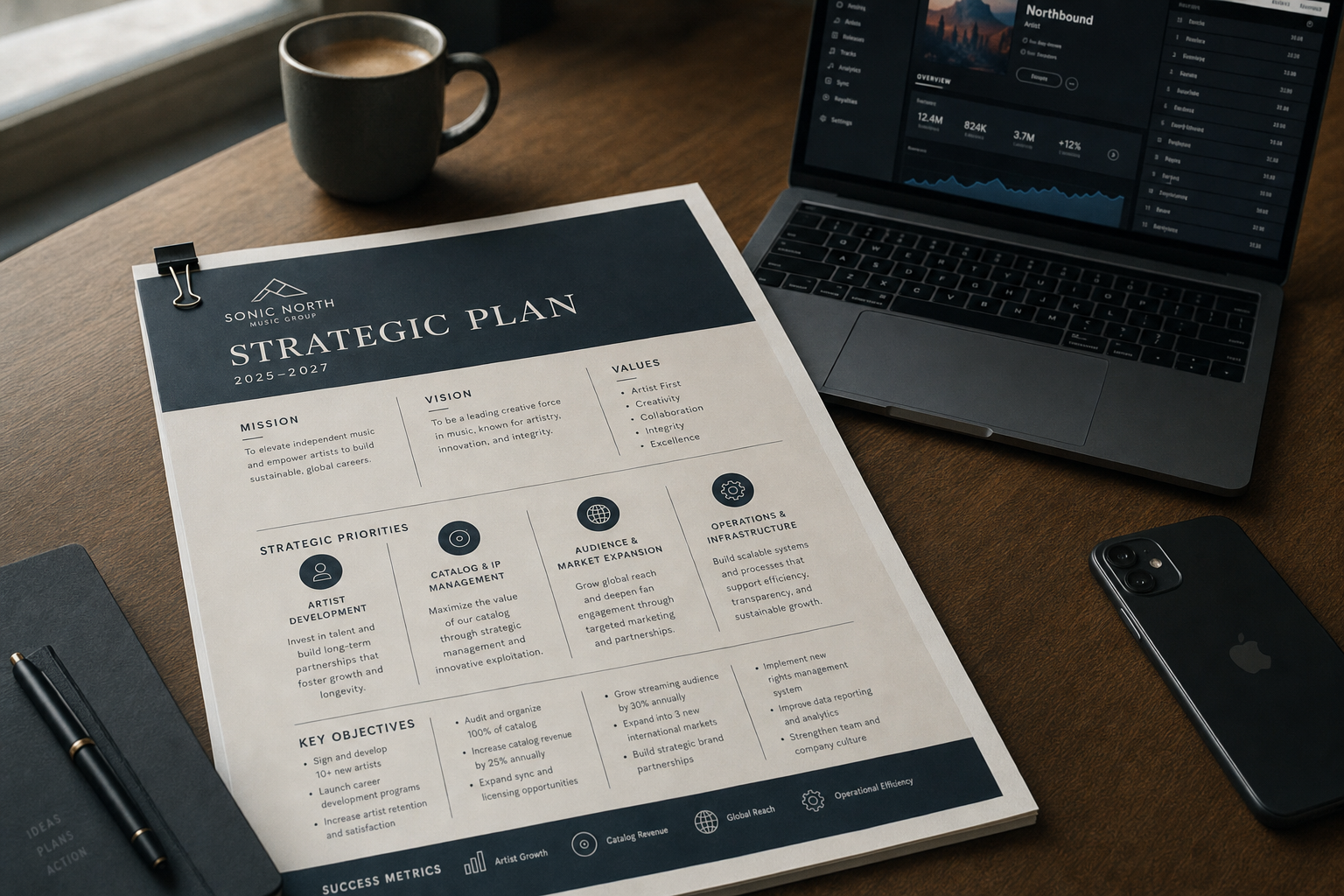
Music Artist Manager builds strategy documents shaped by industry viewpoints, not one flat template.
UK artists get tax and registration guidance written for UK systems, not repackaged US defaults.
Five concrete actions sit alongside the strategy: review, timeline, splits, tracking, masters.
Most strategy tools give you the same generic checklist regardless of your project. Music Artist Manager generates a full strategy document built around your specific release details, shaped by named industry viewpoints and adjusted for your location. If you're UK-based, you get regionally accurate tax and registration guidance, not US-centric defaults.
Most release planning advice comes in one of two shapes. Either it's a blog post telling you to "build your audience six months out", with no mention of your genre, your team, or your existing catalogue. Or it's a template planner with blank cells, waiting for you to already know what belongs in them.
Neither tells you what a strategy for _your_ release should actually contain. And neither does the work of thinking through the dependencies and sequencing that make up a real rollout plan.
A useful release strategy names the specific actions you need to take, in an order that reflects how the music business actually moves. It accounts for the shape of the project you're running: whether you have a catalogue behind you or this is your first release, whether you're working with a label services deal or going fully independent, whether you hold all the rights or you're managing a split with three writers and two feature artists. It reflects where you are based, because UK-based artists face different registration and tax obligations than US-based ones, and a strategy built for one jurisdiction can send you in the wrong direction if applied literally to the other.
Why most release templates don't work
A generic template assumes you already know what goes where. It gives you a structure, but it doesn't help you decide what to put in it, and it doesn't tell you what depends on what.
Here's what a real rollout sequence looks like. You confirm the release date and lock it with your distributor. That date dictates your playlist pitching window, which Spotify opens four weeks before release and closes at release. You can't pitch effectively without final metadata, which means you need cover art, ISRC codes, writer and producer credits, and split agreements in place before the pitching window opens. If you're releasing in the UK and you've written or co-written the track, you need to register it with PRS for Music before release so that streaming and broadcast royalties flow to the right place. If you're paying a producer, mixer or featured artist, you need their invoice and payment terms locked before you file your accounts, which in the UK happens annually and pulls directly from your records of project costs and income.
None of that is optional, and none of it happens in isolation. A strategy that just tells you to "finalize your credits" without connecting that action to playlist pitching, royalty registration and distributor submission is giving you a checklist, not a plan.
What a project-specific strategy document should contain
A strategy built around your own project starts by reading what you've already entered. If you've named your release, confirmed a rough timeline, identified your writers and collaborators, and noted your territory, the strategy should reflect all of it. It should address your release by name, reference the actual collaborators involved, and frame registration and reporting advice for the jurisdiction you're operating in.
The document should cover five areas, in sequence:
Release planning and timeline. The strategy should state your release date and explain what that date controls. It should map backwards from release to identify your playlist pitching window, your pre-save campaign start date, your metadata finalization deadline, and your distributor submission date. If you've noted that this is a single ahead of an album, it should address catalogue sequencing and explain how a lead single affects album rollout timing.
Rights, splits and registration. The strategy should list every writer, producer and featured artist on the project, confirm that splits are locked, and explain what needs to be registered where. For UK-based artists, that means PRS for Music registration for publishing, PPL for neighbouring rights if you're the master owner, and accurate split data filed with your distributor so that royalty statements reflect your actual entitlement. For US-based artists, it means PRO registration with ASCAP, BMI or SESAC. The strategy should name the specific registration step, not just tell you to "sort out your rights".
Marketing, content and audience growth. The strategy should explain what your content calendar needs to include in the lead-up to release, based on your available assets. That means video content, lyric breakdowns, behind-the-scenes material, and playlist pitching copy. It should also explain how to structure your pre-save campaign and what platforms to prioritize based on where your existing audience sits. If you don't yet have an audience, it should acknowledge that and frame the content strategy as audience-building rather than conversion, because those are two different briefs.
Distribution, monetization and tracking. The strategy should confirm your distributor, explain your payout terms, and list what you need to track once the release is live. That means monitoring your streaming income, checking that royalty splits are being paid correctly, tracking playlist adds, and noting spikes in audience geography so you can target future campaigns accordingly. It should also explain what financial records you need to keep, particularly if you're UK-based and filing annual accounts, because HMRC expects project income and costs to be documented clearly.
Post-release review and catalogue strategy. The strategy should explain how to assess whether the release succeeded, what metrics to review, and what that means for the next project. If the release underperformed, the strategy should frame that as useful feedback rather than failure, and explain what you can learn from it. If the release exceeded expectations, it should explain how to capitalize on that momentum in the next rollout.
How Music Artist Manager generates a strategy built around your project
Music Artist Manager generates a release strategy document based on the actual details you've entered about your project. It's not a template with placeholders. It's a document written specifically for your release, using your project name, your collaborators, your timeline, and your location.
The strategy is generated using intelligent technology that runs on a dedicated endpoint with a 300-second timeout. That's longer than a typical response time because the generation task is more involved: it's pulling from your project data, applying a set of industry viewpoints, and structuring a multi-section document rather than returning a quick answer.
The industry viewpoints are defined within Music Artist Manager's own data and are called "mogul lenses". Each lens represents a specific area of music industry expertise, so the strategy isn't shaped by one generic voice but by multiple informed perspectives that reflect how real operators think through a release. The result is a document that reads like it was written by someone who has planned rollouts before, not by a system outputting generic advice.
The strategy is UK-aware. If you're based in the UK, the document adjusts its tax and registration advice accordingly. That means it references PRS for Music and PPL, explains HMRC record-keeping requirements, and frames your financial tracking in UK terms. If you're based outside the UK, the strategy adjusts to reflect US or international norms instead. This matters because generic advice tends to default to US-centric assumptions, and UK-based artists following that advice often miss registration steps or misunderstand their reporting obligations.
The strategy is delivered two ways. It's emailed to you, and it's shown directly in Music Artist Manager under "My Strategy". That view brings the generated document together with five concrete next actions: review the strategy, confirm the release timeline, lock in split sheets, set up financial tracking, and organize master assets. Those five actions are sequenced so that you're not being asked to do something that depends on a step you haven't completed yet.
Music Artist Manager also uses contextual suggestions that read your current account state and prompt differently depending on it. If you haven't set up a project yet, you see a different prompt than if you have projects but no split sheets in place. If you've got split sheets locked but no release date confirmed, the prompt reflects that. The result is that the "what do I do next" guidance reflects where you actually are, not where the app assumes you are.
Why industry viewpoints matter
A strategy shaped by multiple viewpoints reflects how release planning actually works. You don't plan a rollout from one single perspective. You think through it as a marketer, a rights administrator, a financial planner, and a catalogue strategist all at once, and you balance those perspectives against each other.
The mogul lenses inside Music Artist Manager represent those different viewpoints. One lens thinks like a rights expert, checking that splits are locked and registration is complete. Another thinks like a marketing strategist, assessing your audience size and content assets. Another thinks like a financial operator, checking that your costs are tracked and your income is being reported correctly.
The strategy document you receive is the result of those viewpoints being applied to your project. It's not one-dimensional advice. It's a plan that accounts for the dependencies and trade-offs that make up a real release, written in a way that reflects how experienced operators actually talk through a rollout.
What you do with the strategy once it's generated
You read it, check it against your own project state, and decide what actions to take first. The strategy is advice, not instruction, and it's built around your project, but you're still the one making the decisions.
If the strategy tells you to confirm your splits before you finalize metadata, and you haven't yet had the split conversation with your co-writer, that's your next action. If it tells you to register with PRS and you've been putting it off, that's what you do now. If it flags that your pre-save campaign needs to start four weeks out and you're currently six weeks from release, you know you've got two weeks to get your content assets ready.
The five next actions in "My Strategy" are there to give you a concrete starting point. You don't have to do them in that exact order, but they're sequenced so that each one makes the next one easier. Reviewing the strategy first makes sense because it tells you what the other four actions are for. Confirming your release timeline makes sense second because everything else depends on it. Locking in split sheets makes sense third because you can't file accurate metadata or royalty registration without them.
The strategy document isn't static. If your project changes, you can generate a new strategy that reflects the updated details. If you push your release date, adjust your collaborator list, or change your distributor, the new strategy will account for it.
Why location-aware strategy matters
If you're based in the UK, your publishing royalties are collected by PRS for Music. Your neighbouring rights are collected by PPL. Your annual accounts need to reflect project income and costs in a format that HMRC expects, which means tracking advance payments, producer fees, marketing costs, and streaming income separately. Your VAT obligations may apply if your music-
Ready to plan your next release?
Stop piecing together spreadsheets and scattered notes. Get your free release strategy and keep your whole rollout in one place.
Written By
Gavin Alexander
Senior Marketeer
As the founder of Music Artist Manager, Gavin has spent years at the intersection of music and technology. Seeing firsthand how chaotic release rollouts and split sheets can be, he designed a platform that brings major-label infrastructure to independent artists and their teams. He writes extensively about industry trends, artist leverage, and workflow optimisation.