Why your ad budget is working against you on Spotify
Learn why Spotify ad spend builds the platform's retention while YouTube ad budget builds your subscriber base, retargeting pixel, and ticket buyers.
Key Takeaways
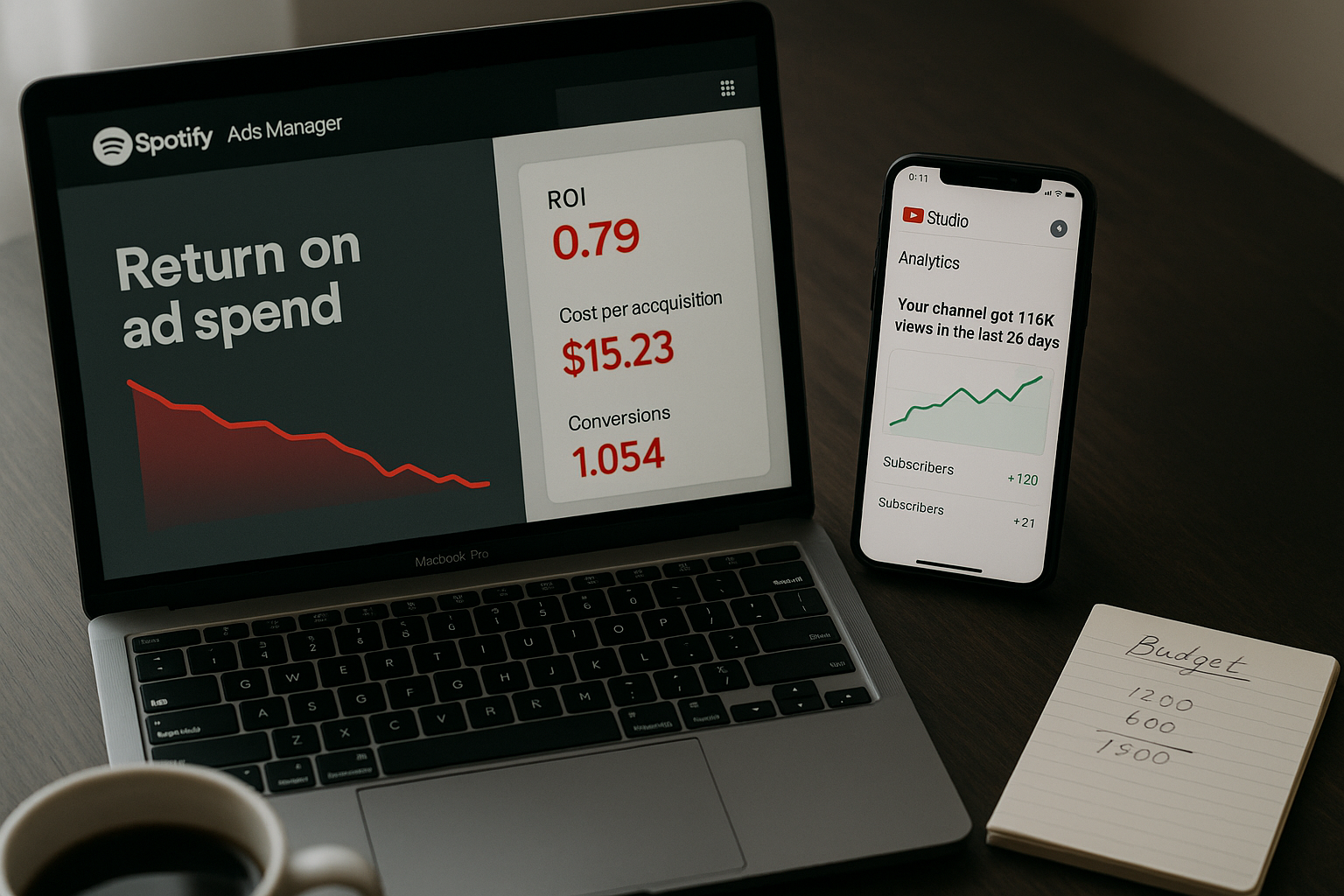
Directing paid ad traffic to Spotify subsidizes a platform you do not own while earning fractions of a cent per stream.
Spotify followers cannot be directly contacted, exported, or monetized outside the platform’s black-box algorithm.
Reroute paid promotional budgets to owned conversion funnels: email captures, direct-to-fan stores, and YouTube watch time.
Build balance-sheet equity by acquiring fan data rather than renting temporary algorithmic exposure on streaming services.
Spotify ads cost you twice. You pay to drive listeners to a platform that pays you fractions of a penny per stream, then you earn almost nothing back. YouTube ads build a subscriber base you own, a retargeting pixel you control, and an audience that actually buys tickets.
At the "Music Managers: The New Power Brokers" conference in May 2026, manager Barreto made a pointed argument that has been gaining traction in independent artist circles: stop putting your ad budget on Spotify. His case isn't that Spotify is a bad platform. It's that advertising on Spotify creates a structural trap most artists don't see until their budget is gone.
When you run a Spotify ad, you pay to bring listeners to a platform that then pays you fractions of a penny per stream. You're essentially subsidising Spotify's business twice: once as an advertiser, once as a creator. By contrast, YouTube ads drive traffic to a platform where your content earns ad revenue and builds a retargetable, subscribable audience. An asset you actually own.
With Spotify now paying out more than £8.7 billion annually to the music industry (£11B+ USD in 2025 alone), and independent artists accounting for roughly half of all royalties, the raw payout numbers look compelling. But the marginal return on paid ad spend is a different calculation entirely.
The market is shifting beneath your feet
Spotify's self-serve Ads Manager has matured considerably. It now offers audio ads, video takeovers, canvas placements, interest-based targeting, and pixel-based retargeting. Saves are running at roughly £0.25–0.60 each. On the surface, that sounds reasonable.
But here's what's shifting beneath the surface:
**YouTube is becoming the primary live-show intent signal.** When audiences watch a full music video or a live performance clip, they're demonstrating far higher intent than someone who streams a song passively on algorithmic autoplay. Barreto's argument at the conference was specifically that video content on YouTube shows potential ticket buyers what to expect live. A conversion the Spotify platform cannot produce.
**YouTube Shorts is driving catalogue discovery at scale** across non-English-speaking markets, creating tour demand in territories artists haven't yet visited.
**The YouTube subscriber as a business asset.** A Spotify follower is platform-locked. A YouTube subscriber can be retargeted via Google Ads, cross-promoted through YouTube's own system, and monetised directly through the platform's Partner Programme. That option becomes available once you hit 1,000 subscribers and 4,000 watch hours.
The strategic implication: Spotify ad spend builds Spotify's retention metrics. YouTube ad spend builds your audience infrastructure.
Why Spotify ad ROI is structurally limited for independents
**Spotify pays on a pro-rata pool model.** Your per-stream rate fluctuates based on total platform activity. A save or follow on Spotify does not translate to guaranteed future exposure. It depends on Spotify's editorial and algorithmic choices.
**Spotify for Artists' Marquee and Showcase tools (paid placements) are designed to re-engage existing listeners, not build new audiences.** Using ad budget for cold acquisition on Spotify means you're paying premium CPMs for listeners who may never return.
Why YouTube ad spend compounds differently
**1. Dual revenue model:** Every view on a monetised YouTube channel earns ad share. You spend on ads to grow views. Those views also earn revenue.
**2. Retargeting pixel:** Google Ads allows you to retarget anyone who watched 30 seconds of your YouTube video. This audience can be pushed merchandise, ticketing, or a next release without additional cold acquisition cost.
**3. Search intent:** YouTube is the world's second-largest search engine. A well-optimised video surfaces organically in perpetuity. A Spotify ad campaign runs, ends, and leaves no lasting SEO trace.
**4. Cross-platform signals:** YouTube watch data feeds into Google's broader ecosystem. Useful if you later run Google Display Ads for tour dates.
Reality check: when this strategy actually works
This is not a blanket "Spotify ads are useless" argument. Spotify paid placements do have a role. Specifically for release-week re-engagement of warm audiences, or for genre-specific targeting where your audience is confirmed Spotify-native (e.g. lo-fi, ambient, playlist-driven genres).
This strategy is most powerful for artists who:
- Already have at least a handful of strong video assets (live sessions, official videos, performance clips)
- Are working towards live touring as a revenue stream
- Are building audiences in new territories
- Have a YouTube channel with at least 200+ subscribers and are ready to grow it intentionally
It will not work well if:
- You have no video content at all
- Your music is purely streaming-native with no visual identity
- You have zero budget (both platforms require spend to test)
Your action plan
**1. Audit your current ad spend.** Pull the last 3 months of Spotify Ads Manager data. Calculate cost-per-save and cost-per-follow. Compare against YouTube's cost-per-view for equivalent campaigns (benchmark: £0.01–0.03 per view for music content via Google Ads).
**2. Identify your best-performing video asset.** This doesn't need to be a polished official video. A well-shot live session or acoustic performance often outperforms high-budget productions for ad conversion.
**3. Set up YouTube channel monetisation eligibility as a milestone.** 1,000 subscribers / 4,000 watch hours. Map out how many months of consistent content plus modest ad spend it would take to reach this.
**4. Run a split test.** For your next release, allocate 60% of your ad budget to YouTube TrueView (skippable in-stream) ads targeting your Spotify audience's demographic equivalents on YouTube. Allocate 40% to Spotify Marquee for warm re-engagement only.
**5. Install Google retargeting pixel.** Use it to build a custom audience of YouTube video viewers (30+ seconds) for future Google Ads retargeting. Particularly useful ahead of live shows or merch drops.
**6. Optimise for search.** Title, description, and tags on every YouTube video should be treated as SEO assets. Research the search terms your potential listeners are already using (e.g., "[genre] artist 2026", "[mood] music for [context]").
**7. Review results at 90 days.** Compare subscriber growth rate, cost-per-subscriber, and downstream ticket/merch conversions against your previous Spotify-only spend periods.
The manager's view
The Spotify trap is easy to fall into because the platform feels like where music lives. And for consumption, it is. But advertising is not about where music lives. It's about where audiences convert into long-term business assets.
A manager thinks in infrastructure. Every pound spent on marketing should build something that compounds: a subscriber base, a retargetable pixel audience, a search-optimised catalogue. Spotify ads can build streams. YouTube ads build a business.
Barreto's point at the conference was blunt: artists who shift even 30% of their ad spend to YouTube will see a structural difference in the quality of their audience within a release cycle. Not more listeners. Better ones. Listeners who know your face, have seen you perform, and are far more likely to buy a ticket.
That's the difference between a fan and a consumer. Your marketing budget should be buying fans.
---
**Use Music Artist Manager's Expenses ledger** to map your current ad spend across platforms, set YouTube growth milestones, and track cost-per-acquisition across Spotify and YouTube campaigns side-by-side.
---
**
Ready to streamline your workflow?
Stop piecing together spreadsheets and scattered notes. Join the waitlist for Music Artist Manager and get your entire rollout in one place.
Written By
Gavin Alexander
Senior Marketeer
As the founder of Music Artist Manager, Gavin has spent years at the intersection of music and technology. Seeing firsthand how chaotic release rollouts and split sheets can be, he designed a platform that brings major-label infrastructure to independent artists and their teams. He writes extensively about industry trends, artist leverage, and workflow optimisation.