Stop wasting ad spend on Spotify: Why smart managers are sending their budget to YouTube
How redirecting your paid ad budget from Spotify to YouTube turns marketing spend into owned revenue, audience data, and ticket sales.
Key Takeaways
Sending paid traffic to Spotify produces zero retargeting pixel data and non-existent fan ownership.
YouTube advertising allows precision audience retargeting, remarketing, and direct click-throughs to ticket and merch links.
Every YouTube view compounds channel authority and long-term algorithmic recommendations across your full video library.
Smart managers demand multi-return promotional assets that build equity rather than vanity playlist stream counts.
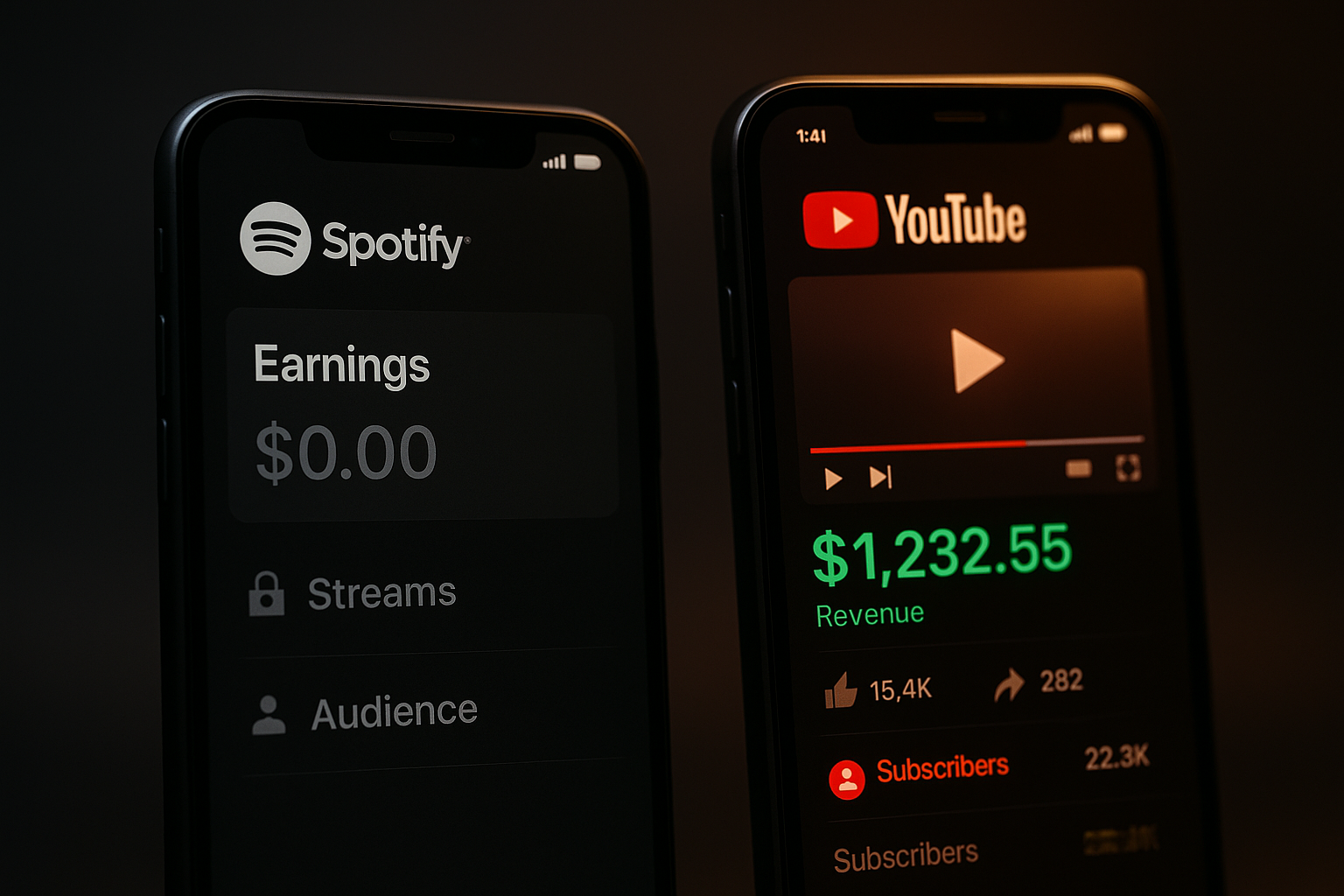
Most independent artists are still running paid ads that send traffic to Spotify. That means you're paying to drive listeners to a platform that captures the data, the monetisation, and the relationship whilst paying you fractions of a penny. Smart managers in 2026 are redirecting that same budget to YouTube, where every view generates ad revenue, builds an owned audience, and converts directly to ticket sales.
At a 2026 industry conference titled "Music Managers: The New Power," Julie Klein — COO of C3 Management, one of the most respected live and artist management companies in the world — made a pointed argument that's flying under most indie artists' radar: stop sending your paid ad budget to Spotify. Send it to YouTube.
Klein's case wasn't ideological. It was operational. When you run a campaign that drives a listener to Spotify, the platform pays you fractions of a penny and keeps all the ad inventory, the data, and the relationship. When you drive that same listener to YouTube, you monetise the view directly, they see your visual identity, and they walk away knowing what your live show looks like. One platform is a black box. The other is a business asset.
Why this matters now
Independent artists in 2026 are increasingly sophisticated about streaming economics. But most are still running paid social campaigns that funnel clicks to Spotify because that's what the playbook has always said. The result: money leaves the artist's pocket, enters Meta's or TikTok's ad auction, and lands on a platform (Spotify) that captures the monetisation upside.
Meanwhile, the live music economy is booming. Touring revenue for independent artists has grown year-on-year as the most reliable income stream in a fractured landscape. The connective tissue between a first-listen and a first-ticket purchase is increasingly video. YouTube is where that journey lives. Savvy management is re-routing budgets accordingly.
The platform shift also reflects a broader trend: artists who think like media companies distribute content across multiple owned or monetisable surfaces, rather than feeding a single streaming platform that controls pricing, discovery, and payout.
YouTube monetises differently to Spotify
YouTube runs ads against video content and pays creators through its Partner Programme (YPP). Each view has ad inventory attached. Spotify does not run display or pre-roll ads against your streams in the same way. Royalties are paid per stream at a fixed rate with no creator-side ad revenue share for standard accounts.
A paid ad driving traffic to YouTube generates: (a) a monetisable view, (b) a subscriber if they engage, (c) a watchable piece of visual content that persists and grows organically via the algorithm, and (d) placement in YouTube's own recommendation engine. That's a discovery layer Spotify charges artists to access via Marquee.
Why YouTube primes live audiences
Video content — live performances, behind-the-scenes, music videos — communicates energy, stage presence, and artist world. A listener who watches you perform before buying a ticket has a fundamentally different relationship to the show than one who only streamed audio. Conversion from YouTube viewer to ticket purchaser is measurably higher than from audio-only platform listener for most artist categories.
The data ownership gap
When you run a Spotify campaign, you get streams and a rough demographic breakdown. When you run a YouTube campaign, you get email remarketing capability, detailed viewer retention data, audience segments you can retarget, and a pixel-ready audience for future ad campaigns.
What you need before you start
This strategy requires:
**A video presence.** Even a performance clip or a lyric video is sufficient. But there needs to be something watchable on YouTube before you spend a pound driving traffic there.
**YouTube Partner Programme eligibility.** That's 1,000 subscribers and 4,000 watch hours, or 500 subscribers with 3,000 hours for the newer YPP tier. If you're below this threshold, YouTube revenue is modest. But building to it is the point of the campaign.
**A minimum viable ad budget.** This approach does not require large spend, but some investment in paid social is assumed. Purely organic strategies are a different playbook.
If you have no video content and no channel, start there before reading on. One properly filmed live performance changes the economics immediately.
How to redirect your ad budget to YouTube
**1. Audit your current ad spend.** Pull the last 90 days of paid promotion. Identify what percentage went to Spotify campaign tools (Spotify for Artists paid promotion, Marquee, etc.) versus video platforms.
**2. Create or repurpose one video asset.** A live performance clip, an acoustic version filmed well, or a simple music video. This is your campaign creative. Minimum 2–3 minutes to earn meaningful watch-time.
**3. Set up or optimise your YouTube channel.** Ensure you have: a channel trailer, organised playlists, consistent thumbnail style, and all links in the description (mailing list, live dates, merch).
**4. Build a Google Ads video campaign targeting your genre audience.** Not just fans of similar artists, but also audiences who have engaged with live music content, festival content, and venue content in your territory. This is the equivalent of buying a targeted front-row seat in the discovery feed.
**5. Install a retargeting pixel.** Use the YouTube audience list to build a custom audience in Meta for future campaigns. Every viewer you earn on YouTube becomes a warm audience for your next Meta ad, without paying Meta for the cold acquisition.
**6. Apply for YPP immediately if not already enrolled.** Even small monetisation signals matter for cash flow and algorithmic favour. Music Artist Manager's Expenses ledger can log this as a new revenue stream.
**7. Track the downstream.** After 30 days, compare: cost-per-click to YouTube vs. Spotify campaign spend. Measure subscriber growth, watch time, and — critically — compare ticket link clicks originating from YouTube audiences versus audio platform audiences.
Capital allocation, not promotion
Every pound you spend on music marketing is a business decision. The question isn't "where do I get the most streams?" It's "where does my marketing budget generate compounding returns?"
Spotify is a distribution channel. YouTube is a media business you can own a piece of. When you route ad spend to a platform that pays you back for every view, stores your content permanently, and builds an audience you can remarket to, you're not promoting music. You're building infrastructure.
Klein's point at the conference was simple: the artists who are winning in 2026 aren't the ones with the most streams. They're the ones whose managers treat every campaign decision as a capital allocation question. That's the difference between an artist with a following and an artist with a business.
Want to see where your YouTube revenue sits next to your streaming royalties? Music Artist Manager's Expenses ledger lets you log and monitor income across all platforms, including YouTube AdSense and YPP earnings.Track all your revenue streams in Music Artist Manager →
---
**Read next:**
-The superfan window before majors move-Superfan economics before labels own them-The sovereign growth engine: architecting data
**
Ready to streamline your workflow?
Stop piecing together spreadsheets and scattered notes. Join the waitlist for Music Artist Manager and get your entire rollout in one place.
Written By
Gavin Alexander
Senior Marketeer
As the founder of Music Artist Manager, Gavin has spent years at the intersection of music and technology. Seeing firsthand how chaotic release rollouts and split sheets can be, he designed a platform that brings major-label infrastructure to independent artists and their teams. He writes extensively about industry trends, artist leverage, and workflow optimisation.