How forensic accounting of promoter settlements can save your tour
Learn which settlement sheet line items promoters hide costs in, and how to challenge every deduction before you sign off.

Key Takeaways
Settlement sheets hide charges in plain sight if you don't know where to look.
Promoters calculate deductions before showing you gross, and that order matters financially.
Every percentage-based fee compounds when stacked, so challenge each one individually with documentation.
The deal memo and the final sheet should match line for line, or you send it back.
Promoters inflate costs. Artists absorb them. This guide walks through every line of a settlement sheet so you can challenge what doesn't belong and keep what you earned. If you've ever felt the numbers didn't add up after load-out, this is the article you audit with.
You played the show. The crowd turned up. The promoter handed you a settlement sheet at 1 a.m. with numbers that don't match the guarantee you negotiated three months ago. This happens more often than it should, and it costs independent artists thousands per tour.
This guide walks you through the exact line items on a standard promoter settlement, the charges that shouldn't be there, and how to challenge them before you sign. It's written for artists and managers who run their own tours and need to protect every pound earned on the road.
Why settlement sheets matter more than your rider
Your guarantee might say £2,000. The settlement sheet is where that number gets adjusted by production costs, venue charges, and a list of deductions that may or may not be legitimate. If you don't audit it, you're trusting the promoter's accountant to look after your interests. They work for the venue.
A single tour of twelve dates can leak £3,000 to £5,000 in unchallenged deductions. That's the difference between breaking even and losing money on the road. Most of those deductions are negotiable or simply wrong, but only if you catch them before you countersign the sheet.
The anatomy of a settlement sheet
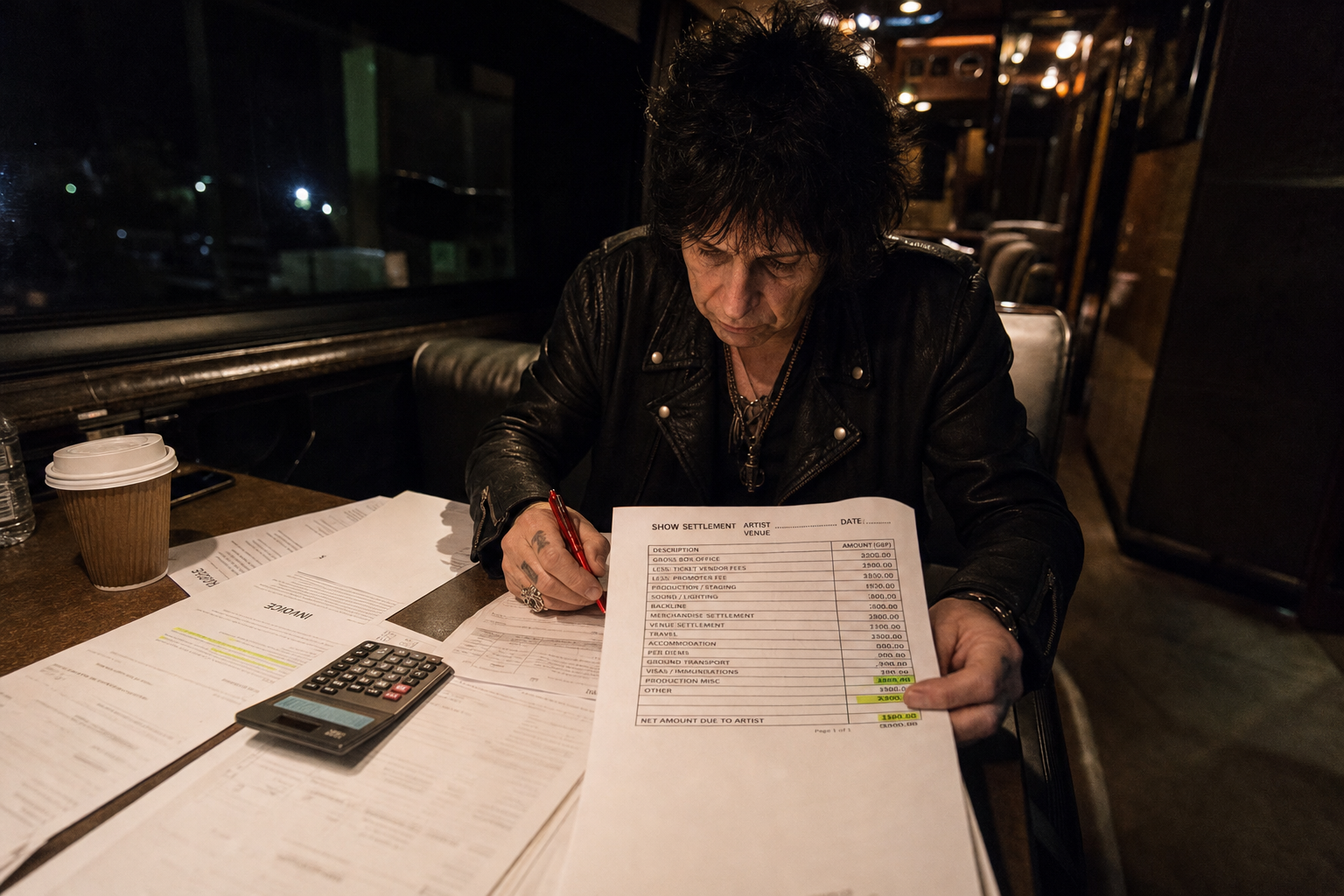
Every settlement follows the same basic structure. Here's what you're looking at:
Gross receipts
Total ticket income. Capacity multiplied by ticket price, minus unsold inventory and comps.
Artist deal
Your guarantee, or your percentage split if you're on a door deal. This is your starting number.
Deductions
Production costs, backline, FOH, lighting, staging, crew, catering, marketing, and venue overhead. This is where the problems start.
Net to artist
What you actually take home after deductions.
Your job is to verify every line in the deductions section. Most settlement sheets are presented as final, but every deduction is a negotiation until you sign.
Line items to scrutinise
Production and backline
What it should say: Itemised costs for equipment you requested in your tech rider and agreed to in the advance.
What to watch for
- Backline you didn't request or use. If your rider specifies a Fender Twin and the sheet lists a Mesa Boogie at £150, you don't pay for it.
- Double charging for items included in the venue's standard package. Many venues include a house PA and monitoring as part of the guarantee. If those items appear as separate line charges, they shouldn't.
- Inflated per-item rates. A standard backline drum kit in the UK should cost between £80 and £150 depending on the city. If the sheet says £300, ask for the invoice from the hire company.
How to challenge it
Cross-reference the settlement against your signed tech rider and the production email thread. If an item wasn't requested or confirmed in writing, you have standing to remove it. Present the promoter with your original rider and ask them to show where you agreed to the charge.
Crew and labour
What it should say: Agreed day rates for FOH engineer, monitor engineer, lighting tech, and stage crew, as confirmed in your advance.
What to watch for
- Phantom crew members. If your advance confirmed a two-person crew and the sheet lists four, you're being charged for people who weren't there.
- Overtime charges that weren't communicated. Load-in ran over by thirty minutes and now there's a £200 overtime line. If the schedule in the advance didn't specify a load-in window or warn about overtime, you can dispute it.
- Tour manager or production manager fees that weren't part of the original deal. Some venues try to pass their own PM's day rate onto the artist.
How to challenge it
Compare crew line items to the advance email and ask for a crew sign-in sheet or timecards. If the promoter can't produce evidence that the person was on site, the charge comes off.
Catering and hospitality
What it should say: Buyout amount or itemised costs for food and drink as per your rider.
What to watch for
- Full retail pricing for rider items. A bottle of mid-tier whisky on a settlement sheet shouldn't cost £60 unless you're playing Wembley. Venues mark up rider items, but you can cap it. Standard practice is cost plus 20 per cent, not cost times three.
- Hospitality for venue staff or the promoter's guests. If the settlement lists catering for twelve people and your band is four, ask who else ate.
- Last-minute additions you didn't approve. Promoter ordered pizza for the green room without asking and billed you £150. You don't pay for unilateral decisions.
How to challenge it
Request itemised receipts for every hospitality charge. If the venue won't provide them, the charges are unverifiable and you can decline to pay. For inflated pricing, propose a capped buyout in future advances: £100 for a four-piece, £150 for a six-piece, no itemisation.
Marketing and advertising
What it should say: Agreed costs for local PR, posters, digital ads, or ticket platform fees, as outlined in the deal memo or the original offer.
What to watch for
- Marketing spend you didn't approve. The promoter spent £500 on Facebook ads without consulting you. Unless your contract specifies that the promoter has discretion to spend on marketing and recoup it, this is their cost, not yours.
- Poster and flyer costs when the artwork came from you and the show sold out. If tickets moved without local advertising, you shouldn't be paying for a poster run that never went up.
- Ticket platform fees that are normally absorbed by the promoter. Dice, Eventbrite, and See Tickets all charge sellers a fee. That's a cost of doing business for the promoter unless your deal specifically shifts it to you.
How to challenge it
Go back to your deal memo or offer email. If the promoter has added a line item that wasn't part of the original terms, it's a new cost and you can refuse it. For marketing spend, ask to see the campaign, the invoices, and the ticket sales data that justify it. If the show sold out in the first week, there's no case for paying for ads in week three.
Venue and overhead charges
What it should say: Transparent allocation of house costs like rent, insurance, and utilities, if your deal includes a percentage split of gross receipts rather than a flat guarantee.
What to watch for
- Mystery "venue fee" or "production overhead" lines with no detail. These are catch-all charges that venues use to pad the settlement.
- Charges for the promoter's own staff. The in-house booker, the venue GM, the box office manager. These are salaried employees. Their cost is part of the venue's overhead, not a touring expense you should carry.
- Rent or mortgage allocation. Some venues on door-split deals try to pass a percentage of their monthly rent onto the artist. This is not standard and not acceptable unless it was explicit in your contract.
How to challenge it
If the charge has no line-item detail, ask for one. If the promoter can't explain what "production overhead" actually covers, it comes off. For percentage deals, your contract should specify which costs are recoupable and which aren't. Anything outside that list is the venue's problem.
Charges that should never appear
These are line items that have no place on a settlement sheet unless you explicitly agreed to them in writing beforehand:
- Drinks for the promoter, their friends, or the venue staff
- Depreciation on venue-owned equipment
- Cleaning or waste disposal fees (this is part of venue overhead)
- Security costs beyond what was confirmed in the advance
- Payment processing fees for the promoter's end (not yours)
If any of these show up, you can strike them immediately.
The comps and guest list problem
Comps reduce your gross receipts. If you're on a door deal, every free ticket is money out of your percentage. Here's what to scrutinise:
Artist comps: Most deals allocate a specific number of guest list spots to the artist, usually ten to twenty depending on the size of the venue. This should be agreed in the offer.
Promoter comps: The promoter also has a list. Industry guests, local press, radio. This is normal and expected, but it should be capped.
Unexplained comps: If the comp count on your settlement is higher than the agreed allocation, ask for the guest list. If the promoter gave away fifty tickets and your agreement capped them at twenty, those extra thirty should not come out of your gross.
How to challenge a settlement in real time
Settlement happens after the show, usually in the venue office or backstage. The promoter hands you the sheet, you review it, and you either sign or negotiate. Here's the process:
Step one: Request the sheet an hour before doors.
You want time to review it before the show starts. Most promoters will resist this. Push for it anyway. If they won't provide it early, tell them you'll need twenty minutes after the show to audit it properly.
Step two: Cross-reference against your advance.
Have your tech rider, deal memo, and production email thread on your phone or printed. Check every line item against what was agreed.
Step three: Mark up the sheet.
Use a pen. Strike any line you're disputing and write your reason next to it. "Not in rider." "Crew not confirmed." "No receipt provided."
Step four: Propose a revised total.
Add up your version of the settlement and present it. This is not aggressive, it's professional. You're showing your work.
Step five: Negotiate the gap.
The promoter will push back. You'll meet somewhere in the middle, or you won't. If the gap is small, say £100 to £200, you might take the loss to maintain the relationship. If it's £500 or more, hold your ground. If you can't agree, don't sign the sheet. Tell them you'll review it with your accountant and send a revised version within 48 hours.
Step six: Document everything.
Take a photo of the settlement sheet, your marked-up version, and any receipts or invoices the promoter provided. Email a summary of the disputed items to the promoter that night while it's still fresh.
What to do if the promoter won't negotiate
Some promoters will simply refuse to adjust the settlement. They'll tell you the costs are fixed, the venue policy is the venue policy, and you can either sign or not get paid.
Here's your position:
You don't have to sign. A settlement sheet is not a legal invoice. It's a proposed reconciliation. If you don't agree with it, you don't sign it, and the promoter has to either negotiate or pursue the disputed amount through other means, which they almost never do.
You can request full documentation. Invoices, receipts, timecards, hire agreements. If the promoter can't provide them, the charges are unverifiable.
You can walk with the guarantee. If your deal includes a guarantee regardless of costs, the promoter is contractually obliged to pay it. The settlement is meant to adjust for overages, but the floor is the guarantee. They can't withhold it because you disputed a line item.
You can decline future bookings. If a promoter consistently inflates settlements and won't negotiate in good faith, don't play their venues again. There are other rooms.
Protecting yourself in the advance
The settlement audit starts before you load in. Here's what to lock down in your advance:
Capped costs. For backline, crew, and hospitality, specify a maximum spend in the production rider or deal memo. "Backline not to exceed £300." "Hospitality buyout fixed at £150."
No recharge clause. Add a line to your contract that says the promoter may not pass any costs to the artist unless those costs are itemised and agreed in the advance. This kills mystery charges.
Itemised settlement template. Some managers send the promoter a blank settlement template a week before the show and ask them to fill it in with projected costs. This sets the expectation that every line will be detailed and justified.
Penalty clause for late payment. If the settlement is disputed and payment is delayed beyond fourteen days, a late fee applies. This keeps promoters honest and discourages drawn-out arguments over small amounts.
Common objections and how to handle them
"This is just how we do it."
Not binding. Industry norms are not contract terms. The advance and the offer email define the deal.
"You're the first artist to ever complain."
Possible, but irrelevant. Other artists might not audit their sheets, or they might have different deals. Your contract is specific to you.
"If you don't sign, we can't pay you tonight."
Fine. You'll sign a modified version and they'll pay within fourteen days, or you'll pursue it as a contract dispute. Immediate payment is not worth accepting incorrect charges.
"The venue owner approved this."
The venue owner isn't a party to your contract. The promoter is.
Real numbers: What a clean settlement looks like
Here's a worked example for a 300-capacity show in Manchester with a £1,500 guarantee plus 70 per cent of net receipts after costs.
Gross receipts: 280 tickets sold at £12 each = £3,360
Artist comps: 15
Promoter comps: 10
Total capacity used: 305 out of 300 (standing room)
Artist deal: £1,500 guarantee or 70% of net, whichever is higher
Deductions
- Backline (bass rig, guitar amp, drum kit): £180
- FOH engineer: £150
- Monitor engineer: £120
- Venue marketing (posters, Facebook ads): £200
- Hospitality buyout: £100
- Total deductions: £750
Net receipts: £3,360 - £750 = £2,610
Artist share at 70%: £1,827
Since £1,827 is higher than the £1,500 guarantee, the artist takes £1,827.
This is a clean settlement because every line item corresponds to something agreed in advance. The crew rates are standard for the city. The backline matches the rider. The marketing spend was discussed in email. The hospitality buyout was capped in the deal memo.
If the settlement had instead included a £300 "venue production fee" with no explanation, a £200 charge for a lighting tech who wasn't requested, and £150 for drinks that the artist didn't order, the artist would dispute £650 and walk with either the guarantee or a significantly higher net figure.
What to track across a full tour
If you're doing ten or twenty dates, settlement patterns will emerge. Track these figures in a spreadsheet:
- Average deductions as a percentage of gross receipts
- Promoters who consistently inflate charges
- Venues where your costs run higher than others with similar capacity
- Charges that appear on multiple sheets but were never agreed in any advance
This data tells you where the leaks are. It also gives you leverage when you renegotiate terms for the next tour. If you can show a promoter that their average deductions run 15 per cent higher than comparable venues, you can propose a capped budget for the next run.
The long game
Auditing settlements isn't about being difficult. It's about protecting the income you earned. Promoters respect managers and artists who know how to read a settlement sheet, because it signals that you're serious about the business side of touring.
The first time you challenge a dodgy line item, the promoter might push back. The second time, they'll present a cleaner sheet. The third time, they won't try to slip anything past you, because they know you'll catch it.
This discipline compounds. Over the course of a year, an artist who audits every settlement will keep an extra £5,000 to £10,000 that would have otherwise vanished into vague production charges and unexplained overages. That money pays for the next recording session, the next tour van, or the manager's commission on a festival slot that wouldn't have been possible without the cash flow to stay on the road.
Treat every settlement sheet as a negotiation. Cross-reference every line. Ask for receipts. Don't sign anything until the numbers make sense. The promoter's accountant isn't looking after your money. You are.
Ready to plan your next release?
Stop piecing together spreadsheets and scattered notes. Get your free release strategy and keep your whole rollout in one place.
Written By
Gavin Alexander
Senior Marketeer
As the founder of Music Artist Manager, Gavin has spent years at the intersection of music and technology. Seeing firsthand how chaotic release rollouts and split sheets can be, he designed a platform that brings major-label infrastructure to independent artists and their teams. He writes extensively about industry trends, artist leverage, and workflow optimisation.