Independent artists are losing thousands on hidden fees
Learn to identify and negotiate venue contract clauses that cut into nightly settlement, then audit each show for genuine profitability.

Key Takeaways
Venue deductions can erase your profit faster than poor ticket sales ever will.
Settlement sheets are negotiable documents, not fixed invoices you must accept in full.
Most artists sign contracts without understanding which clauses cost them real money per night.
Auditing your nightly settlement takes fifteen minutes and protects hundreds of pounds per show.
Most independent artists lose money on tour not because they book badly, but because they settle badly. Venue contracts and nightly settlement sheets contain clauses that carve out your margin before you've even loaded out. This article gives you the specific line items to audit, the percentages that matter, and the negotiation points that protect your door split.
You booked the gig. The capacity looks right, the door price works on paper, and you've run the maths three times: 150 paid tickets at £12 means £1,800 gross. Take away your 20% commission to the agent, your £300 backline hire, £200 on petrol and accommodation, and you're walking away with £900 for a four-piece.
Then you get to settlement. The promoter slides the sheet across the bar, and suddenly there's a production deduction you didn't negotiate. A service charge you never saw written down. A bar minimum you didn't hit. That £900 becomes £400, and you've just worked a six-hour show for £100 per head before tax.
This happens because most independent artists and their managers treat the gig confirmation as the contract. It isn't. The real financial terms live in three places: the original booking agreement, the rider addendum, and the settlement sheet you sign at 11pm when you're too tired to argue. This article walks through where the money disappears, what clauses to flag before you confirm, and how to audit settlement on the night without killing the relationship.
Why venue deals cost you more than the percentages suggest
The headline split is never the full picture. A promoter offers you 80% of door after costs, and that sounds clean until you read "costs" as a defined term. Here's what regularly appears under that line:
- Production charges. Lighting, sound engineer fee, stage power. Sometimes itemised, often a flat deduction. £150 to £400 is common for a 200-capacity room.
- Marketing spend. Facebook ads, poster printing, ticket platform fees. If the promoter hasn't capped this in writing, they can back-charge the entire campaign.
- Venue hire. Some promoters don't own the room. They're renting it and passing the cost through to you.
- Staffing. Door security, ticket scanner, additional bar staff brought in for your expected crowd.
- Minimum bar take. The venue guaranteed the promoter a certain amount of bar revenue. If your crowd doesn't drink enough, the shortfall comes off your settlement.
The last one catches people out most often. You're not responsible for how much your audience spends at the bar, but the contract can make you responsible anyway if the clause is in there and you signed it.
The three documents that matter, and when to check them
The booking confirmation email
This is not a contract, but it sets expectations. It should state: date, venue, agreed door split or guarantee, any caps on deductions, who pays for backline, and whether there's a rider. If the email just says "80/20 split after costs", you don't have enough detail to settle cleanly.
Red flag terms
- "Costs to be confirmed"
- "Standard production deductions apply"
- "Settlement at promoter's discretion"
If you see any of these, ask for the full settlement formula in writing before you confirm. A sentence like "80% of gross door revenue after deduction of sound engineer fee (£120), lighting hire (£80), and ticket platform fee (8% of gross sales)" is specific enough to settle against.
The venue contract or rider addendum
This is the document the promoter should send after booking is confirmed. It often includes guest list limits, soundcheck time, curfew, and critically the full cost schedule. This is where you'll see production, marketing, staffing and bar minimum clauses written out.
What to negotiate now, not at settlement
- Cap the production deduction. If they're charging £300 for sound and lights, write that number into the contract. No "up to" clauses.
- Remove or cap marketing spend passthrough. Offer to approve the campaign budget in advance, or agree a fixed contribution like £100 regardless of what they spend.
- Strike the bar minimum entirely, or make it the promoter's risk. You're being paid to perform, not to sell drinks.
- Guest list as a fixed number, not a percentage of capacity. "Ten guest list spots" is clear. "Up to 10% of door sales" means they can deduct ticket value later if the list runs over.
If the promoter won't negotiate any of this, that tells you how settlement will feel. Decide whether the exposure or the audience is worth eating the cost, but go in knowing the real number.
The settlement sheet
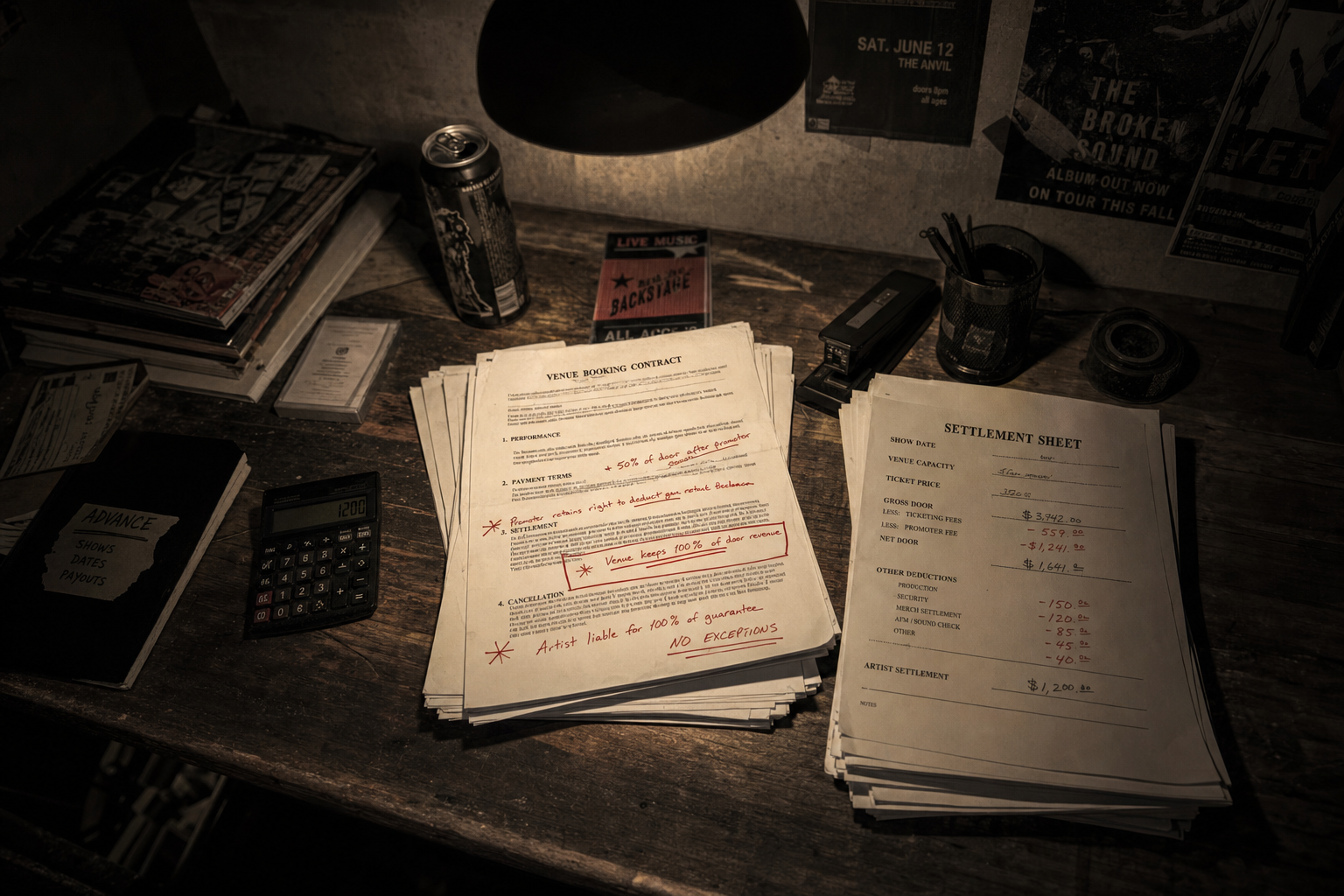
You'll see this at the end of the night, usually handwritten or pulled from a template on a laptop. It should show: total tickets sold, gross door revenue, each agreed deduction by line item, your net payment, and signature lines for both parties.
Check these figures before you sign
1. Ticket count matches your estimate. If you counted heads during the set and saw 80 people, but the sheet says 52 paid, ask to see the ticket platform report or the door scan log.
2. Deductions match the agreed schedule. If the contract said £120 for sound and the sheet says £200, don't sign until they explain it.
3. No new line items. "Venue cleaning fee" or "late curfew penalty" shouldn't appear for the first time at settlement unless you genuinely caused damage or overran and that was written into the rider.
4. Bar minimum shortfall is calculated correctly. If this clause exists, ask to see the bar till receipt or end-of-night report. Promoters have been known to claim a shortfall without proving it.
If the numbers don't match, say so. Politely, but clearly. "This doesn't match the agreed breakdown. Can we go through it line by line?" If they refuse or pressure you to sign because the venue is closing, don't sign. Take a photo of the sheet, send a follow-up email the next day with your questions, and make payment conditional on resolving them.
You will not get blacklisted for checking your settlement. You'll get a reputation as someone who reads the deal, which is the reputation you want.
How to structure a touring deal that protects the door take
If you're booking a run of shows, treat the deal structure as the first line of defence. Here are three models that shift risk and reduce settlement surprises:
Guaranteed fee vs door split
A straight guarantee means you get paid a fixed amount regardless of ticket sales. The promoter takes all the upside and all the risk. You lose the chance to earn more if the show sells well, but you know your number before you leave home.
A door split means you share the risk and the upside. It works when you can drive ticket sales yourself and you trust the promoter to report honestly. It fails when costs aren't capped or when the promoter controls ticketing and doesn't give you access to sales data.
Blended model: Guarantee plus percentage over a threshold. Example: £300 guarantee, then 70% of gross door revenue after the first £600 in sales. You're protected on the downside, and you benefit if the show performs. This is the structure to push for if you're playing 150 to 300-capacity rooms and you have a mailing list or strong local following.
Who controls ticketing
If the promoter uses their own ticketing platform and doesn't give you admin access, you're settling blind. Push for a platform where you can see live sales data, or insist that they send you a sales report 48 hours before the show and a final report before settlement.
If they won't agree, consider advancing your own tickets through your Bandcamp, website, or a third-party platform you control. You keep the ticket income, the promoter gets a portion of it at settlement, and you have your own count to reconcile against.
Marketing contribution vs passthrough
Agree upfront whether you're contributing to marketing, and if so, how much. Options:
- Fixed contribution: "We'll pay £100 towards ads, promoter covers the rest." Clean, no surprise charges.
- Approval-based spend: "Promoter submits planned marketing spend for approval before committing." You see the Facebook ad budget, the poster quantity, the PR fee if there is one, and you agree or negotiate before money moves.
- No passthrough: "Promoter covers all marketing as part of their role, artist fee is net of this cost." This usually means a lower door split or guarantee, but no settlement surprises.
Settlement audit checklist for the night of the show
Bring this list to every gig where you're being paid on a door split. Check it before you sign anything.
- Ticket sales count matches your independent count or the platform report you can access
- Each deduction line matches the agreed cost schedule in the contract
- No new charges appear that weren't discussed in advance
- Bar minimum shortfall, if applicable, is backed by a till receipt or manager-signed bar report
- Guest list count matches the agreed number, and you have the names if challenged
- Signatures are required from both parties, and you get a copy of the signed sheet before you leave
If you're managing multiple artists, build this into a settlement template. Bring a printed copy to every show, fill it out at the venue, and keep it in a folder with the contract. When you're negotiating the next run of shows with the same promoter, you have a record of what actually happened versus what was agreed.
When to walk away from a venue deal
Not every gig is worth playing. You're building a business, not a "journey". If the numbers don't work, the relationship is combative before you've even loaded in, or the promoter won't put cost caps in writing, the gig isn't going to pay what you need.
Walk if
- The promoter refuses to cap production or marketing deductions in writing
- There's a bar minimum clause and they won't remove it or make it their risk
- You can't get access to ticket sales data before or during the show
- The settlement terms are described as "discretionary" or "to be confirmed on the night"
- The promoter has a history, verifiable through other artists you know, of disputed settlements or non-payment
You'll lose some gigs this way. You'll also stop losing money on gigs that looked good in the confirmation email and fell apart at settlement.
What Music Artist Manager tracks for you
Inside the Tour & Live manager, you'll log each confirmed show with its deal structure: guarantee, door split, agreed deductions, ticket platform, settlement formula. As sales data comes in, the manager compares projected payout against costs and flags when a show is trending toward break-even or loss before you leave for the venue.
Settlement sheets can be photographed and uploaded to the Records manager on the night. The manager cross-checks them against your logged deal terms and highlights discrepancies. If you're running a multi-date tour, the Financial manager consolidates actual settlement data by show and by promoter, so you can see which relationships are paying out as agreed and which ones aren't.
This is not a replacement for reading the contract and negotiating upfront. It's a structure for operationalising what you've already negotiated, so you're not rebuilding your settlement audit process from memory at 11pm in a venue office.
The real cost of not checking settlement
You played twelve shows on a regional tour. Each one had a production deduction that wasn't capped. The promoter back-charged an average of £180 per show instead of the £120 you expected. That's £720 in unplanned costs across the run. If your backend split was 70%, you've just lost £504 that should have been in your account.
Multiply that across two tours a year for three years. You've left £3,024 on the table because you signed settlement sheets without checking them against the contract.
This isn't hypothetical. This is the actual maths when you treat booking confirmations as contracts and settlement sheets as a formality. The fix isn't complicated. It's reading the deal, negotiating cost caps, and checking the numbers before you sign. The promoters who respect that process are the ones you want to work with long-term. The ones who don't are showing you exactly how the next ten shows will go.
Ready to plan your next release?
Stop piecing together spreadsheets and scattered notes. Get your free release strategy and keep your whole rollout in one place.
Written By
Gavin Alexander
Senior Marketeer
As the founder of Music Artist Manager, Gavin has spent years at the intersection of music and technology. Seeing firsthand how chaotic release rollouts and split sheets can be, he designed a platform that brings major-label infrastructure to independent artists and their teams. He writes extensively about industry trends, artist leverage, and workflow optimisation.