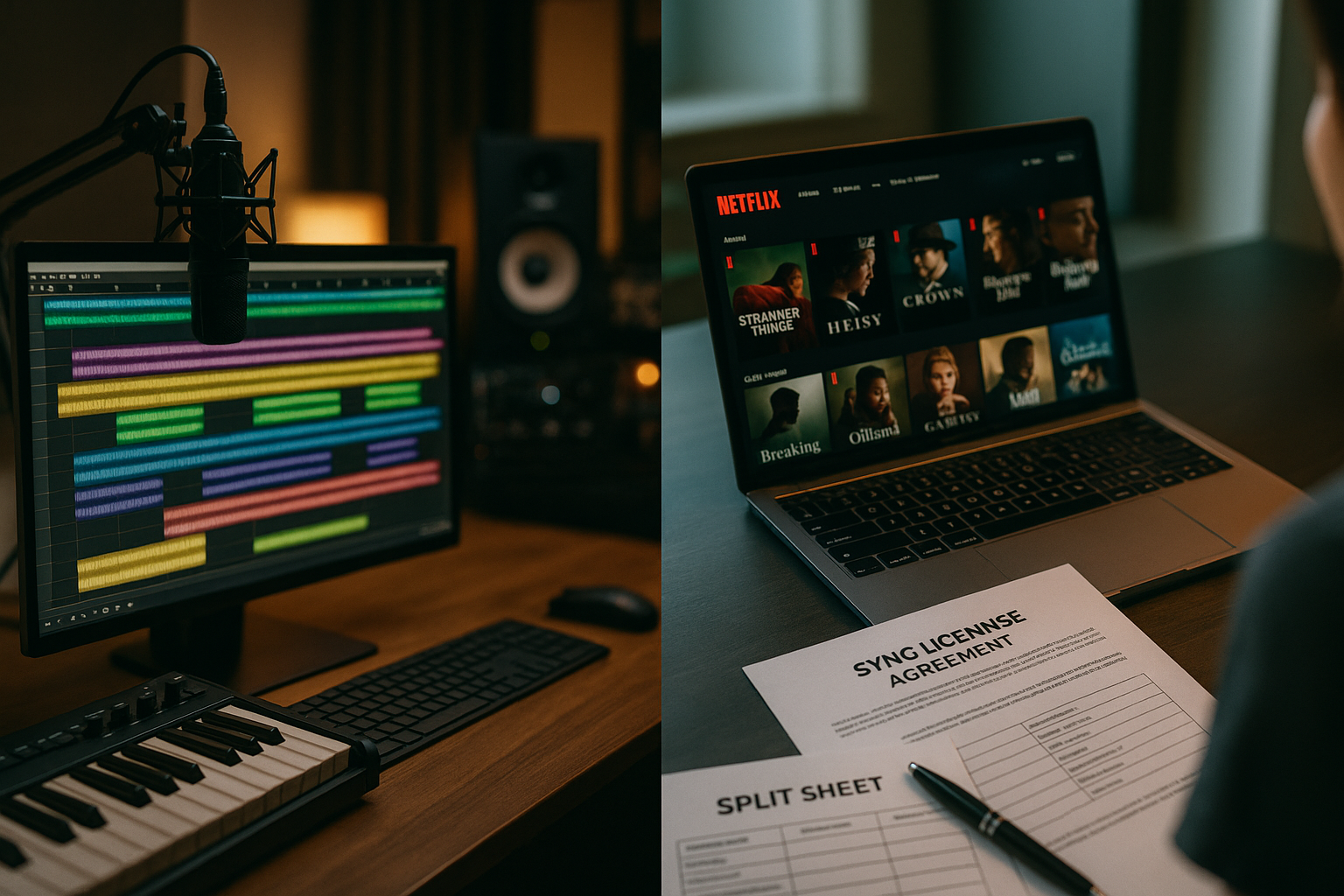
The licensing consent framework
Spotify negotiated new licenses for AI remixes instead of using old rights. That precedent forces independent artists to act now or lose control.

Key Takeaways
Spotify negotiated new AI rights with UMG because standard distribution agreements don't cover derivative music creation.
Independent artists on DistroKid, TuneCore, or CD Baby likely don't have AI-derivative consent in their contracts.
Default inclusion in AI remix features without updated terms creates infringement risk you need to address now.
Proactive negotiation means explicit opt-in consent, separate royalty tracking, and controlled revenue splits before features launch.
Spotify negotiated new licenses for AI remixes instead of using old rights. That precedent forces independent artists to act now or lose control.
On May 21, 2026, Spotify and Universal Music Group announced a licensing agreement enabling fan-created AI covers and remixes through a paid add-on for Premium subscribers. The keyword that matters: "landmark." This isn't a features announcement. It's the first major DSP to publicly admit it needs new licenses for AI-derivative music, not old ones reinterpreted.
That admission changes the legal landscape for every independent artist with music on streaming platforms.
What actually happened
Spotify negotiated explicit consent with UMG before launching AI remix features. They didn't claim their existing streaming licenses covered it. They didn't interpret broad distribution language as sufficient. They sat down and wrote new terms that specified consent, credit, and compensation for AI-derivative works.
This matters because Spotify had every incentive to avoid this negotiation. New licensing deals cost money. They slow down product launches. They create precedent that other rightsholders can point to. Spotify chose to negotiate anyway.
The reason: Their legal team concluded that existing agreements don't cover generative AI use cases. Full stop.
Why streaming is moving toward premium add-ons
The music streaming market is saturated. Western subscriber growth has stalled at 95% household penetration in the US. Platforms are shifting from "acquire subscribers" to "retain subscribers and increase ARPU" (average revenue per user).
AI-derivative music creation is a feature designed to create an additional revenue stream while deepening artist-fan relationships through creative participation. Spotify admitted in Q1 2026 earnings that AI licensing was "the only structural blocker" preventing rollout of these tools.
Translation: The tech works. The ambiguity is legal. The Spotify-UMG deal resolved that ambiguity for UMG.
Independents are now facing the same question UMG negotiated.
The licensing gap in your distribution agreement
Standard DSP distribution agreements contain broad language drafted before generative AI existed. Terms like "stream, perform, distribute, reproduce" were written to cover playback and delivery, not the creation of new derivative versions using your master and composition as source material.
Most independent artists use distributors like DistroKid, TuneCore, CD Baby, or Amuse. These agreements were templated between 2008 and 2018. None of them explicitly authorize AI-derivative creation because the technology didn't exist in commercial form when the contracts were written.
Spotify's decision to negotiate separately with UMG proves that existing language isn't sufficient. If it were, Spotify would have cited those clauses and launched the feature without new deals.
What this precedent establishes
The Spotify-UMG agreement sets three structural expectations:
- Opt-in consent is required. Platforms cannot default-include your catalogue in AI remix features without explicit permission.
- Separate tracking is necessary. AI-derivative versions must be tracked independently from the original recording for royalty purposes.
- Dedicated revenue streams apply. Revenue from AI-created versions flows through new splits, not existing mechanical or performance royalty structures.
These three components - consent, credit, compensation - are now the industry standard for AI-derivative licensing. UMG secured them. Major labels will demand them. Independents need to claim them before platforms attempt to reinterpret old agreements as sufficient.
The timing window you're in right now
Spotify's feature isn't live yet in most territories. Apple Music and Amazon Music haven't announced equivalent tools. This is the negotiation window.
Once these features launch, platforms will default to one of two positions:
- Opt-out model: Your music is included unless you manually disable it in settings.
- Silence-as-consent model: Lack of objection is treated as implicit permission.
Both models favor the platform. Neither requires explicit negotiation or updated terms.
Independent artists who act now - before features go live - force distributors and platforms to negotiate explicitly. Artists who wait until after launch are negotiating from a weaker position, often retroactively, after their music has already been used.
Who this applies to (and who it doesn't)
- This applies to:
- Artists with existing masters and compositions distributed to DSPs
- Artist-songwriters who own both master and publishing rights
- Independent artists using third-party distributors
- This does not apply to:
- Artists signed to major labels (your label negotiates with DSPs on your behalf)
- Artists who have already opted out of AI via distributor settings (if that option exists)
What to do right now
1. audit your distribution agreement
Log into your distributor dashboard. Download your full terms of service or distribution agreement. Search the document for these terms:
- AI
- Derivative
- Remix
- Generative
- Machine learning
Most agreements won't include any of these terms. That's the gap.
2. document the absence
Write a brief note for your records: "My distribution agreement with [Distributor Name] does not include explicit language permitting AI-derivative creation. I have not consented to this use case as of [Date]."
This creates a legal paper trail. If your music is later included in AI features without updated terms, this documentation supports a claim of non-consent.
3. contact your distributor directly
Send your distributor this message (adapt as needed):
"I reviewed my distribution agreement and did not find explicit language permitting AI-derivative creation (covers, remixes, or other generative uses of my master and composition). Do my existing rights grant you or streaming platforms the ability to create AI derivatives of my music? If yes, please cite the specific contract language that authorizes this. If no, I'd like to discuss adding explicit AI-derivative licensing terms to my agreement."
Force them to answer. Most distributors haven't updated their terms yet. Their response (or non-response) tells you where you stand.
4. monitor platform rollout
If Spotify, Apple Music, or Amazon Music launch AI-remix features in your territory, check whether your music is included by default or requires opt-in.
Default inclusion without updated terms is a red flag. It suggests the platform is interpreting old language as sufficient, which contradicts the Spotify-UMG precedent.
5. negotiate proactively
If your distributor admits the gap or offers to update terms, propose these three elements (based on the Spotify-UMG framework):
- Opt-in consent required: No AI-derivative use without your explicit written permission.
- Separate royalty tracking: AI-created versions tracked independently, with transparent reporting.
- Revenue share for AI-created versions: Define the split (e.g., 50/50, 60/40) and ensure it flows through your distributor account, not buried in general streaming payments.
These aren't aspirational. They're what UMG secured. Independent artists deserve the same structural protections.
Why silence is the worst move
The music industry has historically moved technology first, then litigated rights later. Napster launched, then labels sued. YouTube launched, then publishers negotiated. SoundCloud launched, then rights were cleared retroactively.
This time is different. Spotify chose to negotiate before launch. That's a structural shift. It signals that AI-derivative revenue is large enough to be worth the legal friction.
Independent artists who stay silent or assume their distributor will "figure it out" will wake up to features they didn't consent to, under terms they didn't negotiate, on revenue splits they didn't control.
The move is to act now, before the feature is live, and carve out your explicit control.
What this means for your catalogue long-term
AI-derivative rights are becoming a separable asset class. In five years, catalogue valuations will explicitly price AI-derivative potential alongside streaming revenue and sync licensing.
Artists who secure explicit consent and separate revenue tracking now are building a more valuable asset. Artists who allow their music to be included under vague legacy terms are diluting future catalogue value.
This isn't theoretical. Publishing companies are already adjusting valuation models to account for AI vulnerability. Catalogues with unclear AI rights are being discounted 10-15% in acquisition offers.
Your move is to clarify your rights now, before the market forces you to.
The bottom line
Spotify and UMG's May 2026 licensing agreement established that AI-derivative music creation requires opt-in consent, separate tracking, and dedicated revenue streams. Independent artists using third-party distributors should recognize this as both a threat and an opportunity.
The threat: Silence equals abandonment of rights.
The opportunity: Early adoption of explicit consent equals future revenue control.
Audit your agreement. Contact your distributor. Negotiate explicitly. Do it before platforms default you into terms you didn't agree to.
- Download our AI Rights Audit Checklist: 5 questions to ask your distributor, with templates for correspondence and documentation.
Ready to streamline your workflow?
Stop piecing together spreadsheets and scattered notes. Join the waitlist for Music Artist Manager and get your entire rollout in one place.
Written By
Gavin Alexander
Senior Marketeer
As the founder of Music Artist Manager, Gavin has spent years at the intersection of music and technology. Seeing firsthand how chaotic release rollouts and split sheets can be, he designed a platform that brings major-label infrastructure to independent artists and their teams. He writes extensively about industry trends, artist leverage, and workflow optimisation.