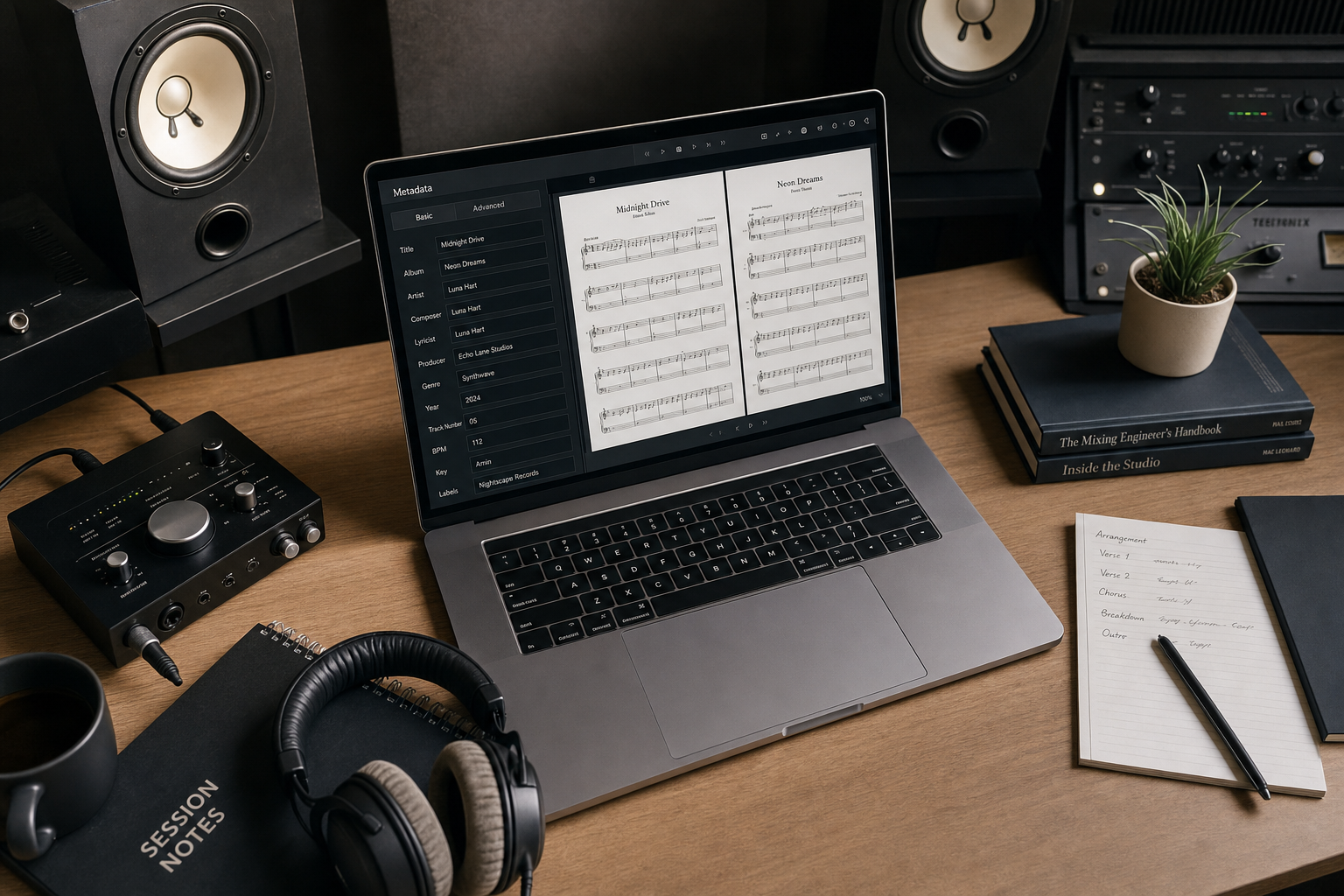
Why your masters are your best sync weapon in 2026
How owning your masters and publishing together makes you faster to license than major-label artists — and why sync supervisors are choosing independent catalogues in 2026.

Key Takeaways
Owning both your master and publishing positions you as a frictionless One-Stop sync licensing partner in 2026.
With independent music capturing over 50% of the market, supervisors actively look for unencumbered indie catalogs.
Instrumentals, clean versions, and stems must be hosted on organized, accessible download links with metadata embedded.
Leverage your administrative agility to command higher sync fees and secure lucrative backend performance royalties.
If you own both your masters and your publishing, you can license music in 24 hours. Major-label artists often wait three months. This is the structural advantage that makes independent catalogues faster to place in TV, film, advertising, and games in 2026.
In January 2026, Spotify confirmed it paid out $11 billion to rights holders in 2025. Independent artists and labels accounted for half of all royalties. Most headlines celebrated streaming parity. But the sharper story was buried beneath the surface.
Music supervisors placing tracks in TV, film, and advertising are now actively bypassing major-label catalogues in favour of independent artists. Not for artistic reasons. For speed. A supervisor working to a campaign deadline cannot wait weeks for a label's legal department to clear a track split across multiple publishers and a licensor in three territories. They need what the industry calls "one-stop clearance." A single rights holder who controls both the master recording and the underlying publishing. Independent artists who own both can say yes in 24 hours. Major-label acts often cannot say yes for three months.
This is the structural advantage that most independent artists are sitting on without realising it.
Market context
Several forces are converging in 2026.
Sync budgets are growing. TV, streaming platforms, and advertising collectively spend billions annually on music licensing. A single national TV ad placement can pay £4,000–£40,000. A streaming drama placement runs £400–£4,000 per episode.
The gaming sector is outpacing film and TV. As gaming revenue overtakes traditional screen entertainment, game studios are actively seeking licensable music from leaner, faster-moving sources.
Production timelines are compressing. Streaming series often go from greenlight to delivery in months, not years. Music supervisors cannot operate on major-label negotiation timelines.
Split-catalogue complexity is a dealbreaker. Any track where one party controls the master and a separate publisher controls the sync licence introduces friction, legal cost, and delay. Supervisors skip these tracks entirely when faster alternatives exist.
Independent artists who have retained both their masters and their publishing (or registered their own publishing entity) are structurally positioned to win these deals in a way that signed artists simply cannot replicate.
The education layer
Two rights govern every sync placement.
1. The master recording right. Who owns the actual recorded file. If you recorded and released independently, this is typically you.
2. The synchronisation (sync) right. The right to pair the composition with a visual. This belongs to the publisher of the underlying composition.
One-stop clearance means a single entity (ideally you) controls both. When a supervisor can negotiate one deal with one person who can sign off on both rights immediately, your track moves to the top of their shortlist.
What breaks one-stop status:
- Signing a publishing deal without retaining sync approval rights
- Co-writing without a signed split sheet, leaving ownership ambiguous
- Sample-based productions where a third party controls a portion of the master
- Distribution deals that include rights grabs on publishing or neighbouring rights
The 200% clearance standard: Increasingly, professional sync briefs explicitly request "200% cleared" tracks. Confirmed ownership of both master and publishing with documentation available on request. This is fast becoming table stakes, not a bonus.
Reality check (eligibility)
This advantage is only real if you have clean documentation:
- Split sheets signed with every collaborator before distribution
- Publishing registered with a PRO (PRS in the UK; ASCAP/BMI in the US)
- Your own publishing entity set up (even a simple self-publishing registration)
- No undocumented samples in the master recording
- Metadata correctly filed (ISRC, ISWC, PRO affiliation embedded in files)
If your catalogue has any of these gaps, the sync advantage evaporates the moment a supervisor requests a licence chain. This is administrative work, not creative work. But it determines whether your music is commercially deployable.
This strategy is best suited to artists with an established catalogue of five or more releasable tracks, clean splits, and no outstanding label or publishing encumbrances.
Practical action plan
**1. Audit your catalogue for one-stop status.** For every track you plan to pitch for sync: confirm you hold the master, confirm you hold the publishing, check for uncleared samples, and verify co-write splits are documented in writing.
**2. Register your self-publishing entity.** In the UK, register as a self-publishing member of PRS for Music. This costs nothing and gives you a legitimate publisher name to present on licensing paperwork. In the US, register with ASCAP or BMI and set up a simple publishing designee.
**3. Create a sync-ready folder for each track.** Include: the full-resolution WAV, a 30-second and 60-second edit, an instrumental version, a stems pack if available, the split sheet, and a one-paragraph "music supervisor brief" describing mood, tempo, and BPM.
**4. Mark your one-stop tracks clearly in your pitching materials.** In any submission to a sync library or direct supervisor contact, label qualifying tracks: "One-stop clearance available. Master and publishing held by [Artist/Entity Name]."
**5. Build a targeted sync pitch list.** Research music supervisors working on shows, games, or campaigns in genres that suit your catalogue. Tools like Syncr, SubmitHub Sync, or direct LinkedIn outreach are viable entry points. Start with mid-tier productions. Emerging streaming dramas, indie games, regional ad campaigns. Supervisors are more accessible there.
**6. Pitch proactively, not reactively.** Do not wait for a brief. Send a curated one-pager to three to five supervisors per month with your top three sync-ready tracks, flagging one-stop status and offering to provide additional formats within 24 hours.
Mindset closer
Most independent artists think about their masters as a defensive asset. Something to hold onto so a label can't take it. That framing is correct but incomplete.
Your masters and publishing, held together in clean documentation, are an offensive commercial weapon. They give you the ability to say yes to a placement opportunity in the time it takes a major-label A&R to forward an email internally. In an industry where sync supervisors are routinely operating under 48-hour deadlines, your administrative agility is worth more than your streaming numbers.
The shift from performer to CEO starts the moment you treat your catalogue as a deployable business asset, not a creative archive.
---
**Music Artist Manager's Splits and Tracks tools helps you document master and publishing ownership across your entire catalogue, track split sheet status, and generate sync-ready track packages.** So you're always 24 hours away from saying yes to a placement.
---
**
Related Reading:
Ready to streamline your workflow?
Stop piecing together spreadsheets and scattered notes. Join the waitlist for Music Artist Manager and get your entire rollout in one place.
Written By
Gavin Alexander
Senior Marketeer
As the founder of Music Artist Manager, Gavin has spent years at the intersection of music and technology. Seeing firsthand how chaotic release rollouts and split sheets can be, he designed a platform that brings major-label infrastructure to independent artists and their teams. He writes extensively about industry trends, artist leverage, and workflow optimisation.