The Pro-Rata model is broken: How independent artists can exploit the shift to User-Centric payouts
Why the pro-rata streaming model punishes independent artists, how fan-centric payouts work, and which platforms to prioritise now.

Key Takeaways
Pro-rata streaming subsidises superstar plays with your revenue, and the model wasn't built for 250 million tracks.
Fan-centric platforms like Deezer pay 3x to 5x higher per stream because only your listeners' payments count.
AI-generated content now makes up 40% of annual uploads, directly diluting every artist's per-stream payout.
Moving 20% of your audience to fan-centric DSPs within 12 months creates measurable revenue uplift without scale.
The pro-rata model is broken. Here's how independent artists can exploit the shift to user-centric payouts.
Your Spotify payouts are being subsidized by superstars' streams. The pro-rata model that governs 90% of streaming revenue wasn't designed for a world where 250 million tracks compete for the same royalty pool. Here's what's changing, and how to position yourself to benefit.
The math doesn't work anymore
Spotify paid out $22 billion in 2025 using the pro-rata model. A mid-tier artist with 1 million monthly listeners earns roughly $0.002–$0.005 per stream. Deezer, using a fan-centric model, pays $0.007–$0.01 per stream to the same artist. Why? Because the pool is smaller and only Deezer subscribers who actually listened contribute.
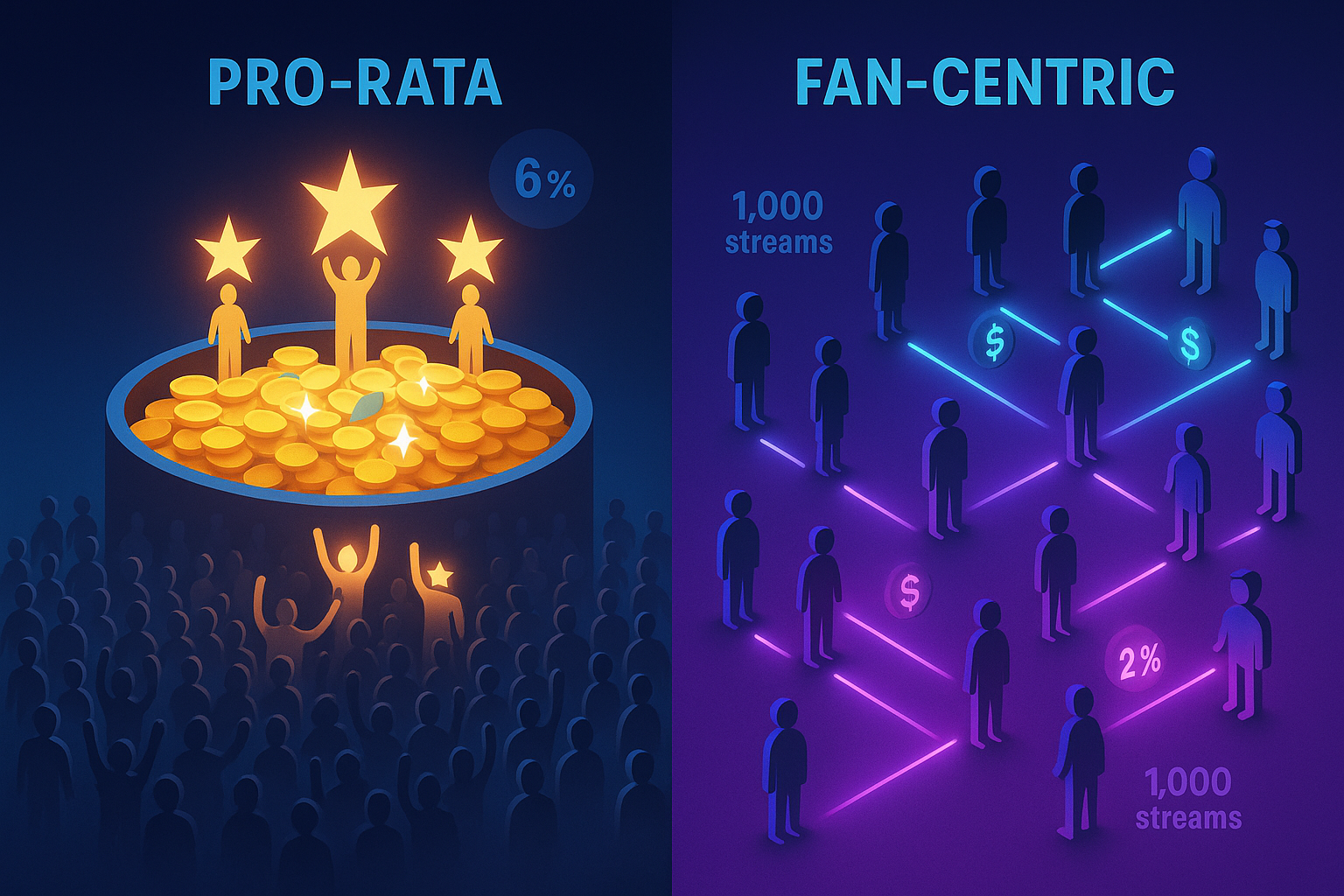
Pro-rata pools all subscription revenue and distributes it by overall platform streaming share. This made sense when Spotify had 10 million tracks. Today, with 250+ million tracks on the platform, pro-rata has become a wealth-transfer mechanism. Superstar streams subsidize volume plays. An AI-generated lo-fi beat gets paid the same micro-fraction as a Taylor Swift track, because both compete in the same pool.
The result: pro-rata economically incentivizes scale over quality, and rewards whale artists while starving the middle class.
The industry is moving
MIDiA Research's 2024 independent label survey found that 75% of independent labels agree "it is time for a new model to run alongside streaming." More than 50% said outright that "streaming is not a place to build artist fandom."
Platforms are responding. Deezer (France), SoundCloud (niche), Tidal (premium), and new entrants like Lutely (2026 launch) are all testing fan-centric models. This is not niche experimentation. It's the future architecture.
The EU's digital regulation and France's Centre National de la Musique (CNM) studies are putting structural pressure on major DSPs to reconsider the pro-rata model. Meanwhile, AI-generated tracks (estimated 40% of Spotify's annual uploads in 2025) are diluting the pro-rata pool. This directly reduces per-stream payouts for human artists.
How fan-centric models work
Under a fan-centric model, only your subscribers' payments count toward your payout. If a listener pays $10/month and only listens to you, you get their full $10 (minus platform cut). Under pro-rata, that same $10 gets pooled with everyone else's subscription fees, and you get a fraction based on your share of total platform streams.
The payout difference is 5–10x higher per stream on fan-centric platforms for artists with dedicated listener bases.
Current DSP breakdown:
- Spotify & Apple Music: pro-rata
- Deezer: fan-centric
- Tidal: partial hybrid
- Emerging platforms: mixed models, trending fan-centric
Who this applies to
This strategy works if you're:
- An artist with 10k–1M monthly listeners (enough to matter on alternate DSPs, but small enough that higher per-stream rates equal real revenue)
- Not dependent on mainstream playlist placement (because alternate DSPs have smaller listener bases)
- Willing to actively push fans to alternate platforms or incentivize secondary platform listens
- Managing a diverse catalog (easier to reach payout thresholds on smaller platforms)
This does not apply if you're:
- An artist with <5k monthly listeners (volumes too small to move the needle on any platform)
- 100% dependent on TikTok/YouTube virality funneling to Spotify (can't force platform loyalty)
- A signed artist whose label contract dictates DSP strategy and payout distribution
Six moves to make now
1. Calculate your current pro-rata tax
Multiply your annual Spotify streams by $0.003. Then multiply by 0.2. You're likely in the 20% paying for the 80%. That's your annual payout reduction due to pro-rata concentration.
2. Audit your current DSP mix
Categorize your monthly streams by platform: Spotify, Apple Music, YouTube Music, TikTok, and "other." If "other" is <10%, you're overexposed to pro-rata systems.
3. Set a target for fan-centric platform growth
Pick 2–3 emerging platforms (Deezer, Tidal, Lutely when it launches, or regional players). Goal: move 20% of your listener base to those platforms within 12 months.
4. Create platform-specific incentives
Exclusive early releases on Deezer or Tidal. Behind-the-scenes content. Special pricing for annual subscriptions to fan-centric platforms. Don't be shy about asking fans to follow you everywhere.
5. Track payout differential
For the next 6–12 months, log your monthly per-stream rate on each platform. Calculate the premium you're earning on fan-centric platforms vs. pro-rata. Use this data to inform your distribution strategy.
6. Prepare for platform shifts
As new entrants (Lutely, etc.) launch and gain traction, prioritize them. The early adopter advantage is significant. Get fans on the platform early, and you'll see higher growth rates due to reduced competition in the catalog.
The shift is structural
The pro-rata model was designed for scarcity and is now governing abundance. Streaming platforms are in a structural race to find the next payout model before creators abandon them.
As an independent artist, you have leverage. Your attention can follow the platforms that pay fairly. The platforms investing in fan-centric models are signaling that they want artists like you. Go where you're valued.
Download the MAM Streaming Platform Comparison Matrix: per-stream payouts, payout timelines, and audience size by DSP. Includes: strategies for optimizing your presence on fan-centric platforms, and a 6-month growth roadmap.
Sources:
- "Music Streaming Must Switch to a Fair and Logical Payout Model. There Is No Time to Lose." — Music Business Worldwide
- "What Is the Value of a Stream in 2025?" (MIDiA Independent Label Survey) — MIDiA Research
- "Fan Centric vs Pro Rata: The Battle Over How Streaming Royalties Are Distributed" — Streaming Calculator
Ready to streamline your workflow?
Stop piecing together spreadsheets and scattered notes. Join the waitlist for Music Artist Manager and get your entire rollout in one place.
Written By
Gavin Alexander
Senior Marketeer
As the founder of Music Artist Manager, Gavin has spent years at the intersection of music and technology. Seeing firsthand how chaotic release rollouts and split sheets can be, he designed a platform that brings major-label infrastructure to independent artists and their teams. He writes extensively about industry trends, artist leverage, and workflow optimisation.