Why streaming will never discover your music (and what smart artists do instead)
Learn why streaming algorithms favour catalogue over discovery, and how smart artists build direct fan infrastructure instead of waiting for playlist placement.
Key Takeaways
Streaming solves distribution, not discovery — your upload is global, but that doesn't mean anyone will find it.
Direct fan channels compound in value; streaming numbers are a lagging indicator of audience health, not a leading one.
An engaged 1,200-person email list outperforms 50,000 monthly listeners with no direct relationship in every business scenario.
Back catalogue only grows in value when your own community resurfaces it — algorithms don't do this for independent artists.
Streaming platforms upload over 100,000 tracks per day, and listeners are retreating to catalogue they already know. If you are treating Spotify as your discovery strategy, you are competing in a broken system. This piece shows you how to build direct fan infrastructure instead, and why that is the only leverage that compounds over time.
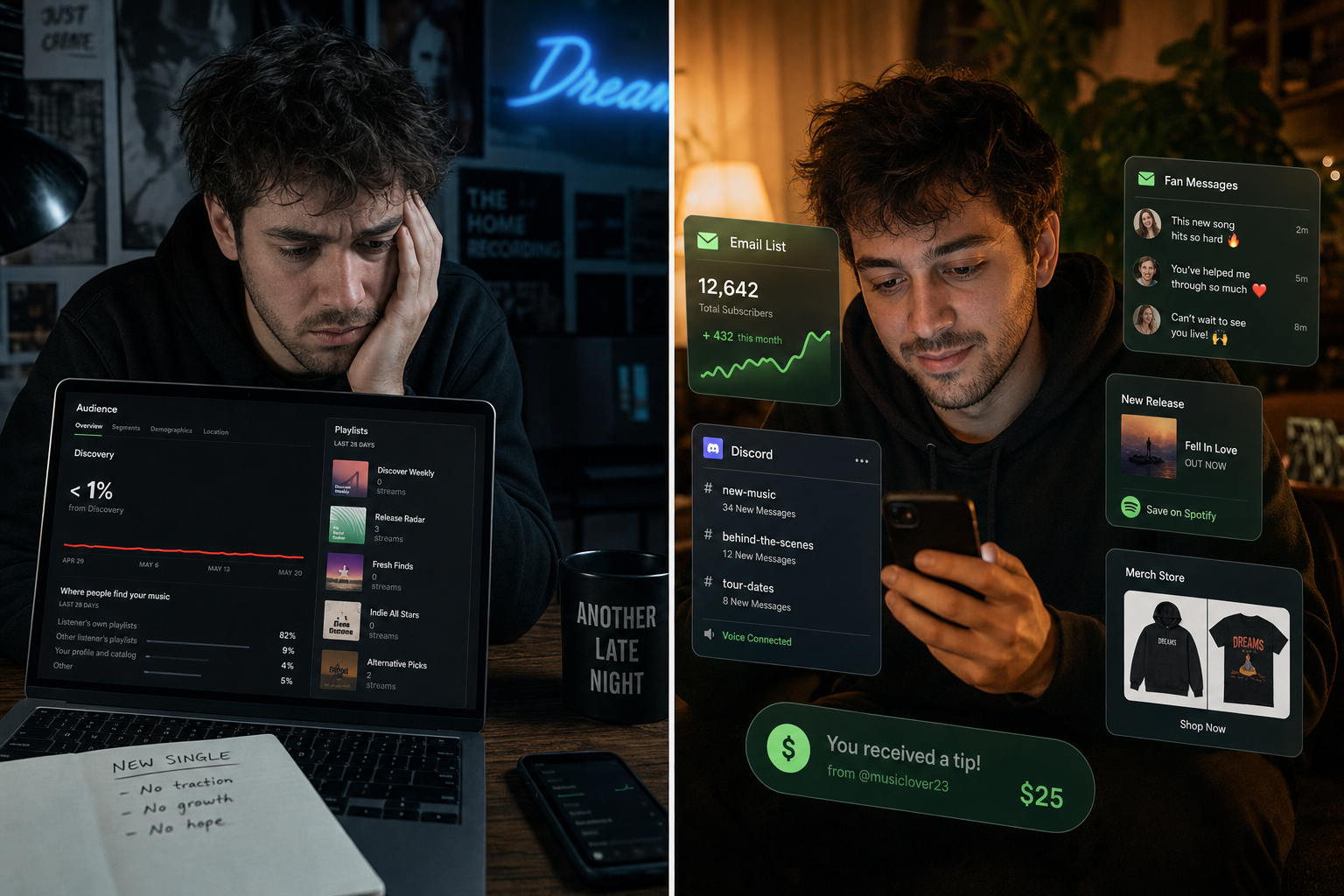
In 2026, one of the biggest streaming hits is Zara Larsson's "Lush Life." A song released in 2015. Meanwhile, the BBC reports that over 100,000 new songs are submitted to streaming services every single day. The maths is brutal: if you release a track this week, it enters a queue of 36.5 million new songs per year competing for a finite amount of listener attention. And algorithms increasingly favour proven catalogue over new discovery. Streaming platforms have quietly become libraries, not launchpads.
The discovery crisis is structural, not temporary
The discovery mechanism most independent artists have been counting on — algorithmic playlist placement, Discover Weekly, Release Radar — is structurally overwhelmed. Platform operators know this. Apple Music and Spotify are doubling down on editorial and social signals (saves, shares, playlist adds) as discovery gatekeepers. This concentrates visibility among artists who already have audiences.
Simultaneously, listeners are retreating to nostalgia and comfort. Catalogue listening is outpacing new music consumption across all demographics. For an emerging independent artist in 2026, "upload and wait" is not a strategy. It is an abdication.
What most artists misunderstand about streaming
Discovery and distribution are two entirely different problems. Streaming solves distribution. Your music is available globally the moment you upload it. It does not solve discovery. Whether anyone actually finds it. Independent artists routinely conflate the two and invest all their energy into release quality while neglecting the audience infrastructure that drives discovery.
Troy Carter — who managed Lady Gaga from her MySpace era — built his management philosophy around treating direct fan access as the primary asset. In Carter's model, the streaming page is the endpoint, not the start. The fan community (email list, Discord, SMS list, Substack, Patreon) is the engine that sends people there. Every time that community grows, the artist's streaming numbers become more predictable and more defensible.
An artist's catalogue only compounds in value if there are fans periodically rediscovering it. That rediscovery does not happen algorithmically for most independent artists. It happens when the artist's own channels surface old work to new fans. This is exactly what the Zara Larsson phenomenon illustrates, but at a label scale. Major labels re-promote catalogue actively. Independent artists need a system to do the same.
Who this strategy is for
This strategy is for artists who have released at least 3–5 tracks and have some existing listenership (even small). Artists who are willing to treat audience-building as a weekly operational discipline, not a one-time campaign. Artists who understand that building a 2,000-person engaged email list takes 6–18 months of consistent effort.
This is not for artists expecting rapid results without consistent community engagement. Or artists who view social media presence as separate from their music business. It is not.
How to build audience infrastructure that compounds
Audit your current fan touchpoints. List every direct channel you own: email list, SMS, Discord, Patreon, newsletter. If you have none, start with one. Email is the most defensible.
Set a community growth KPI, not just a stream target. Replace "I want 10,000 monthly Spotify listeners" with "I want 1,000 email subscribers by Q1 2027." Direct contacts convert to streams. Streams do not convert to direct contacts.
Create a back-catalogue surfacing schedule. Every month, re-promote one older track through your direct channels with a new context. A story behind the song, a live performance clip, a collab announcement. This is how catalogue compounds.
Build your "entry point" asset. Create one high-value free resource (a sample pack, a behind-the-scenes PDF, early access to unreleased demos) that converts social followers to email subscribers. Promote it consistently.
Track conversion, not just plays. Measure how many fans move from streaming to a direct channel each month. This is the metric your manager should be tracking.
Treat each release as a community recruitment event. Every song launch should have a "join the inner circle" call to action, not just a Spotify link. Your goal is to convert new listeners into direct contacts before the algorithm forgets about them.
The mindset shift that matters
Streaming numbers are a lagging indicator of audience health, not a leading one. An artist who treats their 1,200-person email list as their most valuable business asset — more valuable than 50,000 monthly listeners with no direct relationship — thinks like a CEO. Their revenue is more predictable. Their release campaigns are more effective. Their deal leverage is real and quantifiable.
The discovery crisis on streaming platforms is not a problem to solve. It is a signal to build differently.
Use Music Artist Manager's Fan Touchpoint Tracker to map every direct channel you own, set monthly growth targets, and see how your community converts to streaming and revenue — all in one place.
Ready to plan your next release?
Stop piecing together spreadsheets and scattered notes. Get your free release strategy and keep your whole rollout in one place.
Written By
Gavin Alexander
Senior Marketeer
As the founder of Music Artist Manager, Gavin has spent years at the intersection of music and technology. Seeing firsthand how chaotic release rollouts and split sheets can be, he designed a platform that brings major-label infrastructure to independent artists and their teams. He writes extensively about industry trends, artist leverage, and workflow optimisation.