Deploying specialist management tools across your artist workflow
Eight specialist managers, one platform, and the prompting habit that turns your project data into a precise release plan.
Key Takeaways
Eight specialist managers replace the one-size-fits-all chatbot that never actually fits.
Specific prompts with real numbers and deadlines get specific answers, not recycled advice.
The Equity Advocate and Contract Lens help with money and agreements before they become problems.
Read Aloud turns a strategy reply into something you can take in on the move, not just at a desk.
Generic advice is built for nobody. Music Artist Manager gives you eight specialist managers who work on your project, each one working from your real data, your budget and your timeline. Here's what that means for how you manage a release.
Most artists open a chatbot and type something like: "what should I do for my release?"
What comes back is generic. It could apply to any artist, in any genre, at any stage. It wasn't written for you. It was written for everyone, which means it was written for no one.
That's the problem with using a general-purpose chatbot to manage a music career. It doesn't know your budget. It doesn't know your timeline. It doesn't know whether you're six weeks out from a single or three months into a touring cycle. It's pulling from the internet, not from your actual project.
Music Artist Manager works differently.
Your managers read your project first
Before your managers answer anything, they work from your real data: your goals, your budget, your genre, your onboarding answers and your history inside the platform.
It doesn't improvise. It reads the brief before it speaks.
And because the work you do as an independent artist isn't one-dimensional, your managers aren't either.
Meet your managers
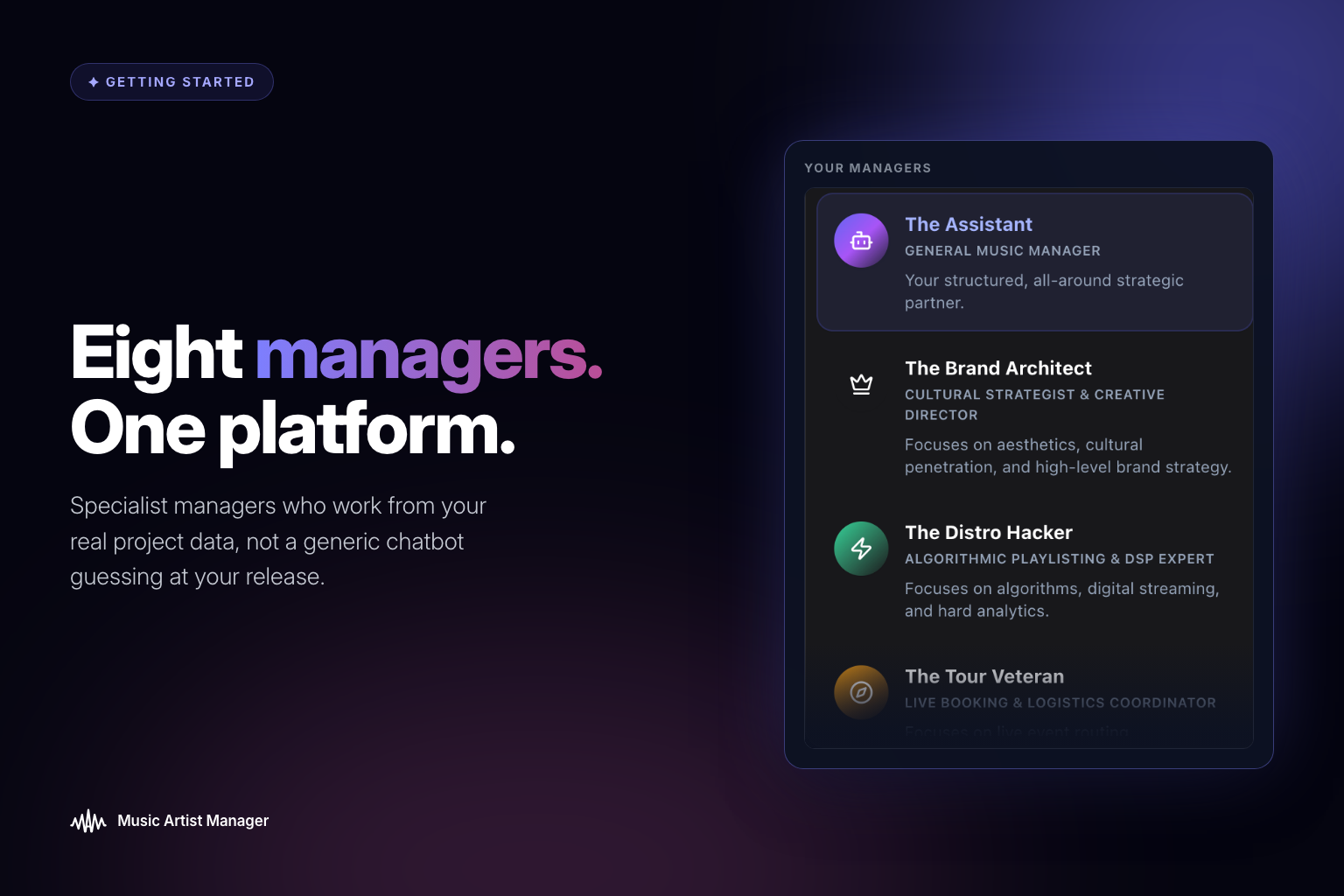
Inside Manager chat, you don't get one assistant trying to do everything. You get eight specialist managers. Each one has a defined lane, and each one stays in it.
Here's who they are and what they handle:
The Assistant handles general operations, admin and task management. Use it when you need a broad view of where things stand, or want to think through your next move across several areas at once.
The Brand Architect works on visual identity, positioning and brand consistency. When your look is drifting or you need to sharpen how you show up across platforms, start here.
The Distro Hacker focuses on distribution strategy, DSP tactics and getting the most from streaming: release windows, platform sequencing and playlist positioning.
The Tour Veteran covers live performance, logistics and booking strategy. From support slots to routing decisions, it thinks in miles and margins.
The Content Strategist handles content planning, social media and audience building. When it suggests a plan, you can add the tasks straight into your project with "Add to Tasks", so your content plan doesn't stay stuck in a chat window.
The A&R Architect focuses on artist development, signing strategy and repertoire planning. If you're thinking about how your catalogue is growing, or what a label conversation might look like, start here.
The Equity Advocate covers splits, royalties and financial structuring, so you understand how deals are usually put together before you agree to one.
The Contract Lens reviews agreements and flags key clauses before you walk into a meeting. It gives you a plain-language preparation summary, so you arrive informed and ready to ask the right questions. It isn't legal advice and doesn't replace your solicitor. It makes the time you spend with your solicitor sharper.
The rule is simple. Use The Assistant when you want a broad view. Switch to a specialist when the work is specific.
How you ask makes a real difference
Your managers work from your actual project data. A specific question with a real deadline, a real number and a real goal gets a specific answer.
A vague question gets a vague answer, even with all that context available.
Here's the difference in practice.
Weak: "What should I do for my release?"
Strong: "My single drops in six weeks. I'm at 1,200 Instagram followers and need playlist positioning. What are my top moves?"
The second question gives your manager a deadline, a real follower count and a clear goal, so it gets back a specific plan. The first gets advice you could have found anywhere.
Bring a number. Name the goal. Give it a timeline. That habit turns Manager chat into a working tool instead of a conversation.
Strategy you can listen to, not just read
Every reply in Manager chat has a Read Aloud button. One tap and the full reply plays back.
That matters because you're not always at a desk. You're driving to a session, packing merch or loading in for a show. Read Aloud means you can take in a strategy reply in the pockets of time your schedule already has.
The work doesn't wait for a screen. Neither should your planning.
Stop asking one assistant to be everything
One assistant trying to handle your distribution, your brand, your contracts, your content and your live career at the same time isn't a manager. It's a guess.
Manager chat gives you specialists. Each one knows its lane, and each one works from your real project data, not a template.
Bring that data. Pick the right specialist. Ask a specific question.
That's how you get a specific answer.
Open your Music Artist Manager dashboard, pick the specialist that matches what you need today, and bring your real project data to the conversation.
Ready to plan your next release?
Stop piecing together spreadsheets and scattered notes. Get your free release strategy and keep your whole rollout in one place.
Written By
Gavin Alexander
Senior Marketeer
As the founder of Music Artist Manager, Gavin has spent years at the intersection of music and technology. Seeing firsthand how chaotic release rollouts and split sheets can be, he designed a platform that brings major-label infrastructure to independent artists and their teams. He writes extensively about industry trends, artist leverage, and workflow optimisation.