Protecting artist earnings with live touring revenue
Where artist money actually comes from, why live pays better than streaming, and how bad admin kills your margin.

Key Takeaways
Artists take home $6 to $7 of every $10 spent on live shows.
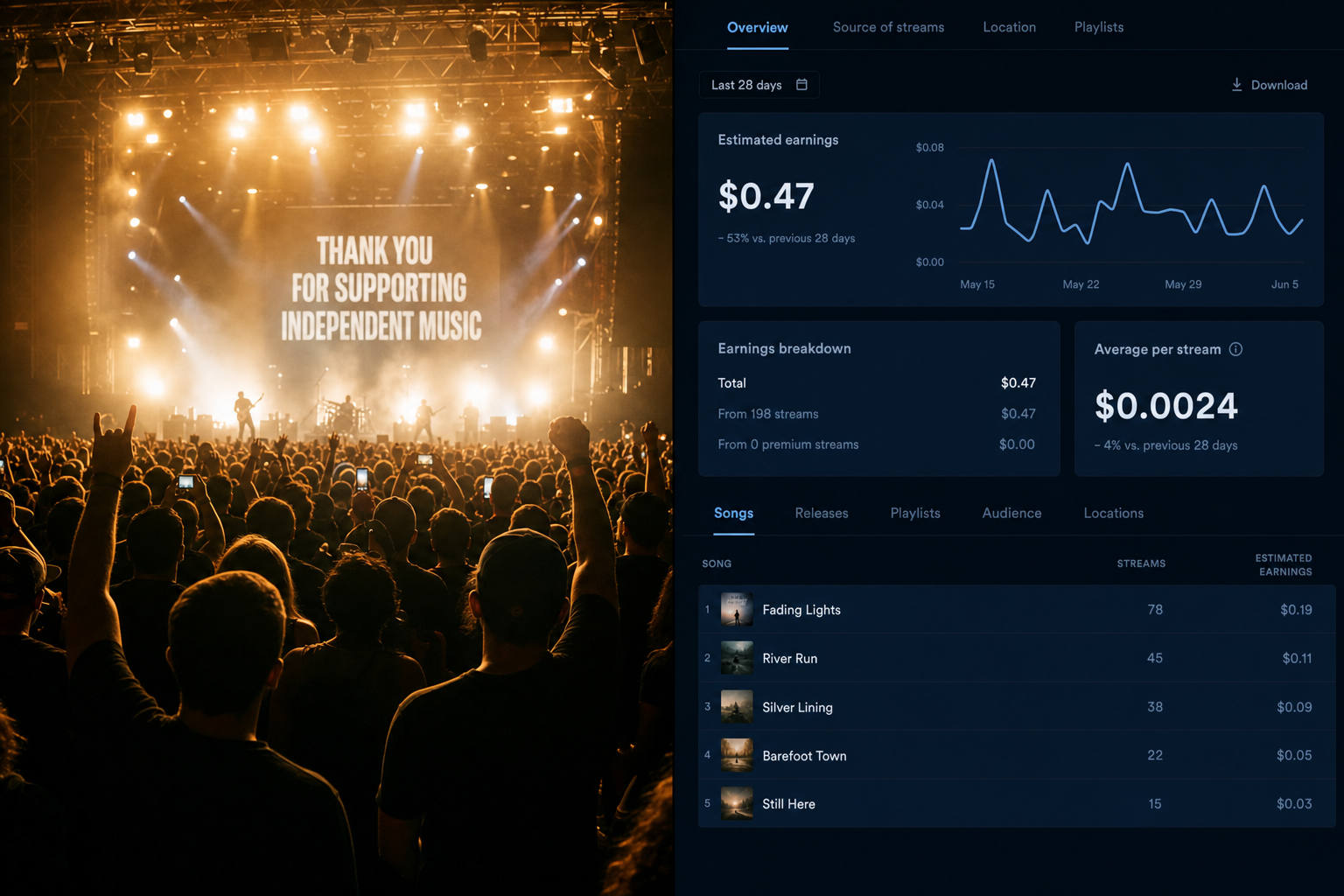
Streaming pays fractions of pennies while live music puts most revenue directly in your pocket.
Live recovered faster than expected post-pandemic, hitting 94% of 2019 levels by mid-2022.
Most artists lose money on live because the admin side, bookings and invoicing, eats their time.
Artists take home $6–7 of every $10 spent on live music. That's the highest revenue share in the industry, and it's not close. This post breaks down where your money actually comes from, why live still dominates, and where most artists lose it on the operational side.
While digital distribution promises global reach, the actual monetisation of your recorded catalogue remains a game of extreme scale. To build a resilient business, artist managers must look to the physical stage, where the direct revenue share between the venue and the performer remains the single highest margin opportunity in the music industry—provided you can successfully navigate the administrative drag that quietly drains your touring profits.
In live music, artists capture $6 to $7 of every $10 spent. That's a 60 to 70% direct revenue share. Streaming pays fractions of a penny per play. Sync licensing is unpredictable. Merch has margin but requires inventory management and upfront costs.
Live puts the majority of the ticket in your pocket.
The revenue breakdown: What the numbers actually say
Goldman Sachs revised its 2022 live music forecasts upward by 5% in their June report. Post-pandemic recovery moved faster than expected. By mid-2022, live revenues hit 94% of 2019 levels.
Here's how artist revenue typically breaks down across formats:
Streaming:
- Spotify pays $0.003 to $0.005 per stream
- You need 250,000 streams to make roughly $1,000
- Revenue splits with distributors, labels (if applicable), producers, and co-writers
- Payment cycles run 60 to 90 days behind
Sync licensing:
- One placement can pay $5,000 to $50,000+
- Highly competitive and relationship-dependent
- Inconsistent pipeline unless you have a dedicated sync agent
- Best for catalogue artists with volume
Merchandise:
- Margins range from 30% to 60% depending on production and fulfillment
- Requires upfront capital and inventory risk
- Works best when paired with live events or strong community engagement
Live performance:
- Artists keep 60% to 70% of ticket revenue on average
- Additional income from merch sales at shows, VIP packages, meet-and-greets
- Direct relationship with your audience
- Immediate cash flow
Live is not just the highest margin format. It's the most reliable one.
Why live remains the most powerful format for independent artists
Streaming rewards scale. You need millions of plays to generate meaningful income. Sync rewards luck and relationships. Merch rewards brand strength.
Live rewards show-up and execution.
You don't need a viral TikTok to sell 200 tickets in your city. You need a local fanbase, a venue relationship, and a professional approach to booking and promotion.
The economic model is simple. A $20 ticket at a 150-capacity venue grosses $3,000. If you're keeping $6 to $7 per ticket, you walk with $1,800 to $2,100 for one night. Add merch sales and you can clear $2,500+.
That's more than most independent artists make from a year of streaming.
The challenge is not the revenue potential. The challenge is managing the operational mess that comes with it.
Where artists lose time and money: The live pipeline breakdown
Most artists treat live performance as a creative priority but an administrative afterthought. That's where the money leaks.
Here's where it falls apart:
Booking:
- Email threads with venue bookers that go nowhere
- No centralized system to track inquiries, confirmations, or rider requirements
- Last-minute scrambles to confirm load-in times, soundcheck windows, and payment terms
Invoicing:
- Waiting 30, 60, or 90 days to get paid because you didn't send an invoice on time
- Venues that "forgot" to process payment because there's no paper trail
- Missing out on deposits because you didn't formalize terms upfront
Logistics:
- Travel and accommodation booked too late, costing 2x what it should
- Bandmates or crew asking the same questions because details weren't documented
- Day-of chaos because no one confirmed the tech rider or stage plot
This is not creative work. This is administrative drag. And it costs you real money.
How a music artist manager fixes the operational side of live
Music Artist Manager built Helicopter Admin and invoicing specifically to close these gaps.
Helicopter Admin gives you a centralized workspace to manage every detail of your live pipeline:
- Track bookings, venue contacts, and contract terms in one place
- Document rider requirements, stage plots, and load-in schedules
- Share updates with your team so everyone has the information they need
Invoicing tools help you get paid faster and protect your revenue:
- Generate professional invoices in minutes
- Set payment terms upfront and track what's outstanding
- Send reminders automatically so you don't have to chase venues manually
These are not flashy features. They are operational fixes that prevent the most common ways artists lose time and money in live performance.
Live is already your highest-margin format. The question is whether you're set up to capture all of it.
What to do next
If you're booking shows but not tracking contracts, payment terms, and logistics in a centralized system, you're leaving money on the table.
Maximising your live performance revenues requires moving beyond chaotic email threads and paper receipts. By integrating your tour operations with the Music Artist Manager Expenses ledger Optimiser and the automated Music Artist Manager Invoicing Portal, you can instantly centralise your booking contracts, formalise deposit structures, and ensure that promoter settlement figures match your projections down to the final pence.
Log in to your Music Artist Manager dashboard today to access the Expenses ledger Optimiser, generate your next venue invoice in under sixty seconds, and secure the true value of your performance before you even load in.
Related Reading:
- https://www.musicartistmanager.com/about
Ready to streamline your workflow?
Stop piecing together spreadsheets and scattered notes. Join the waitlist for Music Artist Manager and get your entire rollout in one place.
Written By
Gavin Alexander
Senior Marketeer
As the founder of Music Artist Manager, Gavin has spent years at the intersection of music and technology. Seeing firsthand how chaotic release rollouts and split sheets can be, he designed a platform that brings major-label infrastructure to independent artists and their teams. He writes extensively about industry trends, artist leverage, and workflow optimisation.