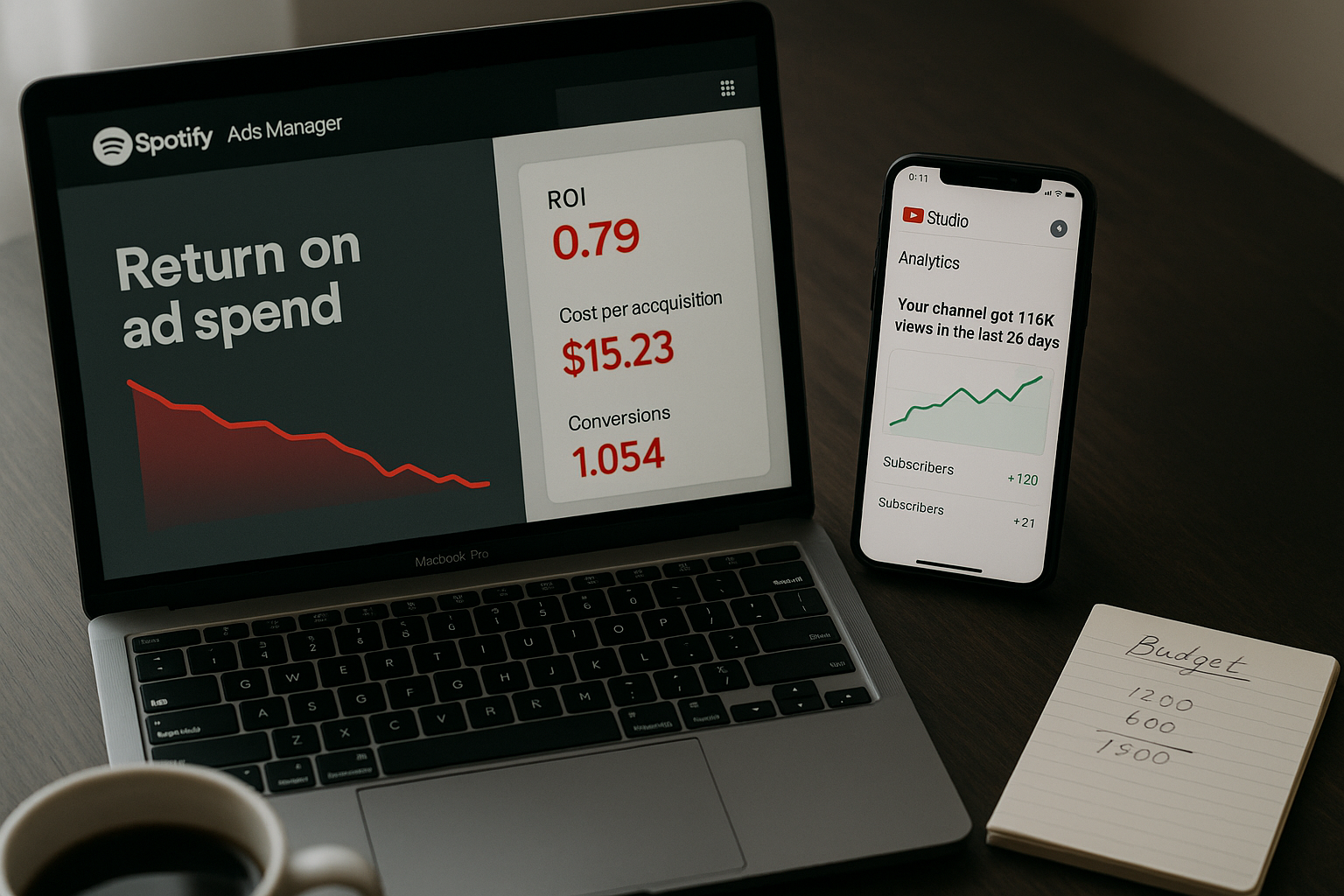
How the TIDAL and symphonic AI split determines your future royalties
TIDAL cut royalties for AI tracks. Symphonic launched transparent tracking. One protects platforms, one gives artists leverage. Here's what changed.

Key Takeaways
TIDAL cut royalties on AI music in June 2026, then Symphonic launched tracking tools in July.
For the first time, artists can see when AI platforms use their work to train models.
Fingerprinting tech now logs which human recordings influenced each AI-generated track, creating a payment trail.
The power shift isn't about stopping AI, it's about artists getting visibility and compensation when it happens.
On 15 July 2026, TIDAL draw a hard line in the streaming landscape by completely cutting royalty payouts for fully AI-generated music. Just five days later, on 20 July 2026, Sureel AI and Symphonic Distribution launched their 'Fair AI' initiative, establishing an alternative tracking protocol to trace and pay creators whose records train machine models. These two events colliding in the same month have forced independent artist managers into a critical, high-stakes decision: watch your assets get harvested in silence, or secure a technical seat at the commercial negotiation table.
Consider the typical manager's morning: you open your quarterly statement only to find your streaming revenues flatlining while synthetic clones of your artist's signature vocal timbre rack up millions of untraceable plays on secondary platforms. The existential threat in 2026 is no longer whether generative models will ingest your master recordings—it is whether you have the technical framework in place to track that consumption and claim your rightful share of the licensing pool.
The market context you need to understand
AI music generation is a $1B+ market in 2026. It runs on training data. That training data is sampled from millions of recordings without explicit permission. This is a legal gray area actively being litigated. Suno, Udio, and others face lawsuits from major labels, the RIAA, and individual artists.
But licensing is a separate question. When an AI tool uses a real artist's work to inform a generated track, that use should be trackable. That use should be compensable.
Until July 2026, it wasn't. AI platforms generated music inspired by training data with no logging of what influenced each output. The artist whose voice, songwriting style, or production texture shaped the AI's generation had no idea, no receipt, and no way to negotiate compensation.
TIDAL's move: Platform gatekeeping
TIDAL's demonetization of fully AI-generated tracks is a defensive play. It says: "We will not pay artists for 100% machine-generated content." The policy is clear, enforceable, and protects TIDAL's payout structure. But it doesn't help the artist whose work trained the AI.
Symphonic's move: Artist visibility
Sureel AI + Symphonic's transparent tracking and compensation system is an artist tool. It's opt-in, meaning artists on Symphonic's platform can choose to participate in AI use tracking. When their music is identified as part of an AI-generated output (via fingerprinting), they get a slice of the licensing deal. For the first time, artists have visibility into how their work feeds AI systems and a lever to monetize that visibility.
This is the power axis: Is the artist in the room when AI licensing conversations happen, or are they invisible?
How AI use tracking actually works
Audio fingerprinting (the same tech Shazam uses) identifies when a human-recorded song appears in another recording, including AI-generated content. When an AI platform generates music, a fingerprinting service scans the output and identifies the human recordings that influenced it. That fingerprint creates a log: "This AI track used elements of Artist X's song Y." With that log, licensing can be negotiated.
Who pays?
In the Sureel AI model:
- The AI platform (or the user of the AI tool) needs a license to use the source artist's work in training or generation
- That license fee flows through a rights organization (similar to how sync licenses work)
- The rights organization distributes the fee to the rights holders: the artist, the publisher, the label (whoever owns what)
Why symphonic, not all platforms?
Symphonic is an independent distributor serving indie artists. Their business model benefits from giving artists more leverage. A major label's distributor (Universal, Sony, Kobalt) has different incentives. They benefit from opacity because it allows them to negotiate AI deals at the platform level and keep the details away from individual artists.
Independent distributors like Symphonic are racing to offer transparency-as-a-service. That's what their artist customers want and what major distributors won't provide.
What about TIDAL's demonetization?
TIDAL is saying: "We pay humans. If the music was made by a machine, we don't." That's philosophically defensible (TIDAL markets itself as the artist-friendly platform) but economically weird. A fully AI-generated track using training data from human recordings is creating value somewhere. TIDAL is just refusing to pay into that value chain.
The policy affects the artist whose work trained the AI less than the artist trying to release AI-generated music. But the principle is clear: platform gatekeeping.
Who this affects (and who it doesn't)
Symphonic's Fair AI tracking applies to you if:
- You're a Symphonic Distribution client (artist or label distributing music through Symphonic)
- Your music has Spotify/Apple/YouTube presence (requires fingerprint matching)
- You opt into the tracking program (it's voluntary, not automatic)
- You release music that stays within human-recorded bounds (fully machine-generated tracks don't participate)
TIDAL's demonetization affects you if:
- You release fully AI-generated tracks to TIDAL
- You're looking to monetize AI music on streaming platforms generally (TIDAL's policy is aggressive; others like Spotify and Apple are less restrictive, but the trend is toward platform gating)
The reality
Symphonic's tool gives visibility. It doesn't change economics overnight. The licensing fees for AI use of training data are still being negotiated. There's no standard rate card yet. But for the first time, there is a mechanism to track and compensate. That mechanism is the leverage point.
TIDAL's policy is a moat. It protects TIDAL's artist-first brand. But it doesn't extend to all platforms, so its effect is limited. What matters more is what other platforms do. If Apple, Spotify, and YouTube follow TIDAL, fully AI-generated music becomes economically unviable on streaming. If they don't, TIDAL becomes the exception.
Your action plan
For independent artists concerned about AI use of your work:
Step 1: Register your master recording and songwriting (1 hour)
Master: Ensure your distributor has your recording registered with a sound recording rights org (SoundExchange in the US, PPL in the UK, etc.)
Songwriting: Register with your local performing rights organization (ASCAP, BMI, SESAC in the US) and mechanical rights org (MRI, HFA, or Harry Fox Agency)
Why: Without registration, the tracking data has nowhere to route the compensation. You'll have visibility but no payment mechanism.
Step 2: If you're on symphonic, opt into fair AI tracking
- Log into your Symphonic artist dashboard
- Navigate to "Rights & Earnings" (or the equivalent)
- Enable "AI Use Tracking & Compensation"
- Your music is now fingerprinted in the system
Step 3: If you release AI-generated music, understand platform policies
- TIDAL: Demonetized (royalty-free tier only)
- Spotify: Allowed, but flagged; human-made music preferred in curation
- Apple Music: Allowed with proper disclosure
- YouTube: Policy varies by country; check locally
Best practice: Disclose AI generation in your metadata. Listeners and platforms are increasingly skeptical of undisclosed AI content.
Step 4: Monitor your dashboard quarterly
Symphonic (if enrolled): Check for AI use tracking reports. Look for unexpected fingerprint matches. These might indicate training data use you weren't aware of.
SoundExchange (US master recordings): Quarterly reports will eventually include "AI licensing" as a separate line item (not live yet as of Aug 2026, but coming).
Step 5: If you get an offer to license your music to an AI training dataset, negotiate aggressively
Now that tracking exists, you have proof of value. The AI platform will tell you: "We trained on 100k human recordings; we want to license your catalog."
Counter with: "My catalog has X streams, Y sync placements; comparable licenses are priced at Z per stream of training data."
Use valuation + AI licensing comps to build your ask.
The moment that determines what happens next
The 2025–2026 AI music moment had two possible outcomes:
Outcome A: Platforms and AI companies build walled gardens, extract value from human-created music without attribution or payment, and artists have no visibility or recourse.
Outcome B: Standards emerge for transparent tracking, opt-in participation, and market-rate compensation. Artists get a seat at the table.
We're in a transition zone. TIDAL's demonetization policy is a defensive hedge (Outcome A prevention). Symphonic's tracking tool is an enabler for Outcome B. But the outcome isn't decided yet.
What's decided is this: You can no longer operate as if AI doesn't exist or doesn't touch your work. The artists who will thrive are the ones who:
1. Know what they own (registration + valuation)
2. Track where it goes (Symphonic, SoundExchange, your distributor dashboard)
3. Negotiate from knowledge (comps, precedent, hard data)
Jimmy Iovine's lens applies here: creators lose power when platforms control the information. The moment Symphonic and similar tools made AI use visible, the information asymmetry started to close. That visibility is the lever. What you do with it (stay passive or negotiate) is your choice.
Next step: Explore the "Rights & Licensing Strategy" section in MAM to understand music registration requirements and sync negotiation frameworks. This is the bedrock knowledge you need before entering AI licensing conversations.
Related Reading:
Ready to streamline your workflow?
Stop piecing together spreadsheets and scattered notes. Join the waitlist for Music Artist Manager and get your entire rollout in one place.
Written By
Gavin Alexander
Senior Marketeer
As the founder of Music Artist Manager, Gavin has spent years at the intersection of music and technology. Seeing firsthand how chaotic release rollouts and split sheets can be, he designed a platform that brings major-label infrastructure to independent artists and their teams. He writes extensively about industry trends, artist leverage, and workflow optimisation.