The $31.7 billion map: Where independent artists have First-Mover advantage right now
How independent artists can identify and enter the four fastest-growing music markets before major labels dominate the space.
Key Takeaways
The global music industry hit $31.7 billion in 2025, but North America only grew 3.5%.
Latin America, Sub-Saharan Africa, MENA, and Asia all posted double-digit growth rates last year.
Major labels are already repositioning through acquisitions and local roster investments in these regions.
Independent artists who move now have 12 to 18 months before these markets become crowded.
The global music industry crossed $31.7 billion in 2025, but the real story is not the headline. Four emerging regions posted double-digit growth while North America barely moved, and independent artists have a 12–18 month window to build positioning before the majors lock down the infrastructure.
The IFPI's Global Music Report 2026 confirmed what savvy managers already suspected: the global recorded music industry hit $31.7 billion in 2025. It's the eleventh consecutive year of growth and the first time the industry has crossed the $30 billion mark. But strip away the headline and the story gets more interesting.
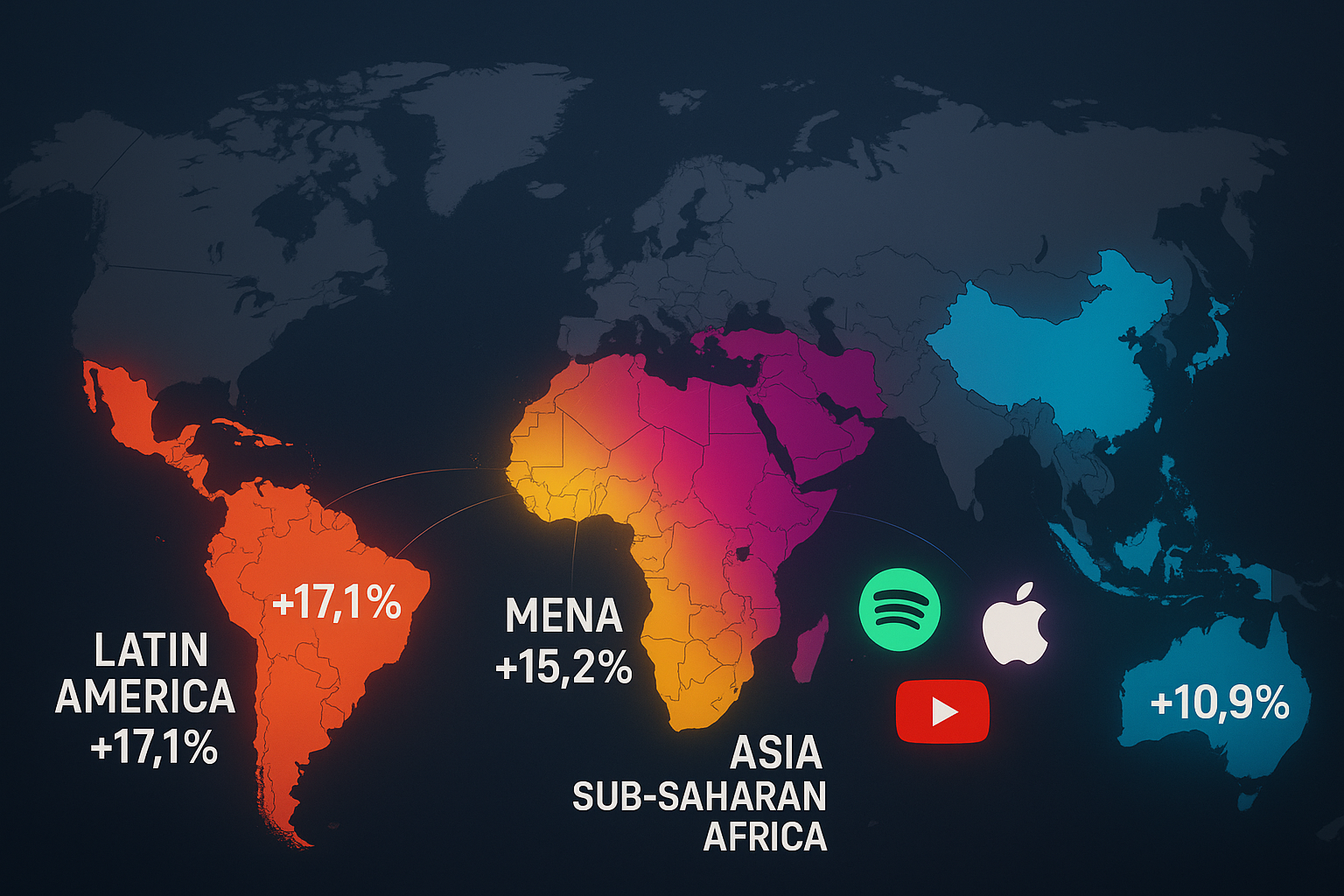
Four regions posted double-digit growth: Latin America (+17.1%), Middle East & North Africa (+15.2%), Sub-Saharan Africa (+15.2%), and Asia (+10.9%). Meanwhile, North America — the region that commands 38.7% of global revenues — grew by only 3.5%.
The industry's growth engine has shifted continents. The majors know it. Their repositioning has begun. But independent artists still have a meaningful window.
Market context: what Tuma Basa saw coming
Tuma Basa built RapCaviar into a cultural institution at Spotify before spending eight years shaping Black music and culture strategy at YouTube. He's long argued that music is becoming borderless. His thesis, articulated clearly in a Music Week cover profile, is that platforms are now the infrastructure that collapses geographic distance overnight. An artist in Birmingham can have their biggest listener base in Lagos or Bogotá without ever setting foot there.
What the IFPI 2026 data confirms is that paid subscription growth in these emerging regions is now outpacing the mature Western markets. The listeners in these territories are not just casual streamers. They are paying customers. That changes the unit economics for independent artists dramatically.
The catch: major labels are already repositioning. Sony, Universal, and Warner have all been accelerating label acquisitions, licensing partnerships, and local roster investments across Latin America and Africa throughout 2025–2026. Independent artists who treat these regions as an afterthought will find a far more crowded and expensive market in 12 to 18 months.
Three structural concepts you must understand
Streaming geography is not random. Algorithms distribute catalogue globally, but editorial and culturally resonant positioning still requires intent.
1. Regional playlist architecture
Spotify, Apple Music, and YouTube each maintain region-specific editorial playlists. "Afrobeats Mix," "Baila Reggaetón," "Arabic Pop Hits." These are curated independently from global charts. Getting onto one of these is not about raw streaming numbers. It is about metadata tagging, release timing aligned to local listening peaks, and pitching in the correct language to the correct regional editorial team.
2. Licensing vs. distribution
Simply uploading to DistroKid and ticking all territories is not a market entry strategy. Sync licensing, neighbouring rights societies (SAMRO in South Africa, APDAYC in Peru), and local publisher relationships are where a meaningful portion of regional revenue actually lives. Most independent artists miss this entirely.
3. Fan discovery vs. fan capture
A spike in streams from Nigeria or Brazil is a discovery event, not a business relationship. Converting those streams into direct fans (email, WhatsApp channels, Patreon equivalents operating in those territories) is the difference between a vanity metric and a revenue channel.
Who this is for
This strategy is not for artists who have not yet established a baseline of 5,000+ monthly listeners or who have not completed their publishing metadata correctly. Chasing global markets before your core product — catalogue, metadata, social presence — is clean is a waste of resource.
This is for artists who:
- Already have even modest organic streaming data showing international listening (this is more common than artists realise)
- Are willing to treat geographic expansion as a 12-month project, not a campaign
- Have music that has stylistic or sonic affinity with at least one emerging-market genre cluster (Afrobeats, Latin urban, Bollywood crossover, Afro-pop, etc.) or are willing to explore intentional collaboration
Six actions to take this week
1. Audit your streaming analytics today
Filter your streaming data by country in Spotify for Artists or Apple Music for Artists. If any of the top-growth regions (Latin America, Sub-Saharan Africa, MENA, Southeast Asia) appear in your top 20 listening countries, even at small numbers, you already have a signal. That is your entry point.
2. Correct your metadata for regional discoverability
Ensure your genre tags, mood tags, and language tags are accurate on every distributor. Reach out to your distributor's editorial pitch tool and explicitly pitch regional playlists. Not just global editorial.
3. Identify and join one relevant regional PRO
If you are already seeing plays from South Africa, register with SAMRO. Brazil: ECAD. This is where streaming royalties do not go if you have not registered. They accumulate in the black box and are redistributed to major label catalogue instead.
4. Build one direct-to-fan touchpoint in the target market
WhatsApp channels have extraordinary penetration across West Africa, Brazil, and India. A simple, consistent broadcast channel costs nothing and begins converting passive listeners into addressable fans.
5. Commission one cultural collaboration
A feature, remix, or co-write with an artist local to your target market is the single fastest route to editorial credibility in that territory. Identify five artists with 50k to 500k monthly listeners in your target region and pitch a collaboration directly via social or email.
6. Map the sync opportunity
Streaming pays fractions. Sync licensing to regional TV, film, and advertising markets (particularly the rapidly growing Nigerian film industry and Latin American streaming-original series) pays multiples. Register your catalogue with a sync licensing agency that has active regional relationships.
For more on positioning your catalogue for sync, read how having your masters as one-stops creates a sync advantage and why independent artists have a structural edge in sync licensing.
The mindset shift
The artists who will build durable international careers in this decade are not the ones who waited for a major label to open doors in Lagos or Medellín. They are the ones who treated geography as an asset class, moved first, and built the fan relationships before the infrastructure became expensive.
The IFPI data is a map. Every growing region is an open door. A CEO does not wait to be introduced to a new market. They research it, test it, and allocate resource accordingly.
Independent does not mean local. Independent means you decide where to compete.
If you are not capturing every revenue stream your catalogue is already generating, start with a full royalty audit to find your hidden income.
Identify your highest-potential international markets from your existing streaming data, then use Projects in Music Artist Manager to schedule territory-specific campaigns aligned to regional listening peaks.
Related Reading:
- https://www.musicartistmanager.com/blog/sync-one-stop-masters-advantage
- https://www.musicartistmanager.com/blog/sync-licensing-indie-one-stop-edge
- https://www.musicartistmanager.com/blog/royalty-audit-hidden-income-artists
Ready to streamline your workflow?
Stop piecing together spreadsheets and scattered notes. Join the waitlist for Music Artist Manager and get your entire rollout in one place.
Written By
Gavin Alexander
Senior Marketeer
As the founder of Music Artist Manager, Gavin has spent years at the intersection of music and technology. Seeing firsthand how chaotic release rollouts and split sheets can be, he designed a platform that brings major-label infrastructure to independent artists and their teams. He writes extensively about industry trends, artist leverage, and workflow optimisation.