The algorithm isn't finding your fans — niche communities already are
How to build direct fan revenue by treating niche communities as your primary discovery channel, not your backup plan.
Key Takeaways
Over 60% of new indie discovery now happens in niche communities, not global playlists.
Direct-to-fan revenue through community platforms bypasses distributor fees and pays better than streaming.
Community gatekeepers respond to genuine participation, not promotional spam dressed as outreach.
Building owned audience takes 6–12 months but survives every algorithm shift and platform update.
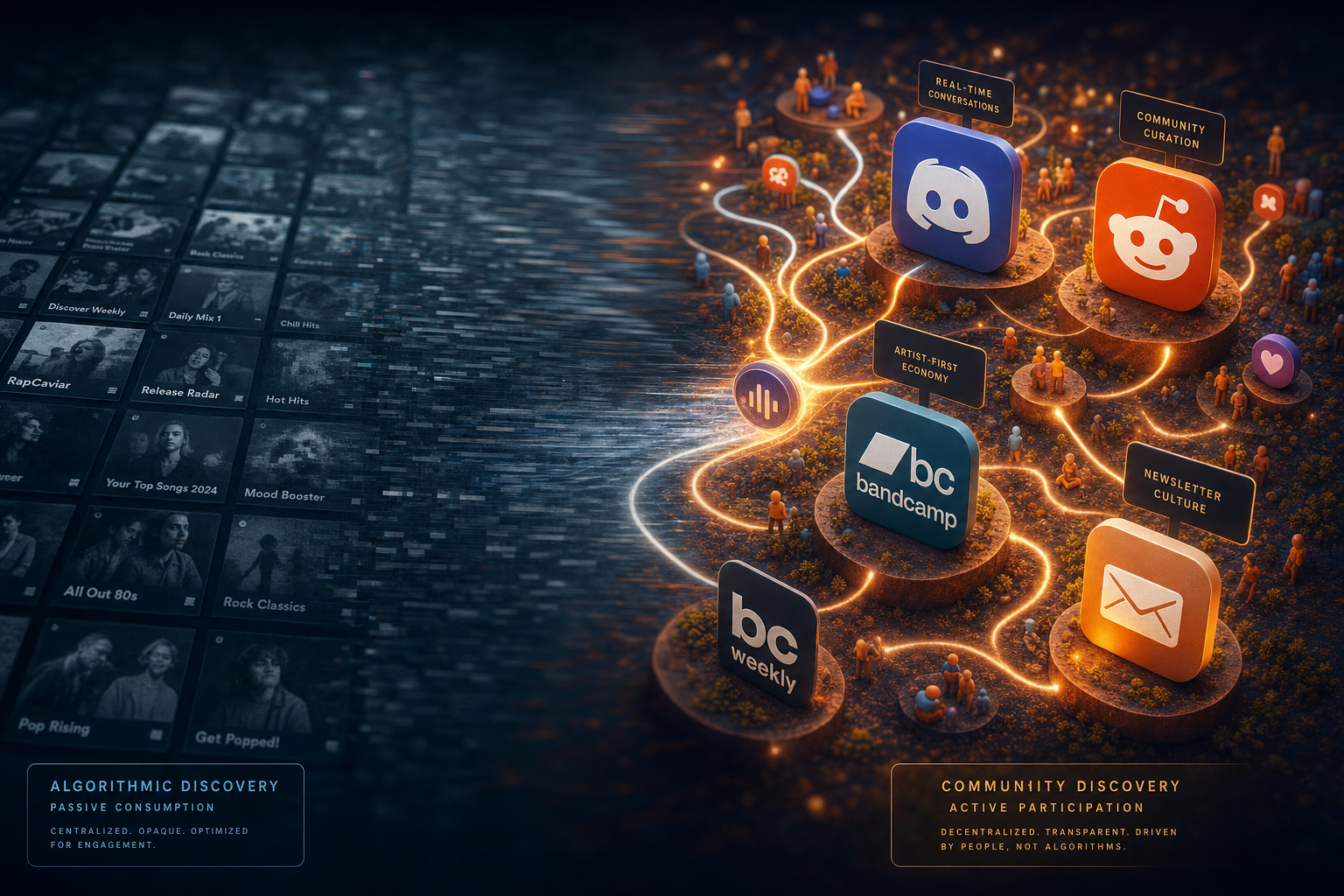
Over 60% of new independent music discovery now happens through niche community platforms like Reddit, Discord, and Bandcamp, not global playlists. These communities consistently outperform passive streaming listeners across every conversion metric that matters: merch, tickets, direct sales, and subscriptions. The artists winning in 2026 aren't chasing algorithmic virality; they're building owned audiences in the specific communities where their fans already live.
A striking data point buried in 2026's indie artist revenue reports: over 60% of new independent music discovery now happens through hyper-localised, genre-specific community platforms. Reddit threads, Discord servers, Bandcamp curations, Substack newsletters. Not global streaming playlists.
Meanwhile, independent artists are retaining 80% more direct-to-fan revenue compared to 2020.
The playlist era didn't disappear. It just stopped being the only strategy worth managing.
Smart managers are now treating community platforms as primary discovery infrastructure, not afterthoughts.
The streaming promise vs. the community reality
The streaming algorithm promised democratisation and delivered consolidation. The top 1% of tracks still capture the vast majority of playlist real estate.
But the infrastructure beneath the algorithm has been quietly maturing.
Discord communities of 5,000 hyper-engaged fans in a micro-genre outperform passive playlist listeners in every conversion metric. Merch, tickets, direct downloads, Patreon sign-ups.
In 2026, the artists winning aren't those chasing algorithmic virality. They're the ones deliberately colonising the communities where their specific audience already lives.
This is a distribution strategy shift, not a marketing tactic.
Community platform tiers: What a manager needs to understand
Tier 1: Aggregator communities
Reddit (r/listentothis, r/[genre]), Facebook groups, genre-specific Discord servers. Low friction to enter, high noise. Best for initial seeding.
Tier 2: Creator-owned communities
Artist-run newsletters (Substack, Ghost), Discord servers managed by the artist, Patreon tiers. Highest engagement and conversion but require ongoing investment.
Tier 3: Taste-maker hubs
Bandcamp editorial, Pigeons & Planes, niche Substack curators with 1,000–50,000 subscribers. Credibility amplifiers. One feature here often triggers algorithmic pickup elsewhere.
The critical management insight
These communities have gatekeepers. Moderators, newsletter authors, Discord admins. They respond to genuine peer outreach, not PR blasts.
The artist or manager who understands the community language gets in. The one who spam-pitches gets banned.
Revenue mechanics: Why this matters financially
Direct-to-fan within a community bypasses distributor and platform fees.
An artist selling 200 Bandcamp downloads at £7 each from a single Reddit thread generates £1,400 with near-zero overhead. That ROI would require hundreds of thousands of streams to replicate via standard DSP payouts.
Reality check: Eligibility
This strategy is not for artists who want passive growth.
Community-based discovery demands:
Patience. Building genuine credibility in a community takes 6–12 months minimum.
Authenticity. These communities are highly allergic to promotional behaviour that isn't wrapped in genuine participation. If the artist isn't genuinely part of these scenes, it shows.
Catalogue depth. A single track won't sustain community discovery. Artists need 8–15+ tracks before community platforms become reliably productive.
Manager bandwidth. Monitoring and engaging across 3–5 community platforms is a real-time commitment. Most solo artists need their manager to own this as a dedicated function.
Who this is not for
Artists purely chasing chart positions or viral TikTok moments. This is a slower, sturdier play.
Practical action plan
1. map the ecosystem (week 1 – 2)
Identify the 5–8 communities where the artist's specific genre lives. Search Reddit, Discord aggregators (Disboard.org), and Bandcamp tags. List gatekeepers: admins, newsletter authors, top commenters.
2. audit the artist's catalogue readiness
Does the artist have 10+ tracks, a Bandcamp page, and a direct purchase option? If not, resolve this before community outreach begins.
3. establish genuine presence first (month 1 – 2)
Comment on posts, share other artists' work, participate as a fan. Do NOT post the artist's own music in this phase. Build trust first.
4. soft introduction (month 2)
Share one track contextually. In a "what are you listening to this week?" thread, not a self-promotional post. Let community reactions guide which track resonates.
5. build tier 2 infrastructure
Launch an artist-owned newsletter (Ghost or Substack, free tier) as the community home base. Every community interaction should have a pathway back to this owned channel.
6. pitch tier 3 taste-makers
Once community credibility is established and there's social proof (comments, shares), personalise pitches to 5–10 niche curators. Reference their specific work. Keep pitches under 150 words.
7. track metrics that matter
Bandcamp direct sales, newsletter sign-up rate, Discord server growth. Not passive stream counts. These are the leading indicators of community traction.
The mindset shift
The algorithm is rented land.
Every artist who has built a fanbase on playlist placement alone has experienced the same reality: one editorial shift, one algorithm update, one platform deprioritisation, and the audience disappears because it was never theirs.
Community-based discovery builds owned audience.
The artists who will still be earning a decade from now aren't the ones who went viral. They're the ones who built communities that chose to show up repeatedly.
A manager's job in 2026 is to help their artist become the most respected artist in their specific world, not the most famous artist in everyone's algorithm.
Music Artist Manager's Contact & Relationship Manager tracks every gatekeeper, community admin, and niche curator relationship in one place. Never lose a warm contact again.
Related Reading:
- Why community platforms are the new A&R: The discovery shift indie artists can't afford to miss — Music Artist Manager
- The 'cultural dividend': How investing in your niche builds exponential, not just linear, returns — Music Artist Manager
- Why independent artists must own a community, not chase a playlist — Music Artist Manager
Ready to plan your next release?
Stop piecing together spreadsheets and scattered notes. Get your free release strategy and keep your whole rollout in one place.
Written By
Gavin Alexander
Senior Marketeer
As the founder of Music Artist Manager, Gavin has spent years at the intersection of music and technology. Seeing firsthand how chaotic release rollouts and split sheets can be, he designed a platform that brings major-label infrastructure to independent artists and their teams. He writes extensively about industry trends, artist leverage, and workflow optimisation.