Why community platforms are the new A&R: The discovery shift indie artists can't afford to miss
How to map micro-communities, build credibility before you release, and turn genre-specific platforms into your primary discovery engine in 2026.
Key Takeaways
Over 60% of independent music discovery now happens through genre-specific community platforms, not streaming playlists.
Direct-to-fan platforms generate over 60% of income for successful indie artists, with 80% more revenue retained than in 2020.
Community infrastructure is a primary asset, not a marketing tactic — discovery has decentralised while revenue has centralised closer to artists.
Building genuine community presence 6–12 months before a release converts better than algorithmic playlist placement on launch week.
Over 60% of new independent music discovery now happens through genre-specific community platforms, not streaming playlists. Meanwhile, successful indie artists are pulling 60% of their income from direct-to-fan channels, with an 80% increase in retained revenue since 2020. If your entire discovery strategy still centres on Spotify editorial placement, you are building on a foundation that has already shifted beneath you.
A cluster of H1 2026 industry data tells a story most artists haven't absorbed yet. Over 60% of new independent music discovery now happens through hyper-localized, genre-specific community platforms, not global streaming playlists. At the same time, independent artists are retaining 80% more direct-to-fan revenue compared to 2020. Direct-to-fan platforms now generate over 60% of income for the most successful indie acts (Reuters, cited via troylike.com, June 2026).
The implication is blunt. If your primary acquisition strategy is "get on a Spotify editorial playlist," you are building on a foundation that is no longer the center of gravity.
The discovery landscape has fragmented upward, not downward
Streaming playlists flattened music discovery for roughly a decade. In 2026, the landscape has fragmented again, but upward in sophistication, not downward in chaos.
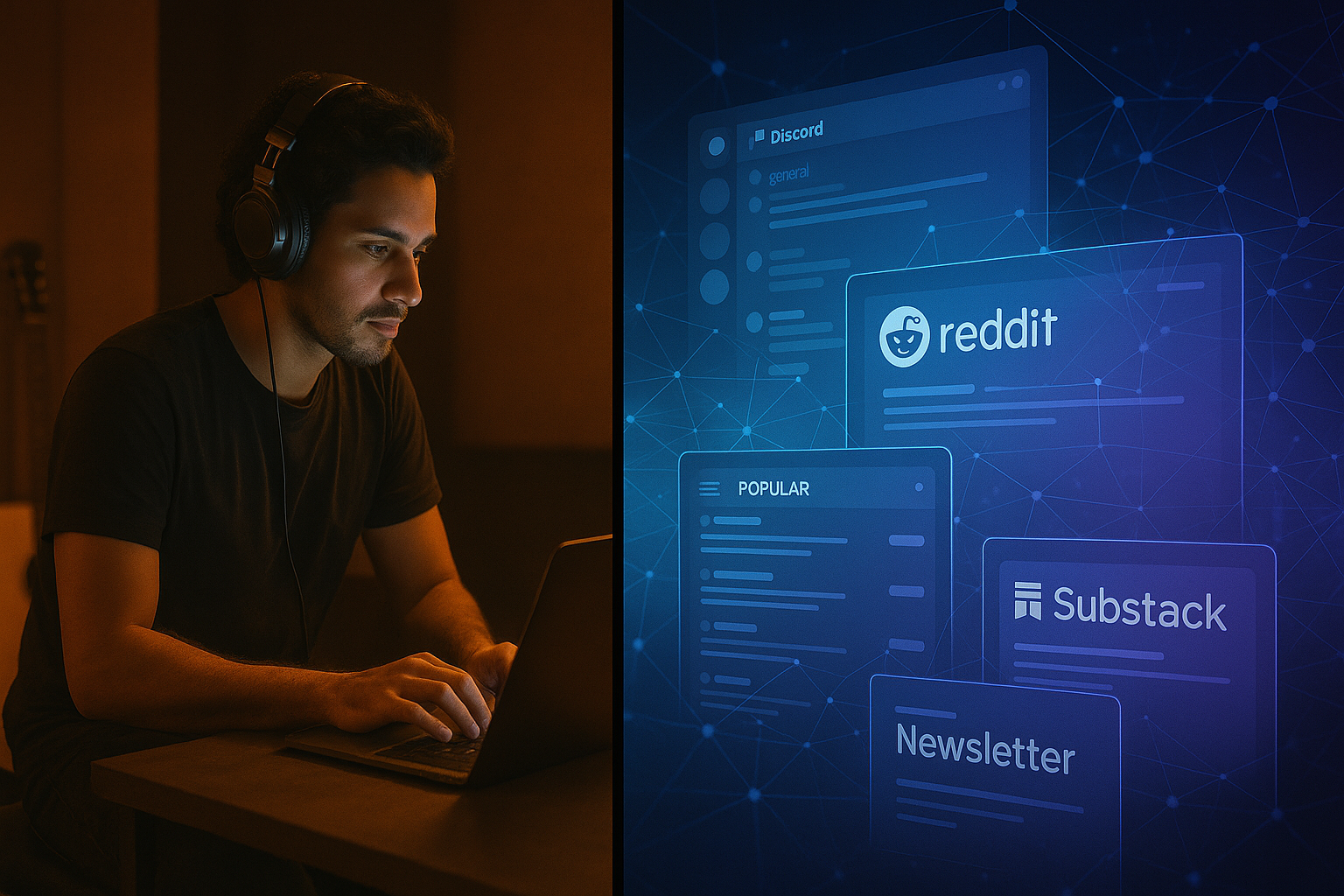
Genre Discord servers, Substack music newsletters, Reddit micro-communities, niche YouTube channels, and artist-curated platforms are driving more first listens than Spotify's Discover Weekly for independent acts.
What this means underneath the surface: discovery has decentralized, but revenue has centralized closer to the artist. Bandcamp, artist-owned subscription models, Patreon, and direct commerce now form the economic engine. Streaming has been demoted to a passive, ambient revenue stream.
Smart managers are updating their mental model accordingly. Community infrastructure is now a primary asset, not a secondary marketing tactic.
Community infrastructure vs. audience: know the difference
There's a meaningful difference between having an audience and having a community.
Audience: passive followers who listen when you release.
Community: active participants who help generate discovery, validate taste, and spend money.
- Audience = people who receive your output.
- Community = people who create context around your output.
Genre-specific community platforms act as taste-validation engines. When a track lands well in a tight Reddit subculture or a niche Discord, it travels outward through recommendation loops that no algorithm can manufacture. These are humans vouching for humans. That's why conversion rates to streams, follows, and purchases are higher from community discovery than from algorithmic placement.
Built-in intelligence tools map your community in real time
Modern distribution and marketing platforms now include built-in intelligence tools. They identify where your existing listeners cluster online: which forums, which YouTube channels, which Substack newsletters. This isn't guesswork. It's data-driven community mapping.
The artists winning this cycle use those signals to go to the community before they need the community. They build presence and genuine participation in the 6 to 12 months before a major release, not in the week of the drop.
This strategy is not for everyone
This approach is for artists who:
- Already have a minimum viable release catalogue (3+ releases, some streaming data to analyze)
- Are willing to invest time in genuine community participation, not spam-posting links
- Have identified a specific genre, micro-genre, or cultural intersection they authentically represent
- Can commit to a 6 to 9 month community-building runway before expecting discovery payoff
This is not a shortcut. It will not replace a badly written song. It will not manufacture virality. And it will not work for artists who treat community platforms as billboards rather than rooms to participate in.
The artists who fail at this approach treat community building as a broadcasting exercise. It is a listening exercise first.
Seven actions to build community infrastructure now
1. Audit your existing listener geography
Use your distributor analytics and Spotify for Artists to identify where your listeners cluster geographically and demographically. Cross-reference this with community platform activity (Reddit communities, YouTube niches, genre Discords).
2. Map three to five micro-communities
Find the specific forums, Discord servers, newsletters, and YouTube channels where your genre audience is most active. Look for communities that are curating taste actively, not passively.
3. Participate as a listener for 30 days before promoting anything
Comment on other people's music recommendations. Share tracks you genuinely love. Build a reputation as a taste-maker, not a self-promoter. This is the Troy Carter principle: community credibility precedes commercial leverage.
4. Identify the community gatekeepers
Every micro-community has 3 to 5 people whose recommendations carry disproportionate weight. Engage with these people directly, genuinely, over time. A recommendation from one credible community gatekeeper is worth more than 100 playlist pitches.
5. Map your direct-to-fan funnel before your next release
Before releasing, ensure you have a mechanism to capture community members as direct contacts (email list, Discord members, Patreon tier). Community discovery that doesn't convert to owned contact data is a missed infrastructure moment.
6. Use release timing to activate community, not just playlists
Structure release week activities around community moments: exclusive listening parties in Discord, community Q&As, Reddit AMAs timed with release day. Platform pitches still go in, but the primary activation energy goes to community.
7. Track community-sourced revenue separately
Use UTM links or platform-specific referral codes to measure what percentage of your direct-to-fan revenue originates from community platforms vs. streaming algorithmic discovery. This data shapes your next release budget allocation.
From content waiting to be selected to infrastructure worth accessing
The playlist era trained artists to think like content waiting to be selected. The 2026 parallel economy requires artists to think like community founders: people who build rooms, set culture, invite collaborators, and create belonging for a specific audience.
The CEO shift here is from seeking validation from platforms to building infrastructure that platforms want access to. When a niche community that you helped build is generating real discovery, real revenue, and real loyalty, labels, sync supervisors, and booking agents come to that community, not the other way around.
That's leverage. That's the asset.
Map where your listeners are clustering online, identify community platform opportunities, and set up direct-to-fan revenue tracking, so you know exactly which communities are driving your business, not just your streams.
Related Reading:
- [The Superfan Window](https://www.musicartistmanager.com/blog/superfan-window-before-majors-move)
- [The cultural dividend](https://www.musicartistmanager.com/blog/cultural-dividend-niche-exponential-returns)
Ready to streamline your workflow?
Stop piecing together spreadsheets and scattered notes. Join the waitlist for Music Artist Manager and get your entire rollout in one place.
Written By
Gavin Alexander
Senior Marketeer
As the founder of Music Artist Manager, Gavin has spent years at the intersection of music and technology. Seeing firsthand how chaotic release rollouts and split sheets can be, he designed a platform that brings major-label infrastructure to independent artists and their teams. He writes extensively about industry trends, artist leverage, and workflow optimisation.