Your A&R strategy: Building a catalogue with long-term value
A&R — Artists and Repertoire — is the function that decides what gets signed, what gets recorded, and what gets released. Without a label, it is your function. Most independent artists make A&R decisions without calling them that, and without the framework that makes those decisions compound over time.


Key Takeaways
Your catalogue communicates something to labels, publishers, and listeners — do you know what it says?
A strong A&R strategy sequences releases to build a coherent story, not just output
The gap between where your catalogue is and where it could be is almost always identifiable in retrospect — find it before rather than after
Long-term catalogue value compounds: a coherent back catalogue is worth more commercially than the same number of disconnected releases
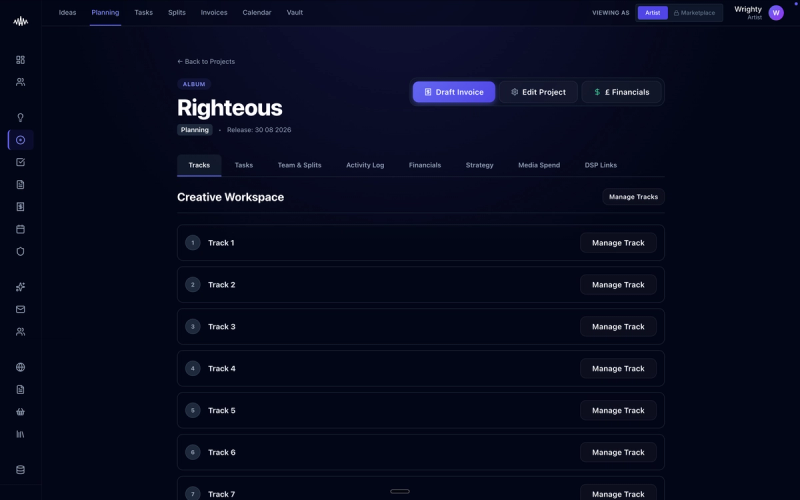
As an independent artist, managing your own A&R—Artists and Repertoire—means taking full control of what you record and release. Without a major label's backing, many artists make these crucial decisions on instinct alone, missing out on the compounding value of a structured release strategy. Developing a deliberate A&R strategy within Music Artist Manager (MAM) ensures that every track you release actively builds your catalogue's long-term commercial value.
Why this matters
Without a cohesive A&R strategy, your releases risk feeling disjointed, which can confuse both your audience and streaming algorithms. This lack of structure often leads to wasted recording budgets on tracks that do not align with your artistic vision, ultimately diminishing the lifetime value of your music catalogue.
How to do it
1. Navigate to the A&R Hub from your MAM main dashboard.
2. Click on Catalogue Builder to review your existing releases and identify musical gaps in your current portfolio.
3. Use the Track Evaluator tool to input metadata, genre tags, and target demographics for your unreleased demos.
4. Assign a strategic priority tier, such as Focus Single, EP Track, or Catalogue Builder, to each demo within the Release Planner.
5. Define your release timeline in the Scheduler to ensure a consistent output that steadily builds momentum.
6. Access the Budget Allocation module to distribute your recording and marketing funds proportionally based on each track's designated priority tier.
Tips
• Avoid over-releasing; strict quality control is key to protecting your brand's integrity and long-term catalogue value.
• Use historical data from your Audience Insights tab to validate your A&R decisions rather than relying solely on gut feeling.
• Regularly audit your back-catalogue in MAM to identify older tracks that can be revitalised through acoustic versions or remix campaigns.
Next steps
Now that you understand the framework, head over to the A&R Hub to begin categorising your unreleased demos and structuring your next twelve months of releases.
Ready to streamline your workflow?
Stop piecing together spreadsheets and scattered notes. Join the waitlist for Music Artist Manager and get your entire rollout in one place.
Written By
Gavin Alexander
Senior Marketeer
As the founder of Music Artist Manager, Gavin has spent years at the intersection of music and technology. Seeing firsthand how chaotic release rollouts and split sheets can be, he designed a platform that brings major-label infrastructure to independent artists and their teams. He writes extensively about industry trends, artist leverage, and workflow optimisation.