The brand architect: Why your music needs a creative director, not just a marketing manager
Learn how a brand architect builds consistent identity and markets the feeling behind your music, not just the track.

Key Takeaways
A marketing manager pushes your release. A brand architect defines who you are before the music drops.
Most artists treat branding as content. Real branding is a system that dictates your visuals, story, and audience positioning.
The goal is not virality. The goal is to make people feel something consistent every time they see your name.
Your archetype, colour palette, and narrative formula should be locked in before you book your first campaign.
Why every independent artist needs a brand architect (and what happens when you skip this role)
Most independent artists hire a marketing manager and wonder why their visuals feel random, their narrative shifts every release, and their audience never quite locks in.
The issue is structural. Marketing managers execute plans. Brand architects build the identity those plans are supposed to sell.
If you do not have someone defining your core archetype, building a repeatable visual and narrative formula, and marketing the feeling of your project before the song, you are running campaigns with no foundation. That shows up in your conversion rates, your retention, and your ability to grow beyond one-off streams.
This is not abstract. This is about building a system that compounds with every release.
What a brand architect actually does
A brand architect is not your graphic designer. They are not your social media manager. They sit upstream of both.
Their job is to define the core emotional and visual identity of your project, then translate that identity into repeatable formats across every piece of content, every campaign, and every release.
Here is what that looks like in practice.
They define your core archetype
Every artist operates within an archetype, whether they know it or not. The rebel. The confessor. The prophet. The sensualist. The outsider.
A brand architect names yours, then uses it as the filter for every creative decision. That archetype becomes the lens through which you choose collaborators, approve visuals, write bios, plan rollouts, and build your stage presence.
This is not about limiting your range. This is about focusing your signal so your audience knows what they are signing up for.
They build a visual formula
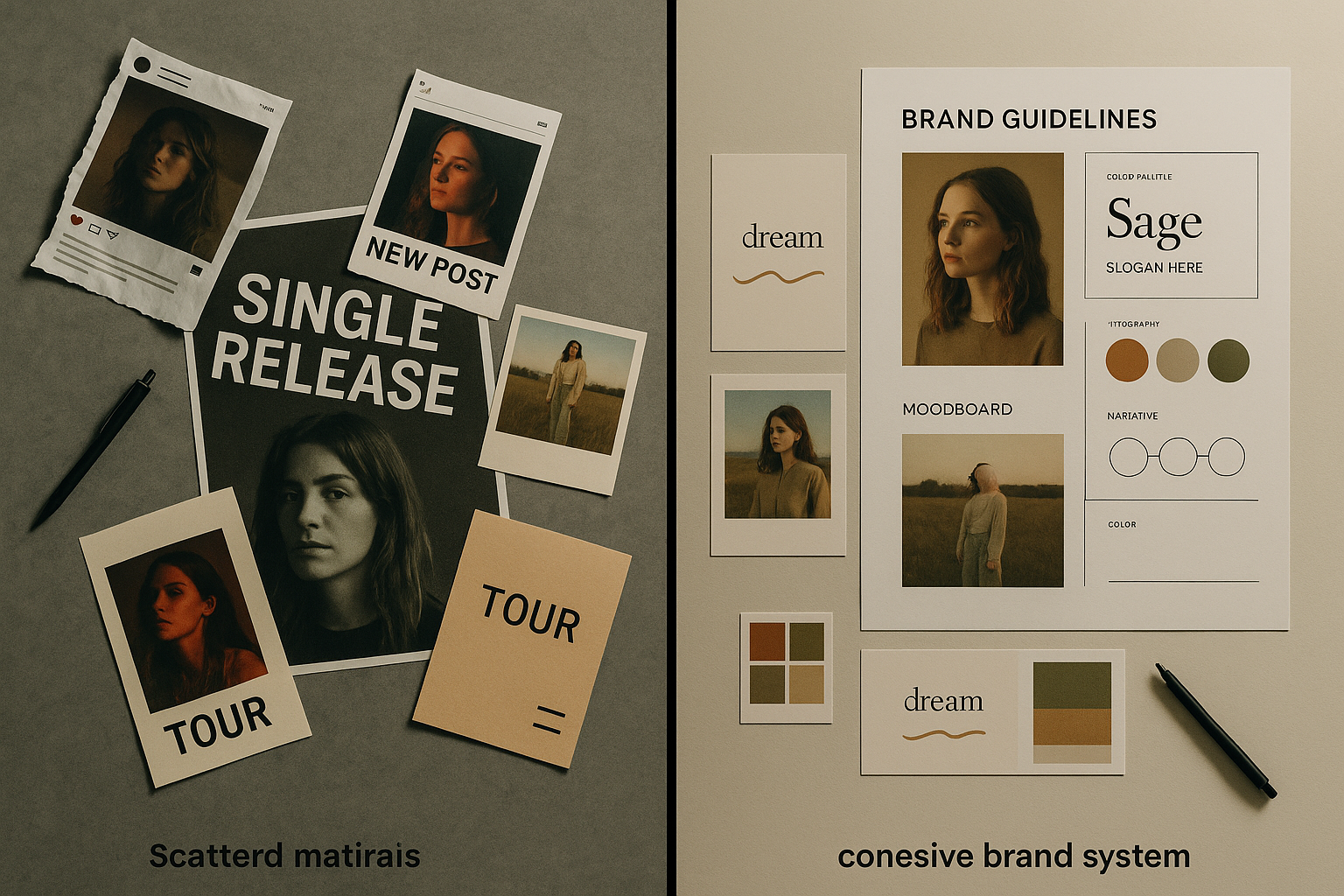
Most artists treat every release like a blank canvas. New photographer, new color palette, new mood board. That creates visual noise, not brand equity.
A brand architect establishes a repeatable visual system. Fonts, color ratios, composition style, image treatment, motion language. Then they enforce it across album art, social content, press photos, and video assets.
Consistency is not boring. Consistency is how people recognize you without reading your name.
They create a narrative framework
Your story is not what you tell a journalist once. It is the structure behind every caption, every interview answer, every piece of content your audience sees.
A brand architect writes that framework. Who you are, what you stand for, what makes your perspective distinct. Then they codify it into repeatable language you and your team use everywhere.
This is how artists start sounding like themselves across every platform without needing to reinvent their message every time they post.
They market the feeling, not the song
Most independent artists market songs. Stream this. Presave that. Buy this ticket.
That is transactional, and transactions do not build fanbases.
A brand architect markets the emotional world your music lives in. The aesthetic. The attitude. The identity someone adopts when they choose to follow you.
When you market the feeling first, the songs become proof of concept. That is how you build demand that lasts beyond release week.
Why this role is distinct from a marketing manager
Marketing managers execute campaigns. They book ads, schedule posts, pitch playlists, manage budgets, and track performance.
Brand architects define what those campaigns should say, how they should look, and what emotional outcome they are trying to create.
You need both. But if you hire a marketing manager before you have a brand architect, you are asking someone to sell a product that has not been designed yet.
That is why so many independent artists burn budget on ads that convert poorly, posts that do not land, and press coverage that does not move the needle. The execution is fine. The foundation is missing.
For a full breakdown of what separates these roles, see The Brand Architect.
What happens when you skip this role
You end up with a fragmented brand. Every release feels like a new artist. Your audience does not know what to expect. Your visuals do not stack into a recognizable identity. Your narrative shifts depending on who is writing the post.
That fragmentation shows up in your metrics. Lower save rates. Weak playlist retention. Followers who do not convert to streams. Press that does not drive discovery.
You are not failing because your music is not good. You are failing because your brand does not give people a reason to care before they even press play.
How to think about hiring or building this function
If you are early in your career, you might not have budget for a dedicated brand architect. That is fine. You can build this function yourself or split it with a creative director who understands strategy, not just aesthetics.
The key is recognizing that this role exists, whether you hire for it or not. Someone needs to own your archetype, your visual system, your narrative framework, and your emotional positioning.
If no one is doing that work, your marketing will always feel like guesswork.
If you are allocating budget across your team, make sure this function is funded before you scale paid ads or hire a publicist. Brand clarity multiplies the return on every other dollar you spend.
For more on how to structure your promotional spend, see Why Independent Artists Are Wasting Their Release Budget (And What the Data Says to Do Instead) and The Multi-Return Rule.
What this role looks like in practice
A brand architect shows up in the early stages of a release cycle, before the single is mixed, before the artwork is commissioned, before the rollout calendar is built.
They ask: what is this release trying to make people feel? What does that feeling look like? What does it sound like in language? How does it show up in every asset we create?
Then they build the system. Mood boards. Visual guidelines. Messaging frameworks. Content templates. Rollout concepts that tie the music to the identity.
Then they hand that system to the rest of the team. The marketing manager executes it. The designer works within it. The social team posts inside it. The publicist pitches it.
That is how you build a brand that compounds instead of resets with every release.
If you are managing yourself, start here
You do not need to hire someone tomorrow. But you do need to start thinking like a brand architect.
Ask yourself: what is the one feeling I want people to associate with my project? What does that feeling look like visually? What does it sound like in words? How do I make every piece of content I create reinforce that feeling?
Write it down. Build a mood board. Create a color palette. Draft three to five sentences that describe your perspective and your world. Use those as your filter for every creative decision.
That is your brand foundation. Everything else builds from there.
Ready to streamline your workflow?
Stop piecing together spreadsheets and scattered notes. Join the waitlist for Music Artist Manager and get your entire rollout in one place.
Written By
Gavin Alexander
Senior Marketeer
As the founder of Music Artist Manager, Gavin has spent years at the intersection of music and technology. Seeing firsthand how chaotic release rollouts and split sheets can be, he designed a platform that brings major-label infrastructure to independent artists and their teams. He writes extensively about industry trends, artist leverage, and workflow optimisation.