Why your promotional budget belongs on YouTube, not Spotify
Why spending your promotional budget on YouTube instead of Spotify generates actual revenue you can reinvest in the next campaign.

Key Takeaways
Spotify promotional spend generates sub-penny streaming royalties that will never recoup your campaign cost.
YouTube promotion earns you Content ID royalties, channel ad revenue, and YouTube Music plays simultaneously.
Video content builds live performance expectations and creates a ticket-buying audience before you announce tour dates.
Every promotional pound should generate compounding revenue, not fund a platform's data collection and growth metrics.
At the MMF-US New York Summit in June 2026, a panel of managers made a blunt case that most independent artists missed: you are spending your promotional budget on the wrong platform. The issue is not algorithm strength or reach. It is structural economics. YouTube is the only major platform where your promotional spend generates royalties back to your operation through Content ID, channel ad revenue, and YouTube Music plays, while Spotify promotional campaigns fund the platform's data engine and return streaming royalties that will never recoup your ad spend.
At the MMF-US New York Summit in June 2026, a panel titled "Music Managers: The New Power Brokers" dropped a blunt consensus that most independent artists have yet to hear: you are spending your promotional budget on the wrong platform.
Speaking from the stage, industry manager Barreto made the case plainly. Shift your ad spend away from Spotify, toward YouTube. The reason isn't algorithm optimisation or reach. It's fundamental: YouTube is the platform where the artist actually earns from the same listener impression that their promotional budget is paying for.
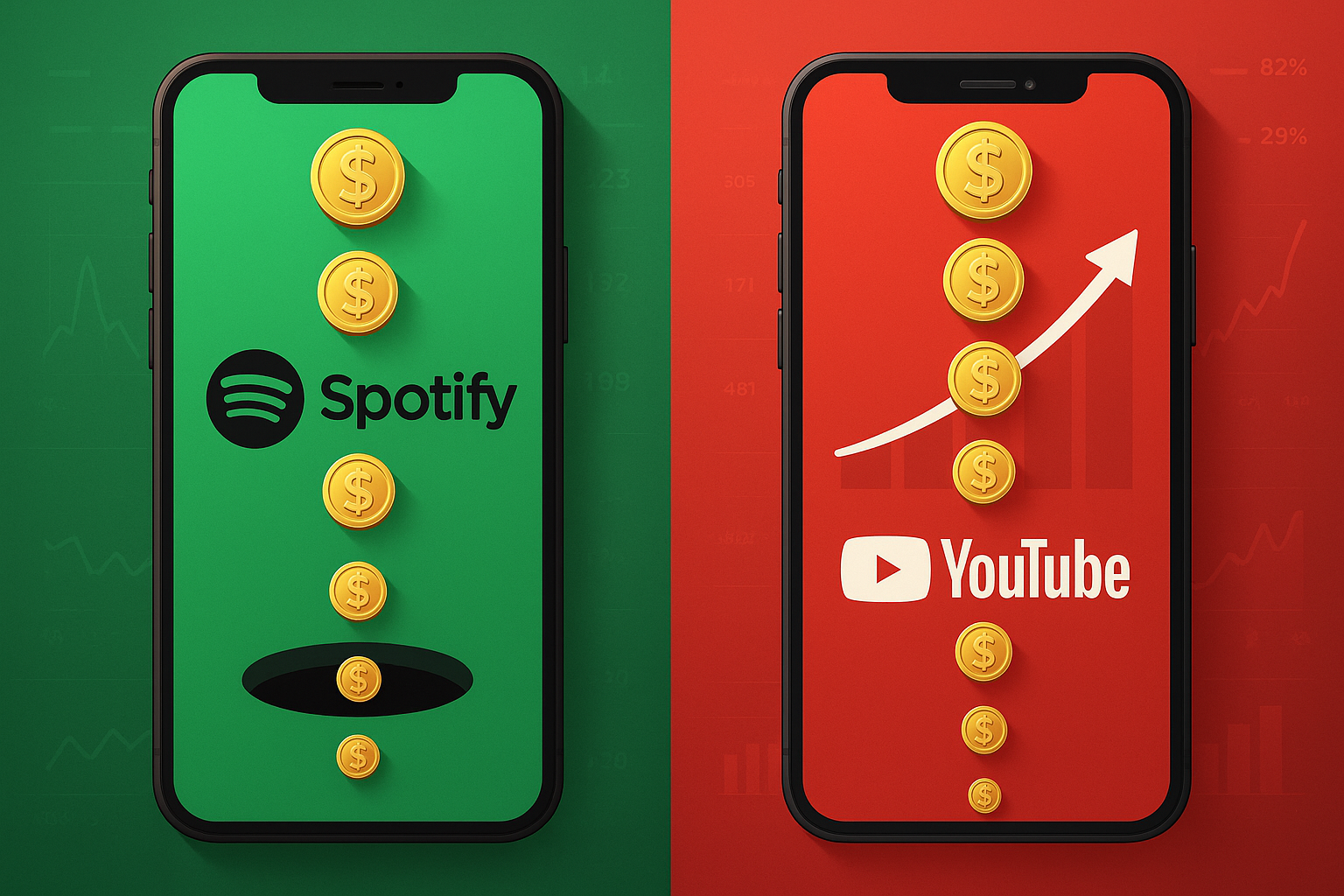
Spend £200 on YouTube promotion, and every stream that follows generates Content ID royalties, channel ad revenue, and YouTube Music plays back into your pocket. Spend the same £200 on Spotify ads, and you've funded Spotify's data flywheel while receiving streaming royalties that, at sub-penny per-stream rates, will never recoup your promotional spend.
Julie Klein, COO of C3 Management, reinforced the structural point: video content on YouTube also sets audience expectations for live performance, building a pipeline that has real commercial downstream value. The promotional pound, on YouTube, does multiple jobs simultaneously.
The math has become impossible to ignore
The shift matters in 2026 specifically because the economics have crystallised:
- YouTube Music's listener base has grown materially as Spotify has hit saturation in key Western markets. The gap in per-stream payout rates remains (YouTube pays roughly half per stream compared to Spotify's weighted average), but this is misleading as a basis for promotional budget decisions. Payout rate is not the same as promotional ROI.
- Ad-spend-to-stream economics on Spotify: An artist running a Spotify Marquee or Campaign Kit campaign is essentially paying to generate streams that pay fractions of a penny back. The net position after a typical indie campaign is deeply negative, with no compounding asset created.
- Ad-spend-to-stream economics on YouTube: A YouTube ads campaign (pre-roll or discovery) generates views that pay ad revenue to your channel, feed into YouTube Music's recommendation engine, create Content ID audit trails, and provide watch-time signals that compound over months.
The managers at MMF-US 2026 are operating at the level where this distinction is career-defining. Most independent artists are still making promotional decisions based on streaming volume optics rather than net economic logic.
Why promotional spend and payout rate are separate questions
Most artists conflate "where should I release?" with "where should I advertise?" These are different decisions with different answers.
- Release everywhere. Spotify, Apple Music, YouTube Music, TIDAL, Amazon. Catalogue must be universal.
- Promote where you earn from promotion. This is the systems question.
On YouTube, your promotional spend does four things:
- Content ID - every video upload registers your compositions and sound recordings. Any user-generated content, shorts, or cover videos that use your audio generate royalties automatically. Promotional spend that drives discovery of your official video also seeds the Content ID ecosystem.
- Channel monetisation - once your channel meets thresholds (1,000 subscribers, 4,000 watch hours), your own promotional-spend-driven views generate ad revenue directly.
- YouTube Music algorithmic carry-through - plays on YouTube proper feed YouTube Music's recommendation engine. One promotional pound buys exposure on both surfaces.
- Video as a live audience funnel - as Julie Klein emphasised, video content communicates the live show proposition in ways that audio never can. Promotional spend on YouTube builds an audience pre-sold on the live ticket.
What Spotify promotional spend does well:
- Playlist editorial consideration signals (useful for very early-stage)
- Discovery Mode (exchange of royalty discount for recommendation priority, a separate, controversial product)
What it does not do:
Generate any revenue that flows back to fund the next campaign.
Who this works for (and who it doesn't)
This strategy is most powerful for artists who:
- Have visual content - at minimum, lyric videos or performance clips. YouTube promotion without video output is a half-measure.
- Are past the initial 1,000-subscriber threshold - or are willing to use the promotional campaign period as the push to get there. Below threshold, channel monetisation is locked, but Content ID and YouTube Music carry-through still apply.
- Have a live performance pipeline - if you are not touring or gigging, the live funnel benefit is moot. YouTube promotion would still make sense for the royalty economics, but the compound value is lower.
This is not the right primary play for:
- Artists still at zero catalogue (first single, no videos)
- Artists whose genre skews heavily toward Spotify-native discovery (lo-fi, playlisted ambient, sleep content - verticals where Spotify's editorial system is genuinely the most powerful distribution lever)
How to restructure your promotional budget
1. Audit your last three promotional campaigns
Calculate total spend vs. total streaming royalties generated from those campaigns. If the ratio is worse than 20:1 (spend to royalty return), your current approach is not economically sustainable.
2. Produce one video asset per release minimum
It does not need to be a high-production music video. A single-shot performance video, a lyric video with strong typography, or a visual essay around the song's concept all qualify. This is the prerequisite.
3. Set up YouTube channel monetisation eligibility tracking
Know your subscriber and watch-hour counts. Map the timeline to threshold eligibility and treat it as a business KPI, not a vanity metric.
4. Restructure the next promotional budget
Allocate at least 60% to YouTube. Use Google Ads (YouTube pre-roll and discovery campaigns) targeting music-relevant audiences. Retain a smaller Spotify allocation if you are in active editorial submission cycles, but treat it as a distribution tool, not a growth engine.
5. Register all audio with Content ID
If you are distributed via DistroKid, TuneCore, or similar, confirm your Content ID settings are active and set to monetise (not block). This is the silent earnings layer that most artists leave unconfigured.
6. Track net promotional ROI monthly
Log spend, attributable streams, Content ID earnings, and channel ad revenue inside your management dashboard. The shift in economics will be visible within two to three campaigns.
The structural difference that matters
Spotify built its business on the insight that music fans will pay a monthly subscription in exchange for access to everything. The side effect, which the industry has been slow to name plainly, is that this model restructures artists as inputs to a platform's catalogue asset, rather than owners of their own promotional infrastructure.
YouTube's model is different. It is an advertising business. When you promote on YouTube, you become a publisher in that advertising ecosystem. Your content earns. Your audience's attention generates revenue that flows back to your operation.
The managers at MMF-US 2026 are not making an aesthetic argument about which platform they prefer. They are making a structural argument about where an artist's promotional budget creates compounding value versus where it disappears.
This is what it means to run your music career as a business: every pound spent is an investment that should generate a return, not a donation to a platform's growth metrics.
The artist who understands this doesn't just release differently. They budget differently, track differently, and ultimately build a more durable economic base beneath their creative work.
Track your promotional ROI properly
Use Music Artist Manager's Budget Tracker to log your promotional spend by platform and automatically calculate net ROI per campaign, so you can see in real time whether your money is working.
Related Reading:
Further Reading:
- "Music managers: The new power brokers" panel" — Music managers forum US MMF-US, NY summit, june 2026
- "How to be an artist manager in 2026" — Artist for artist, may 2026
- "YouTube music vs Spotify 2026: Payouts, users, and priority" — Chartlex, april 2026
- "The best ad strategy for music promotion in 2026" — Substream magazine, june 2026
- "MMF-US LA summit" — Music managers forum US
Ready to streamline your workflow?
Stop piecing together spreadsheets and scattered notes. Join the waitlist for Music Artist Manager and get your entire rollout in one place.
Written By
Gavin Alexander
Senior Marketeer
As the founder of Music Artist Manager, Gavin has spent years at the intersection of music and technology. Seeing firsthand how chaotic release rollouts and split sheets can be, he designed a platform that brings major-label infrastructure to independent artists and their teams. He writes extensively about industry trends, artist leverage, and workflow optimisation.