Why streaming market saturation is an industry myth
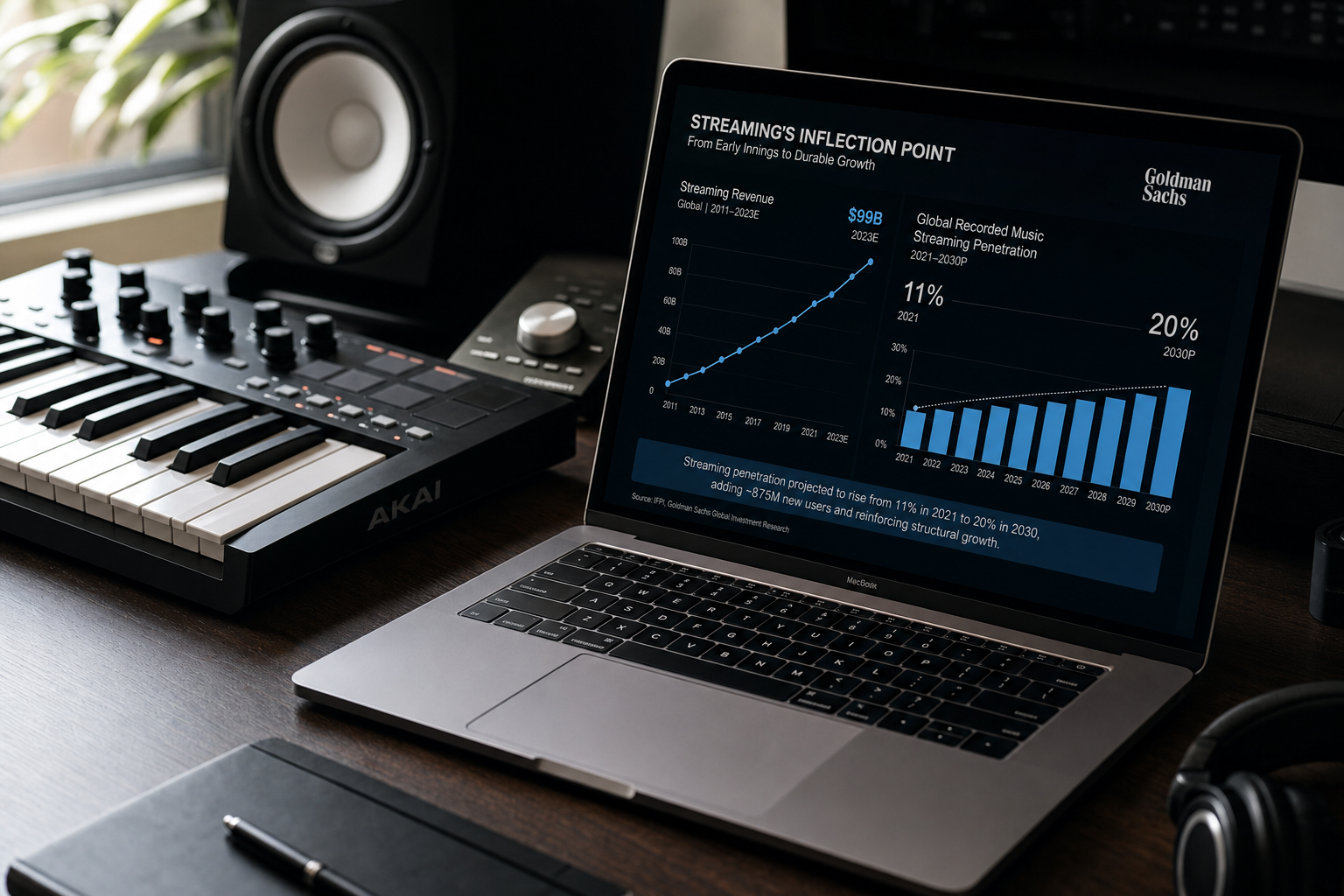
Streaming penetration sits at 11% globally. Goldman Sachs projects 20% by 2030. The growth window is open, not closed.
Key Takeaways
US paid streaming penetration in 2021 was 47%, half the rate of Netflix at 84%.
Music subscriptions cost 55% less than Netflix, yet conversion rates remain structurally low.
Goldman Sachs projects global paid streaming users will nearly double from 11% to 20% by 2030.
Growth will come from older demographics, emerging markets like India and China, and tiered pricing models.
The music industry loves to say streaming has peaked. The data says otherwise. Goldman Sachs projects paid music streaming penetration will nearly double globally by 2030, with the biggest growth coming from older listeners, emerging markets, and tiered pricing structures that haven't even launched yet.
Music media has been running the same story for years: streaming growth has peaked, the platform economy is tapped out, and artists need to look elsewhere for revenue. The implication is clear. We have hit saturation, and the only direction left is down.
Goldman Sachs looked at the same market and reached the opposite conclusion.
In their June 2022 report, they found that paid music streaming penetration in the US sat at 47% of the addressable market. For comparison, SVOD services like Netflix were at 84%. Music subscriptions also cost roughly 55% less than Netflix in the US. The pricing gap alone suggests headroom, not a ceiling.
Globally, the picture is even clearer. In 2021, only 11% of smartphone users worldwide had a paid music streaming subscription. Goldman Sachs projects that figure will hit 20% by 2030. That is not a plateau. That is structural growth in progress.
Where the growth is actually happening
The narrative around streaming saturation assumes the market is uniform. It is not. Growth is segmented, and the segments with the most upside are still largely unconverted.
Older demographics remain underpenetrated.Subscription adoption skews younger. As platforms refine pricing tiers and improve catalogue discovery for legacy audiences, conversion rates will climb. This is not speculative. It is behavioural economics at scale.
Emerging markets represent the largest addressable audience.China, India, and Africa have smartphone penetration rising faster than streaming adoption. Infrastructure is catching up. Payment rails are improving. Localised catalogue depth is expanding. These markets are not secondary. They are where the next wave of subscriber growth will come from.
ARPU expansion is the third lever.Platforms are introducing tiered pricing models. Hi-fi subscriptions, family plans, student discounts, and bundled offerings all push average revenue per user higher without requiring net new subscribers. This is margin expansion, not just volume growth.
Why this matters for independent artists right now
If streaming is still in a growth phase, the artists who invest in infrastructure now will be positioned to scale when the market expands. Waiting until the opportunity is obvious means you are late.
Infrastructure is not gear. It is not marketing budget. It is the operational systems that let you move faster, release smarter, and capture more value per stream. That means organised metadata. Clean splits. Sequenced release calendars. Royalty tracking that does not require a spreadsheet and three hours of admin.
Most independent artists are still operating like it is 2015. They are using consumer tools to run a commercial operation. They are losing money to disorganisation, not to the market. The market is growing. The question is whether your operation can grow with it.
Who this applies to
This is relevant if you are releasing music consistently. If you have collaborators. If you are managing splits across multiple projects. If you are planning a catalogue rollout or preparing for a label conversation. If you are treating your music career as a business, not a side project.
This does not apply if you are releasing once a year with no plan beyond upload and hope. Growth markets reward repeatable systems. If you do not have a system yet, build one. If you have one but it is manual and slow, automate it.
The shift
You are not building for the market as it is today. You are building for the market as it will be in 2030. Goldman Sachs has given you the map. Paid streaming penetration is going to double globally. Older audiences will convert. Emerging markets will scale. Pricing tiers will expand ARPU.
The artists who win in that environment are the ones who can execute at speed without breaking their operation. That requires infrastructure. That requires systems. That requires treating your music career like the commercial entity it already is.
Music Artist Manager is built for this. It gives you the operational backbone to manage releases, splits, collaborators, and royalties in one place so you can focus on the music instead of the admin. If you are serious about scaling your catalogue and your career, start building the infrastructure now.
Visit Music Artist Manager and see what a real operating system for independent music looks like.
Related Reading:
- https://www.musicartistmanager.com/about
Ready to streamline your workflow?
Stop piecing together spreadsheets and scattered notes. Join the waitlist for Music Artist Manager and get your entire rollout in one place.
Written By
Gavin Alexander
Senior Marketeer
As the founder of Music Artist Manager, Gavin has spent years at the intersection of music and technology. Seeing firsthand how chaotic release rollouts and split sheets can be, he designed a platform that brings major-label infrastructure to independent artists and their teams. He writes extensively about industry trends, artist leverage, and workflow optimisation.