Touring logistics and merch math for emerging acts
Touring can bankrupt you fast. Learn the real math behind van rentals, door deals, routing strategy, and why merch is what keeps most tours alive.
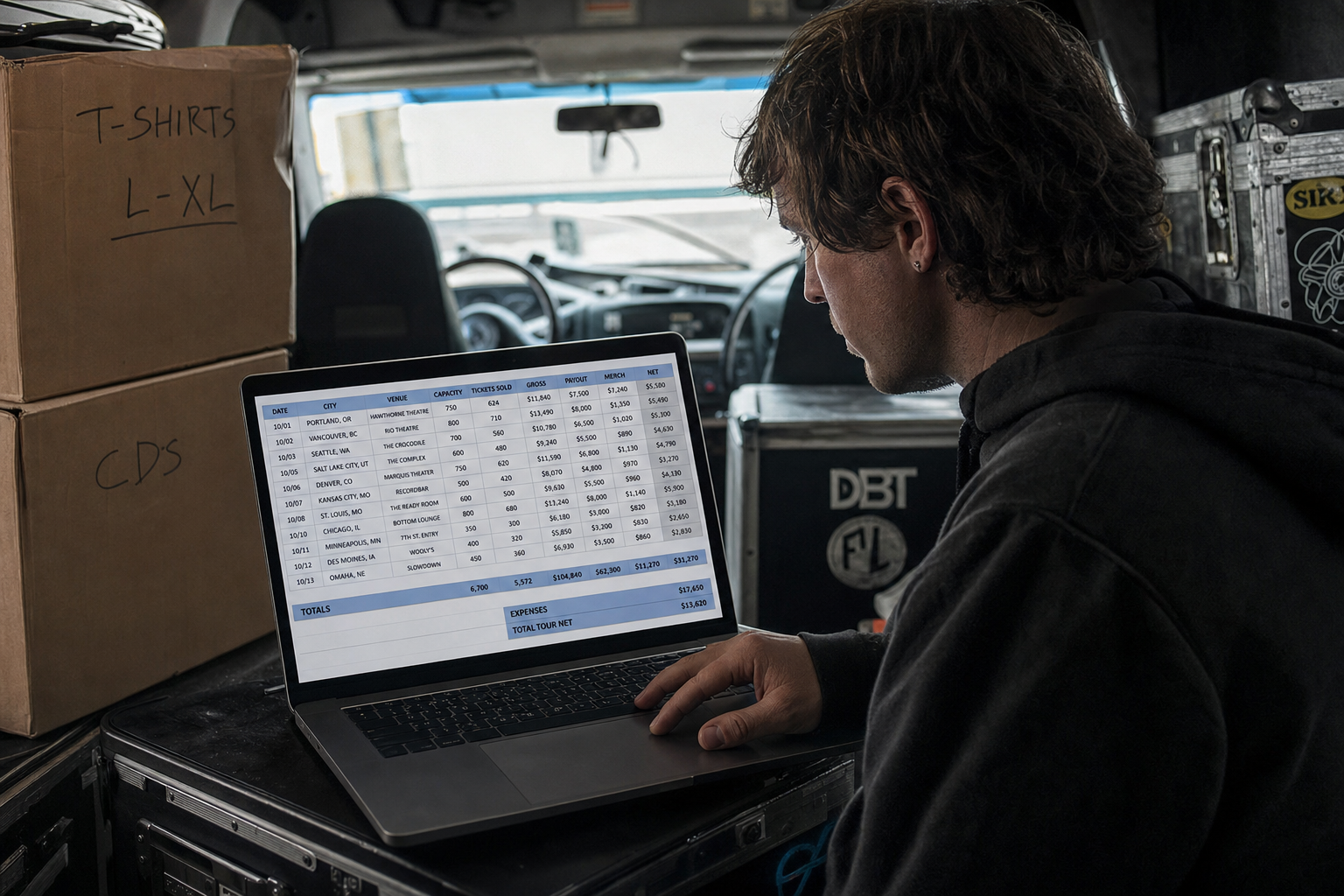

Key Takeaways
Touring without a forensic P&L budget often results in heavy losses; merchandise sales are what keep indie runs profitable.
Understand the mechanics of venue door splits, production deductions, and merch concession fees before signing dates.
Route tours tightly to minimize travel overhead, fuel costs, and lodging expenses during multi-city runs.
Optimize high-margin merchandise items and capture fan data at the merch table to fund future tour legs.
Most independent artists lose money on their first tour. The math is brutal: van hire, fuel, lodging, guarantee splits, and rider costs stack up faster than ticket revenue ever will. Merch is often the only line item that keeps the entire run from going red.
Touring can bankrupt an unprepared artist. Most emerging acts lose money on their first run because they build the budget backwards. They book the shows, then panic over logistics. By then, the math is already broken.
This breakdown covers the real costs of a multi-city tour: van rentals, fuel, per diems, deal structures, routing strategy, and why merch is often the only line item that keeps you solvent. If you're planning your first regional or national run, this is the operational framework you need before you confirm a single date.
The two deal structures you'll see (and when to walk away)
Most small to mid-sized venues offer one of two models: a guarantee or a door split. Understanding which one protects your downside is the difference between breaking even and bleeding out.
Guarantee: The venue pays you a flat fee regardless of turnout. You get paid even if three people show up. This is your safety net early on. If a promoter offers $300 to $800 guaranteed, you can model your budget around that number with confidence. The downside: if you pack the room, you don't see the upside. You leave money on the table.
Door split: You and the venue split ticket revenue after expenses. Common structures are 70/30 or 80/20 in your favor, but only after the venue recoups sound, staff, and marketing costs. On paper, this sounds artist-friendly. In practice, "expenses" can eat half the gross before you see a dollar. Always ask for the expense breakdown in writing before you agree.
When to walk: If a promoter offers pay-to-play (you buy tickets upfront and resell them), walk. If they offer exposure as compensation, walk. If the door split includes uncapped expenses with no transparency, walk. Your time and gas cost money. Treat them that way.
Routing strategy: The hidden cost multiplier
Bad routing destroys margins. If you zigzag across three states to play four shows, your fuel and lodging costs will outpace your guarantees. Smart routing is about geography, not opportunity.
Cluster your dates. Book regionally first. A loop through the Southeast (Atlanta, Charlotte, Nashville, Birmingham) over six days will cost a fraction of what a scattered national run costs. You stay moving, you minimize backtracking, and you reduce dead travel days.
Avoid one-offs. A single show in Denver between two Midwest dates might feel worth it, but the drive will cost you $400 in gas alone, plus a lost day you could have used to advance another market. Every show needs to justify its place in the route, not just the lineup.
Use radius clauses carefully. Some venues require you not to play within 50 to 100 miles for 30 to 90 days before or after the show. If you're routing a region, make sure your buyer's radius clause doesn't box you out of nearby markets that would otherwise make sense.
The real cost of the road: Line by line
Here's what a 10-day, 8-show regional tour actually costs for a four-piece band with one crew member.
Van rental: $1,200 for 10 days (cargo van or small Sprinter).Fuel: $800 (estimate $80/day at 300 miles/day average).Per diems: $1,500 ($30/day per person, five people, 10 days).Lodging: $1,200 (split rooms, $150/night for 8 nights, budget motels or band housing).Merch production: $1,000 (upfront cost for shirts, vinyl, or posters you'll sell on the road).Misc/emergency buffer: $500 (parking, tolls, gear repair, food overages).
Total outlay: $6,200 before you've made a dollar.
Now assume you're getting $500 per show as a guarantee. Eight shows at $500 each is $4,000 gross. You're $2,200 in the red before merch.
This is why merch math matters.
Merch is not a side hustle. it's your profit center.
If you sell $150 to $300 in merch per night, you're adding $1,200 to $2,400 over eight shows. That swings you from a $2,200 loss to break-even or a small profit. Merch is often the only reason a tour doesn't bankrupt you.
What moves: T-shirts and vinyl. Shirts should be priced at $20 to $25. Vinyl at $20 to $30 depending on pressing cost. Posters and stickers are margin fillers, not anchors. Don't lean on them.
Production cost: Budget $6 to $8 per shirt (including printing), $10 to $12 per vinyl unit if you're pressing 300 or more. That means a $25 shirt nets you $17 to $19. A $25 vinyl nets you $13 to $15. You need volume, but the margins are real.
Merch display matters. Have a lit table, price signs, and someone working it all night. If your merch is shoved in a corner with no visibility, you're losing 40% of potential sales. Treat the table like a storefront, because that's what it is.
How to model the break-even before you book
Before you confirm the tour, build a break-even model. List every cost. Add your guarantees. Add conservative merch projections (assume $150/night unless you have data that says otherwise). If the model shows a loss you can't cover, don't book the tour yet.
Either renegotiate deals, cut costs (fewer people, cheaper lodging, tighter routing), or add dates that improve the margin. The goal is not to get rich. The goal is to not go broke while you build an audience in new markets.
What this tour actually buys you
A break-even or small-profit tour is a win if it's your first or second run. You're not touring to make money yet. You're touring to prove demand, capture emails, build relationships with local promoters, and create content (video, photos, testimonials) that supports your next campaign.
But none of that matters if you go into debt and can't afford to do it again. The math has to work, or the strategy is broken from the start.
Next steps: Before you route your tour, make sure your release calendar supports it. Timing your tour around a single or EP drop maximizes the return on both efforts.
Ready to streamline your workflow?
Stop piecing together spreadsheets and scattered notes. Join the waitlist for Music Artist Manager and get your entire rollout in one place.
Written By
Gavin Alexander
Senior Marketeer
As the founder of Music Artist Manager, Gavin has spent years at the intersection of music and technology. Seeing firsthand how chaotic release rollouts and split sheets can be, he designed a platform that brings major-label infrastructure to independent artists and their teams. He writes extensively about industry trends, artist leverage, and workflow optimisation.