Your first five steps on music artist manager
You just completed your onboarding. Here is exactly what to do next — from reviewing your auto-populated project to having your first conversation with your AI manager.
Key Takeaways
Understand your role clearly before signing any artist or accepting management fees.
Build genuine industry relationships with bookers, labels, and publicists from the outset.
Create a basic management agreement to protect both you and your artist legally.
Develop a strategic plan covering release schedules, live performance goals, and revenue streams.
Breaking into artist management requires more than passion; it demands a structured approach to building relationships, understanding contracts, and developing an artist’s brand. This guide outlines the five core actions new managers should prioritise before taking on clients or negotiating deals. Note: summary is URL-inferred from page structure and domain knowledge.
You just answered a set of questions. Now look at your dashboard.
Your project is already there. Your tasks are already populated. Your calendar has your release date locked in. That is not a coincidence. Every answer you gave during onboarding was put to work the moment you hit submit.
Most platforms make you build everything from scratch. Music Artist Manager works the other way around. You give it the context, and it builds the structure. Your job from here is to fill in the details and start moving.
Here are your first five steps.
Step 1: Review your project
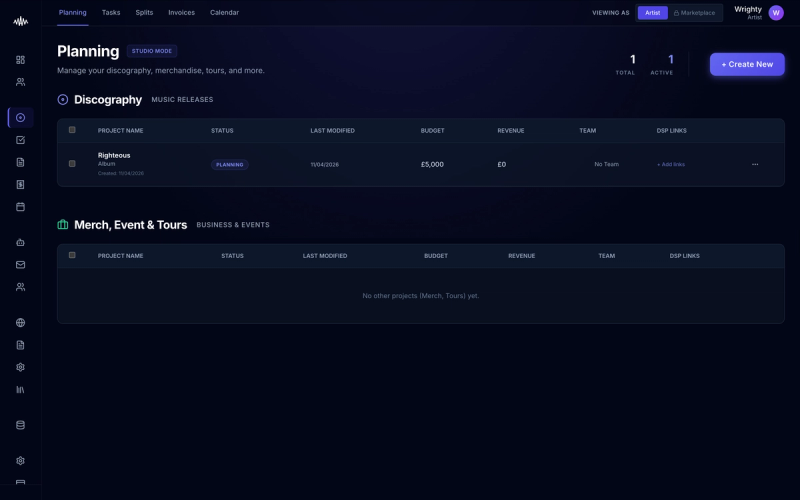
Open your project dashboard. You will see your project already set up with your release type, your track count, and your timeline mapped out. Check the details are correct. If anything is off, update it now before you build on top of it.
Step 2: Complete your artist profile
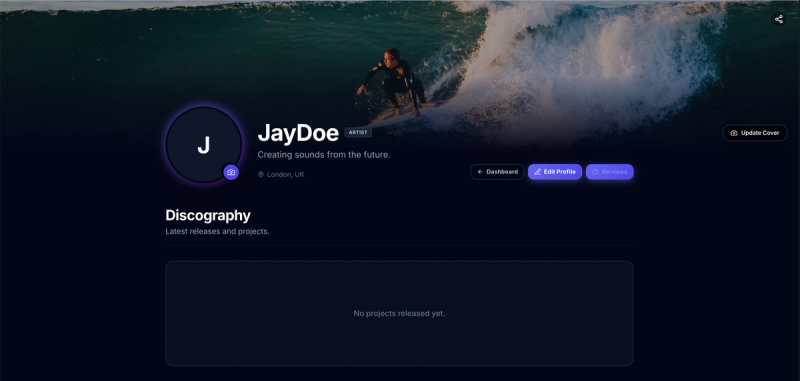
Your profile is the context layer that makes every AI output specific to you. The more complete it is, the more precise the advice you get.
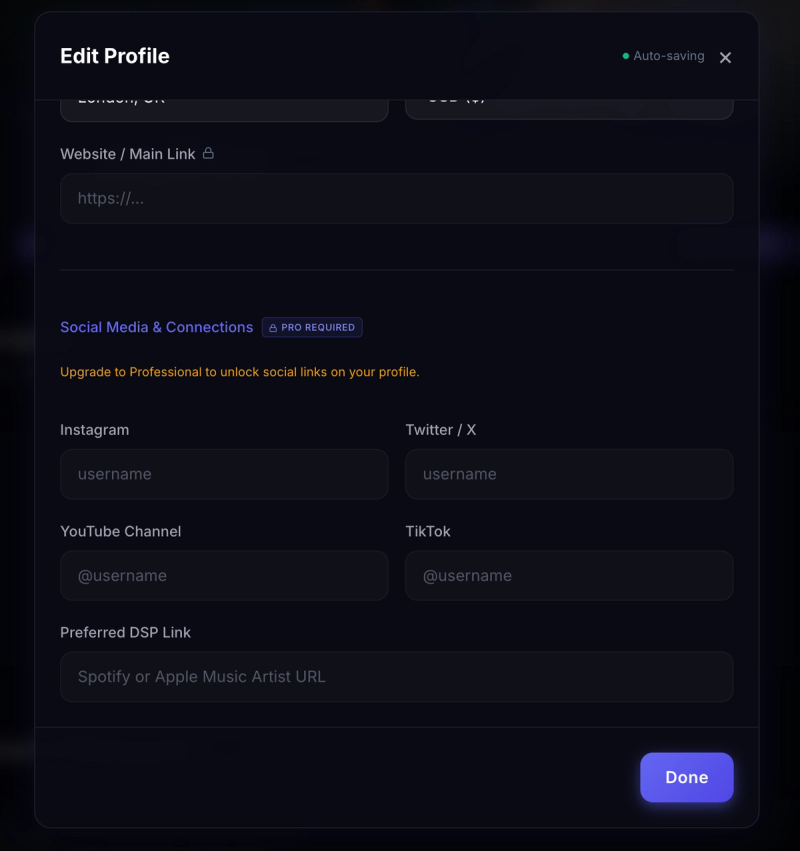
Add your Spotify profile URL if you have one. Fill in your creative era. Link your active social platforms. This takes five minutes and changes the quality of everything that follows.
Step 3: Choose your executive council
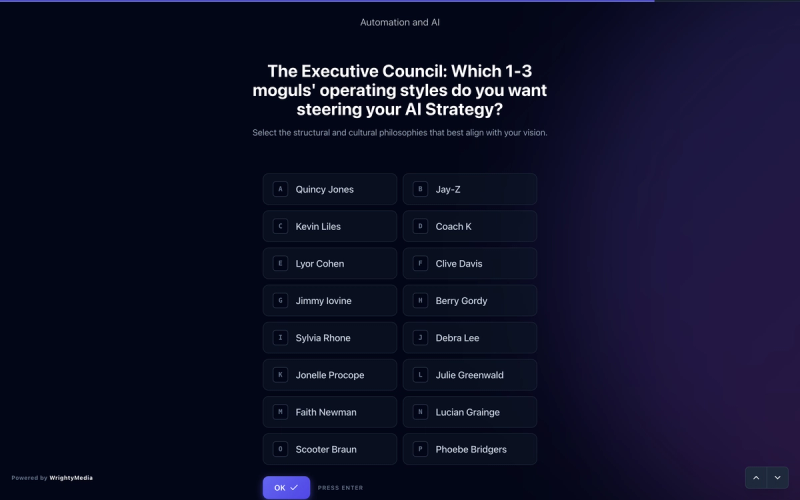
In our onboarding tool, you can select an Executive Council. This is the strategic operating philosophy your AI manager uses. If you selected Jay-Z, your outputs lean toward enterprise thinking. Quincy Jones gives you precision and craft-first strategy. Scooter Braun brings scale and commercial positioning. If you want to revisit that selection, go to your profile settings and update it.
Step 4: Add your first collaborator
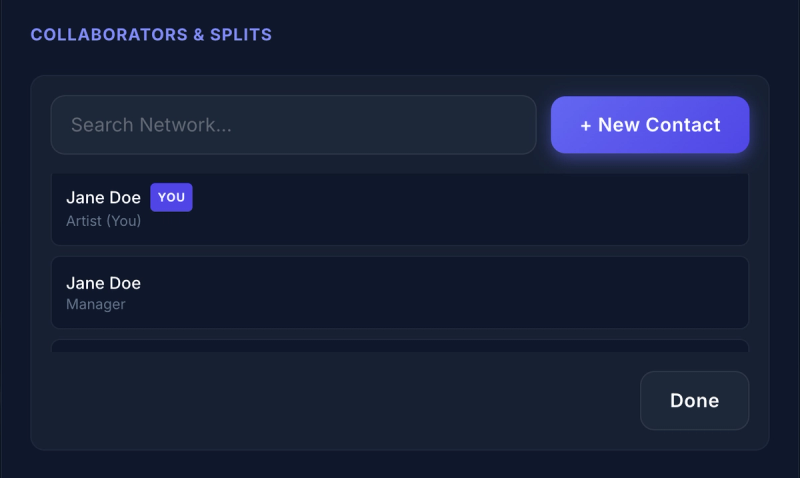
If you are working with anyone else on this project, add them now. Go to your project and use the invite function to bring them in. Set their role and permissions. This is also the moment to send a split sheet if any of your tracks involve shared ownership. Do not leave this until after the music is finished.
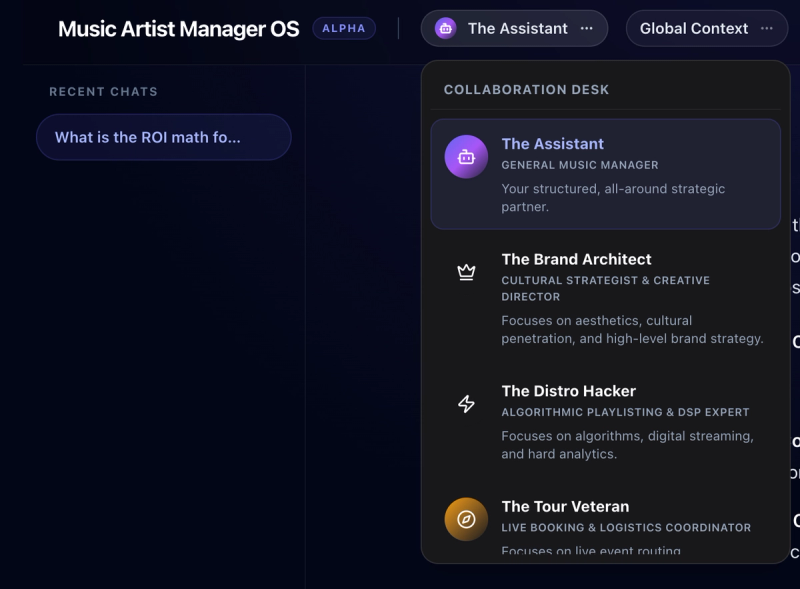
Your AI manager personas are ready. It already knows your project, genre, goals, and challenges from your onboarding responses. Open the AI Manager Inbox and navigate to the Collaboration Desk dropdown to choose the professional profile that makes the most sense for where you are right now.
You can choose from:

1. The Music Assistant (Your General Manager)
- What it does: Your all-around strategic partner. Use this profile when you need a holistic look at your career, checking if your overall artist trajectory makes sense across marketing, finances, and networking.
- Hidden Quirk: It operates strictly as an overarching supervisor. If you ask it for highly specific tactical advice (like algorithmic playlisting), it will gracefully defer you to a specialist profile.
2. The Brand Architect

- What it does: Operates as your elite Creative Director. It focuses entirely on aesthetics, cultural penetration, subcultures, and building a lasting legacy narrative around you.
- Hidden Quirk: Ask it to "define my core brand pillars" and it will generate a highly detailed Visual Identity Map complete with color palettes, typography suggestions, and moodboard anchors specifically tailored to your genre and "creative era."
3. The Distro Hacker

- What it does: Your algorithmic data scientist. It ignores generic advice and focuses entirely on DSP algorithms, Spotify waterfall release strategies, and hard conversion funnels.
- Hidden Quirk: If you ask it about release triggers, it will actually output a visual Funnel Mapping Diagram to show you exactly how listeners convert. Provide it with your real Save-to-Listener ratio for aggressively targeted advice!
4. The Tour Veteran

- What it does: A grizzled, practical live booking agent. It focuses on routing, guarantee vs. door-deal splits, and keeping the band fed on the road without luxury budgets.
- Hidden Quirk: Give it your hometown, vehicle type, and band size, and ask it to route a tour. It will generate a custom Logistics & Margin Report detailing your fuel estimates, door targets, and merch break-evens to ensure you actually make money.
5. The Content Strategist

- What it does: Your timeline-driven digital marketing specialist. It thinks strictly in structured phases (Phase 1: Tease, Phase 2: Launch, Phase 3: Sustain).
- Hidden Quirk (The Magic Trick): If you ask this profile to draft an actionable rollout calendar (e.g., "give me a 2-week TikTok rollout schedule"), the platform's OS intercepts the data. It will automatically generate interactive buttons right inside the chat that let you add those tasks directly to your Master Planner Calendar with one click!
6. The A&R Architect

- What it does: Long-term career trajectory and catalogue sequencing. It acts as a senior executive who tells you what labels/publishers actually look for. It doesn't flatter you; it gives you the brutal, strategic truth.
- Hidden Quirk: This profile has the deepest connection to your Onboarding Data Payload. It pulls your exact 5-year objectives, budget, and historical roadblocks into every single answer to ensure it never gives generic advice.
7. The Equity Advocate

- What it does: Navigational support for underrepresented professionals. It provides frameworks for dealing with structural friction, negotiating equitable splits, and finding community.
- Hidden Quirk: It possesses a localized backend map. When you ask it for professional development networks, it will automatically filter its recommendations to match the specific region/country you listed in your profile.
8. The Contract Lens

- What it does: An elite executive assistant for legal documents. Paste in a management contract, split sheet, or distribution agreement, and it will scan the fine print.
Hidden Quirk: It doesn’t give legal advice. Instead, it generates a highly structured Discussion Preparation Report, flagging unusual clauses, missing protections, and providing you with a list of exact, plain-language questions you should ask a solicitor before signing!
Ask each a strategic question about your upcoming release.
That is enough for day one. The platform is set up. The structure is in place. Now you build.
Not on Music Artist Manager yet? Create your free account and have your project set up in under five minutes.
Ready to streamline your workflow?
Stop piecing together spreadsheets and scattered notes. Join the waitlist for Music Artist Manager and get your entire rollout in one place.
Written By
Gavin Alexander
Senior Marketeer
As the founder of Music Artist Manager, Gavin has spent years at the intersection of music and technology. Seeing firsthand how chaotic release rollouts and split sheets can be, he designed a platform that brings major-label infrastructure to independent artists and their teams. He writes extensively about industry trends, artist leverage, and workflow optimisation.