The equity advocate: Why your music manager should prioritize human preservation over profit
Why the equity advocate role protects your career, structures fair deals, and builds your team without requiring industry credentials.
Key Takeaways
Most managers chase placements and deals. Equity advocates protect artists from the power structures that come with them.
If you're building alone, you're also carrying the legal, financial, and emotional load that should be shared with a co-founder structure.
Burnout isn't a personality flaw. It's what happens when artists operate without structural protection or equitable splits from day one.
You don't need credentials to be taken seriously. You need clarity on ownership, transparent splits, and someone who knows how the room works.
Most managers tell artists what to do. Equity advocates ask what the artist needs to survive. This article explains how the equity advocate model protects your health, structure, and career without asking you to prove you belong first.
Most artist managers take a percentage and call it alignment. The equity advocate does something harder. They restructure power before the deal is signed.
This is not traditional management. It's a protective model built around human preservation, equitable ownership, and professional development that doesn't care about your resume. If you're an independent artist trying to build without burning out, or a manager who wants to operate differently, this is the blueprint.
What an equity advocate actually does
An equity advocate is a manager who treats the artist as a co-founder, not a client. That means shared infrastructure, transparent split structuring, and ongoing education that happens in real time, not after the damage is done.
Here's what that looks like in practice:
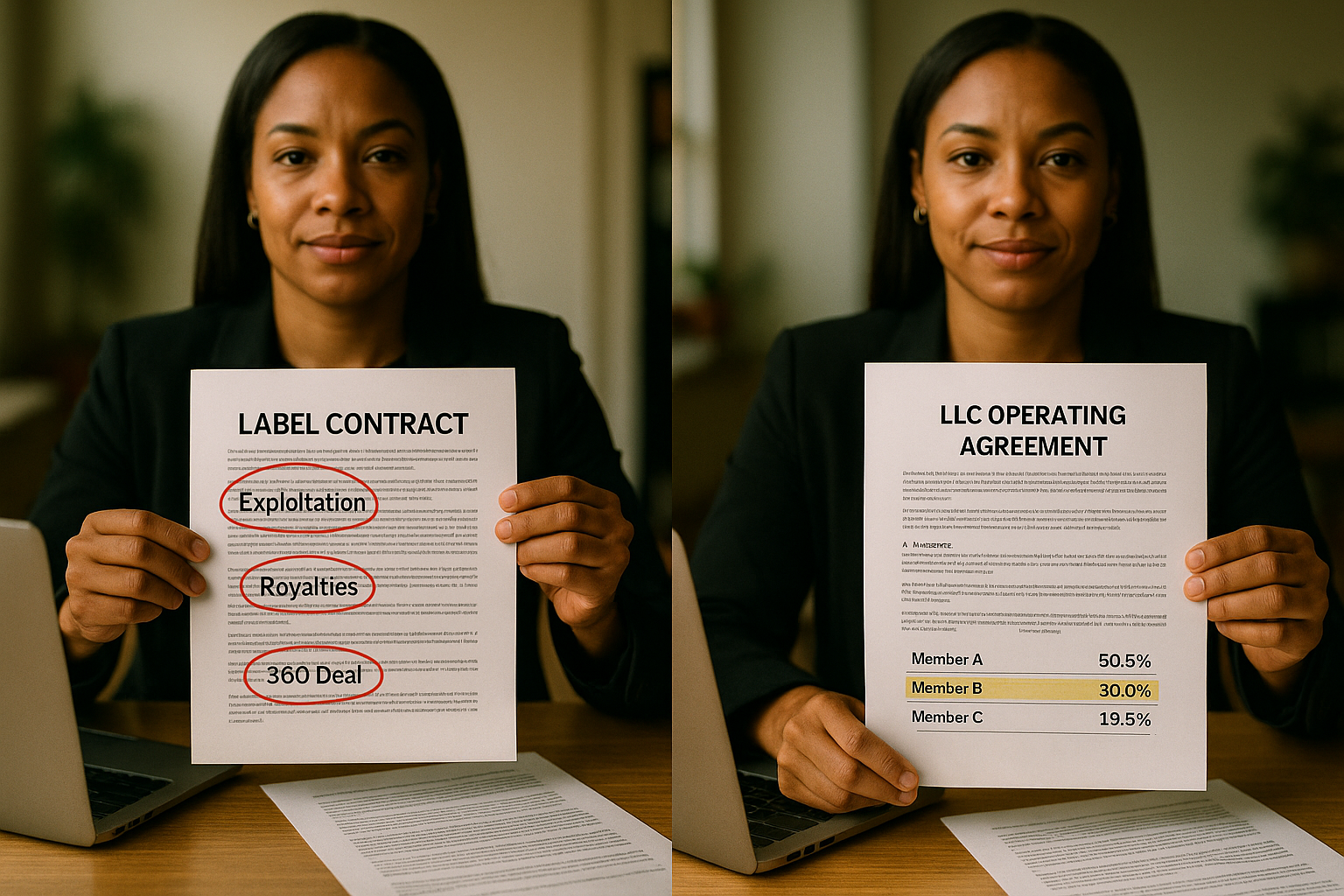
Co-founded LLCs.You and your manager form a legal entity together. This isn't symbolic. It means joint ownership of the business structure, shared decision-making, and splits that reflect contribution, not industry default percentages.
Equitable deal architecture.Every contract, publishing split, and advance gets reviewed through one lens: does this protect the artist's long-term equity, or does it trade future value for short-term cash? The equity advocate pushes back on predatory terms before you're in the room.
Credential-free professional development.You don't need a degree or industry connections to access this knowledge. The equity advocate teaches DSP mechanics, royalty waterfall structures, catalogue strategy, and release sequencing as part of the relationship. You learn by doing, with someone who has already done it.
Burnout prevention as infrastructure.This isn't about self-care messaging. It's about building release calendars that don't demand output you can't sustain, budgets that don't force you into debt cycles, and team structures that don't collapse when you need a break.
Why this model exists
Traditional management operates on a commission model: the manager takes 15 to 20 percent of gross income and acts as a service provider. That structure works when the artist already has leverage. But for independent artists, it often creates misalignment.
You're building a catalogue from scratch. You're funding your own releases. You're trying to grow an audience without label support. A percentage of nothing is still nothing, so the manager's incentive is often to push for faster growth, bigger advances, and shorter timelines. That can lead to burnout, bad deals, and catalogue fragmentation.
The equity advocate flips the model. Instead of taking a cut and optimizing for short-term revenue, they co-own the business and optimize for long-term equity. That means slower growth is fine if it protects the artist's health and catalogue value. It means turning down deals that don't serve the 10-year plan. It means teaching the artist to negotiate their own contracts, even if it makes the manager less essential over time.
This is management as infrastructure, not extraction.
How equitable deal structuring actually works
Equitable doesn't mean equal. It means fair based on contribution, risk, and value creation. Here's how that gets structured:
Publishing splits.If you write the song alone, you own 100 percent of the composition. If your manager helps structure the concept, arranges co-writes, or funds the demo, you discuss a split that reflects that input. Nothing is assumed. Everything is documented.
Master ownership.You own your masters unless you explicitly choose to share ownership in exchange for funding or distribution support. If your manager advances recording costs, you agree on a recoupment structure that doesn't trap you in debt or force you to give up equity you can't get back.
LLC operating agreements.If you form a co-founded LLC, the operating agreement defines profit splits, decision-making authority, and exit terms. This protects both parties. You know exactly how revenue flows, who controls what, and how the relationship ends if it needs to.
Advance negotiations.When a label, distributor, or sync opportunity offers an advance, the equity advocate models the recoupment timeline and long-term royalty impact. If the advance costs you more in backend revenue than it provides upfront, you walk. If it accelerates your plan without gutting your catalogue value, you take it.
This isn't theoretical. These are the actual decision points where independent artists lose leverage because they don't have someone in the room who knows how to run the numbers.
Burnout prevention as a business strategy
Burnout isn't a personal failure. It's a structural outcome of bad planning. The equity advocate treats it like a budget line: if your release calendar, touring schedule, or content output isn't sustainable, the plan is wrong.
Here's how that gets built in:
Release windows that match capacity.If you can't sustain a single every six weeks, you don't release a single every six weeks. You build a plan around what you can actually deliver without sacrificing quality or mental health.
Revenue diversification.You don't rely on one income stream. You build catalogue royalties, sync placements, session work, teaching, or production income so that one bad quarter doesn't collapse your entire financial model.
Team structure that scales.You don't hire a full team before you need one. You start with a co-manager or equity advocate who can handle multiple roles, then add specialists (publicist, tour manager, creative director) only when the revenue supports it.
Exit plans for bad deals.Every contract you sign includes a clear exit clause. If a partnership isn't working, you know exactly how to end it without losing your catalogue or your revenue.
This is what protection looks like in practice. It's not aspirational. It's operational.
Why this model isn't standard
Because it requires the manager to care more about the artist's equity than their own commission. Most managers can't afford to do that, especially early in an artist's career when revenue is low. The equity advocate model only works if the manager has other income, believes in the long-term value of the catalogue, or is willing to take less upfront for bigger backend participation.
That's a feature, not a bug. It filters for managers who are actually aligned with your long-term success, not just your next release cycle.
Who this model is for
This is for independent artists who want to build a business, not just release music. It's for managers who want to operate as co-founders, not service providers. It's for anyone who understands that the industry's default structures weren't designed to protect artists, and that building differently is the only way to survive long-term.
If you're an artist, you don't need permission to demand this model. You need to know it exists and find someone who operates this way.
If you're a manager, you don't need a certification to offer this model. You need to structure your deals around equity, teach as you go, and build infrastructure that protects the artist's long-term value.
This is how you manage without extracting. This is how you build without burning out. This is the equity advocate model.
Ready to streamline your workflow?
Stop piecing together spreadsheets and scattered notes. Join the waitlist for Music Artist Manager and get your entire rollout in one place.
Written By
Gavin Alexander
Senior Marketeer
As the founder of Music Artist Manager, Gavin has spent years at the intersection of music and technology. Seeing firsthand how chaotic release rollouts and split sheets can be, he designed a platform that brings major-label infrastructure to independent artists and their teams. He writes extensively about industry trends, artist leverage, and workflow optimisation.