Why independent artists are winning on physical sales (and why streaming is no longer the answer to catalog growth)
How 63% of physical album sales now bypass retail, and why independent artists should treat streaming as discovery, not revenue.
Key Takeaways
63% of first-week physical album sales now come from artist-owned channels, not retail.
Streaming builds awareness. Direct-to-fan channels build revenue. The funnel is inverted.
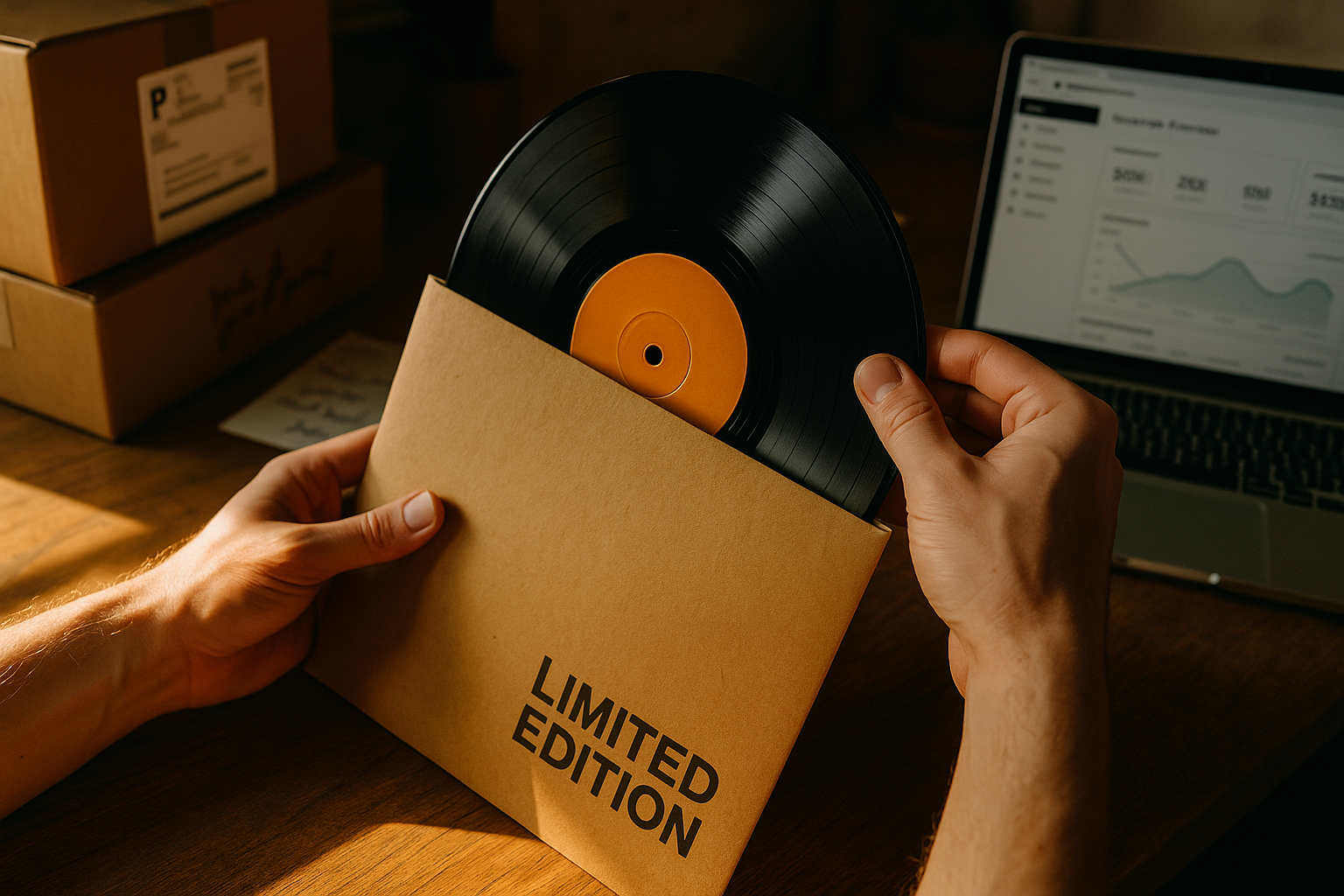
Physical scarcity creates premium pricing. Limited runs justify margins 3 to 5 times higher than streaming.
Owning your fan email list is more valuable than owning your master recordings without distribution.
Why 63% of Physical Album Sales Now Happen Direct-to-Fan (And What That Means for Your Release Strategy)
The numbers just flipped on streaming-first artists
In 2024, 63% of first-week physical album sales in the US came from direct-to-fan channels. Not Target. Not Amazon. Not your distributor's retail network. Direct.
This is not a trend. It's a structural inversion of how fans buy music. If you're still building your release strategy around streaming payouts and hoping for retail placement, you're optimizing for the wrong revenue channel.
Here's what changed: streaming became the discovery layer. Direct sales became the conversion layer. The artists who understand that split are monetizing their catalog at 3-5x the margin of those who don't.
What the data actually says
Luminate's 2024 Year-End Report shows clear consolidation of first-week album purchases toward artist-owned channels: Bandcamp storefronts, Shopify sites, and direct web sales. Meanwhile, retail shelf space continues to shrink, and streaming payouts remain flat or declining for mid-tier artists.
MIDiA's 2024 independent label survey found 75% of respondents agree "it is time for a new model to run alongside streaming." Translation: labels are already repositioning streaming as a discovery tool, not a revenue driver.
Physical scarcity is now a feature, not a bug. Vinyl, cassettes, signed variants, and limited runs perform because they're the proof of fandom. Fans who care enough to purchase expect to buy directly from you. If they can't, they won't.
The new conversion funnel
Old model: build streams → earn royalties → grow awareness.
New model: build community → create scarcity → capture full-price sales direct → use streaming to seed awareness only.
Here's how it works in practice:
- Playlist or TikTok viral moment drives discovery (30% of promo budget here).
- Listener becomes aware, streams a few tracks (DSP does its job).
- You capture email via landing page, presave, or content gate.
- You launch D2C offer 48 hours before public release to your list.
- 50% of first-week sales come from email, 25% from social, 25% from organic.
This is the funnel. Streaming metrics measure reach. D2C sales measure revenue. You need both, but only one pays your rent.
Who this applies to
Artists with 5,000 to 500,000 engaged fans. That's enough volume to generate meaningful D2C revenue, but too small for retail placement.
Artists releasing physical product in any form: vinyl, cassette, CD, or limited-run formats.
Artists who are not 100% dependent on streaming income and can be strategic about where they promote.
Who this does not apply to
Artists with fewer than 1,000 engaged fans. The fulfillment overhead outweighs the margin until you have volume.
Artists releasing digital-only. But consider adding one physical drop per year as a test. The data suggests it's worth it.
Artists locked into label deals that dictate distribution. But you should negotiate D2C carve-outs in your next contract.
Six actions to take this quarter
1. Audit your sales mix
Pull the last 12 months of revenue by channel: Spotify, Apple Music, Bandcamp, merch, anything else. If D2C represents less than 20% of your non-streaming revenue, you're leaving money on the table.
2. Set up a D2C storefront
Choose Bandcamp, Shopify, or a platform built for artists (Lutely, Bridge, etc.). Minimum viable product: one physical variant (vinyl, cassette, or limited CD) plus a digital bundle. You can expand from there.
3. Create scarcity and exclusivity
Do not release unlimited quantities. Use limited runs (500 copies, numbered), special variants, or signed editions. Price vinyl at $20-35. That's not greed. That's the market rate for a premium loyalty product.
4. Build your email list ruthlessly
Every D2C purchase must capture an email. Use pre-release announcements to that list 48 hours before public launch. Track your email-to-sale conversion rate. Aim for 50% of first-week sales to originate from email.
5. Use streaming to seed, not monetize
Allocate 30% of your promo budget to playlist pitching and algorithmic discovery. The goal is not royalties. The goal is to get 10x more listeners on the DSP, knowing 5% of them will see your D2C offer and convert.
6. Track and iterate
After each release, measure: streams-to-D2C conversion rate, average D2C order value, and repeat purchase rate. Optimize the funnel, not just the output. The artists who win here are the ones who treat this like operations, not art.
The mindset shift
The era of "write a hit, wait for the royalty check" is over. Today's independent artist is a direct-to-fan operator first, a recording artist second.
Your master recordings are not the revenue engine. They're a permission slip to enter fans' attention. The revenue engine is the pipeline you build: the email list, the storefront, the fulfillment flow, the relationship.
Streaming is the awareness moat. D2C is the profit center. Treat them accordingly.
When Taylor Swift reclaimed her masters, she didn't just own the recordings. She owned the direct relationship with millions of fans who would buy from her, not through her. That's the model. Catalog ownership is worthless if you can't monetize it at scale through direct channels.
You don't need her audience to make this work. You need her structure.
Ready to build your D2C pipeline? Download the D2C Operations Guide: inventory strategy, email funnel, pricing psychology, and a 90-day launch calendar built for independent artists.
Sources:
- Luminate 2024 Year-End Music Report: Physical Sales & Streaming Trends
- Music Business Worldwide: "Global Audio Streams Jumped 14% in 2024 to 4.8 Trillion"
- Neon Music: "Independent Artists Make Money in 2025: Direct-to-Fan Sales Now 63% of First-Week Physical Revenue"
Ready to streamline your workflow?
Stop piecing together spreadsheets and scattered notes. Join the waitlist for Music Artist Manager and get your entire rollout in one place.
Written By
Gavin Alexander
Senior Marketeer
As the founder of Music Artist Manager, Gavin has spent years at the intersection of music and technology. Seeing firsthand how chaotic release rollouts and split sheets can be, he designed a platform that brings major-label infrastructure to independent artists and their teams. He writes extensively about industry trends, artist leverage, and workflow optimisation.