Escaping the streaming trap
How to build a predictable direct-to-fan revenue stack using Patreon, Shopify, and Discord without relying on streaming payouts.
Key Takeaways
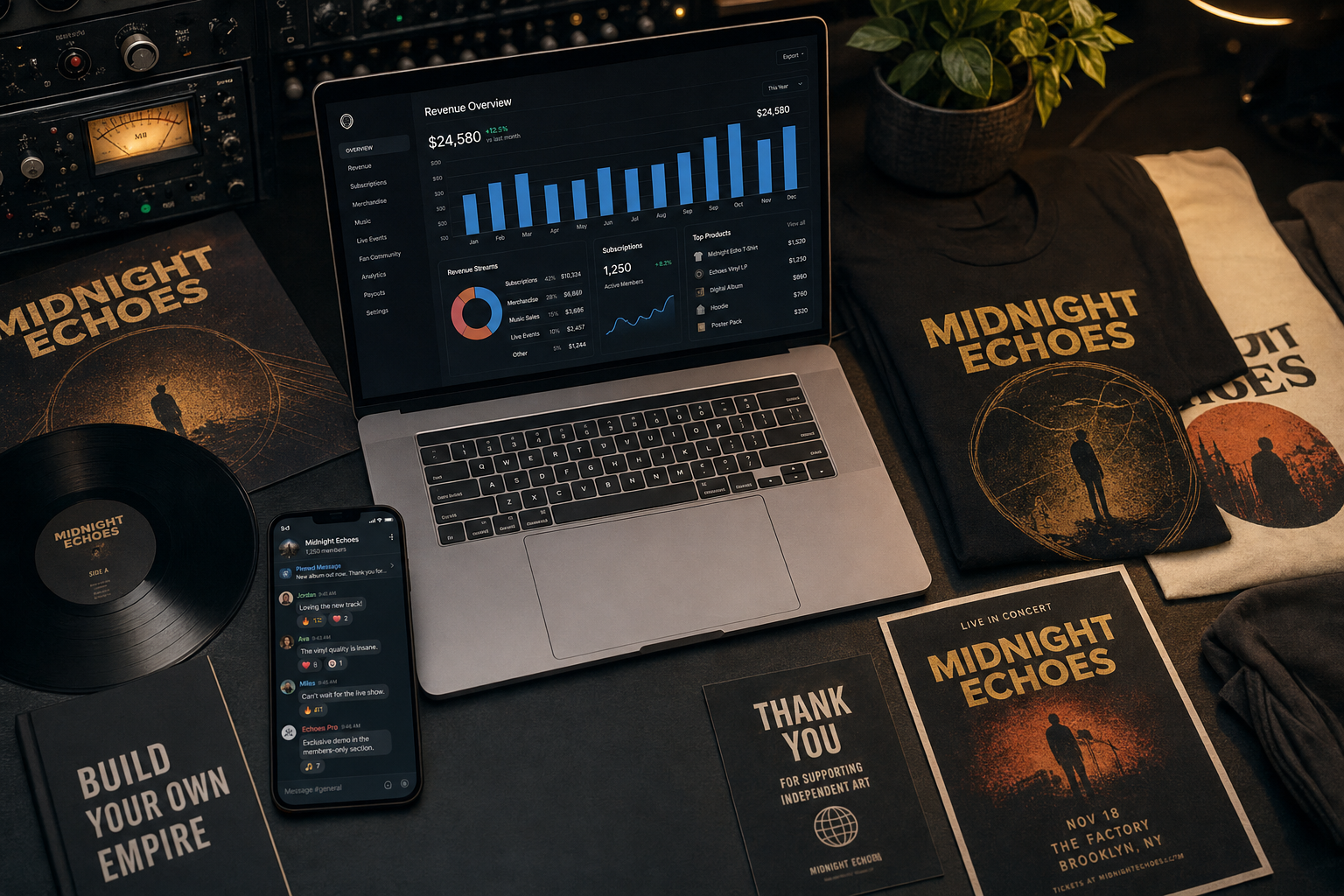
DSP royalties alone will not fund a career. You need owned revenue channels.
Subscription models through Patreon create predictable monthly income and tighten the artist-fan relationship.
Exclusive merch drops via Shopify drive urgency and let you segment audiences based on real purchase behaviour.
Discord communities turn passive listeners into active participants who show up for every release and campaign.
Most independent artists still rely on DSP income as their primary revenue source. That model is broken. This guide walks you through the exact software stack and fan engagement infrastructure you need to build predictable income outside the streaming trap.
If you're managing an artist who's pulling 50,000 monthly streams on Spotify and still can't afford rent, you already know the math doesn't work. At $0.003 to $0.005 per stream, that's $150 to $250 a month before splits. This isn't a sustainability model. It's a marketing expense with a payout attached.
The alternative isn't to abandon DSPs. It's to stop treating them as your primary revenue source and start building owned channels that convert casual listeners into paying supporters. This means subscriptions, exclusive merchandise, and active fan communities. Not as side projects. As core infrastructure.
This playbook is for independent artists and their management teams who are ready to operate like a direct-to-consumer brand. You don't need a label's budget. You need the right stack, a clear monetization strategy, and the discipline to execute consistently.
The direct-to-fan revenue stack: What you actually need
Your tech stack determines how efficiently you can convert attention into revenue. Here's what that looks like in practice.
Subscription platform: Patreon
Patreon is the standard for a reason. It handles recurring billing, tier management, and content delivery without requiring you to build backend infrastructure. You set up membership tiers, deliver exclusive content, and collect predictable monthly income.
Amanda Palmer runs one of the most successful musician accounts on Patreon, generating over $1 million annually from roughly 15,000 patrons. Her tiers range from $1 to $25+ per month. At the $5 tier, patrons get early access to new songs, behind-the-scenes updates, and patron-only livestreams. At $25+, they receive physical zines, handwritten postcards, and access to private video calls.
The model works because it's structured around exclusivity and access, not just content. Fans aren't paying for what they could pirate. They're paying for proximity and inclusion.
Tactical setup
- Start with three tiers: $3, $10, $25
- $3 tier: early song releases, patron-only Discord channel
- $10 tier: monthly Q&A sessions, exclusive demos, stem files
- $25 tier: limited physical items, one-on-one video calls (quarterly)
- Post consistently. Weekly at minimum. Monthly won't sustain engagement.
Merchandise platform: Shopify
Shopify gives you full control over your storefront, customer data, and margins. Unlike Bandcamp or print-on-demand platforms, you own the customer relationship. That means you can retarget, segment, and build lifetime value.
Taylor Swift's merchandise strategy is built on scarcity and event-based drops. Limited-edition vinyl variants tied to album cycles. Exclusive apparel that's only available for 48 hours. Numbered items that create collectibility. This isn't accidental. It's designed to generate urgency and repeat purchases.
You don't need Swift's budget to use the same framework. You need product that feels exclusive and a release calendar that creates urgency.
Tactical setup
- Use Shopify's customer tags to segment buyers by purchase history
- Create product drops tied to release cycles: pre-order bundles, limited vinyl variants, tour-exclusive items
- Set up abandoned cart emails. Shopify's native email tools are sufficient for under 1,000 monthly visitors.
- Track customer lifetime value (CLV). If your average CLV is under $40, your pricing or product mix needs adjustment.
Community platform: Discord
Discord isn't just a chat app. It's where your most engaged fans congregate, discuss your work, and build identity around supporting you. This is where you convert listeners into community members who show up for releases, buy merch, and recruit new fans.
BTS uses a combination of Discord-like platforms and proprietary community tools to organize millions of fans globally. Their fan community doesn't just consume content. They translate it, promote it, and defend it. That level of mobilization doesn't happen on Instagram comments. It happens in structured, persistent communities where fans have roles, recognition, and shared purpose.
You don't need millions of fans to make this work. You need a core group of 100 to 500 engaged members who feel like stakeholders in your success.
Tactical setup
- Create a free tier for general fans and a paid tier for Patreon supporters
- Structure channels by function: general chat, release feedback, collaborations, off-topic
- Use roles to recognize superfans: assign badges for patrons, longtime members, top engagers
- Host weekly or biweekly listening parties for new releases or demos
- Don't let the community self-moderate too early. You or your team need to be present daily until culture is established.
Subscription models: How to structure predictable income
Subscriptions work when the value is recurring and exclusive. That means you're not just gating content. You're creating ongoing access to something fans can't get anywhere else.
The mistake most artists make is treating Patreon like a tip jar. They post sporadically, offer vague "exclusive updates," and wonder why retention is low. Retention happens when the value is consistent, the content is genuinely exclusive, and the artist shows up.
What successful tiers look like
High-performing Patreon accounts structure tiers around escalating access and tangibility.
Low tier ($3 to $5): Digital exclusivity. Early releases, demos, works-in-progress, patron-only posts. This tier should convert casual fans who want to support but aren't ready to spend $10+ monthly.
Mid tier ($10 to $15): Interactive access. Monthly Q&A sessions, input on upcoming projects, access to private Discord channels, stem files or instrumentals. This tier converts engaged fans who want to feel involved in your creative process.
High tier ($25+): Physical and personal access. Handwritten notes, limited physical items, quarterly video calls, credits on releases. This tier is for superfans who view supporting you as part of their identity.
Retention strategy
Churn is your biggest problem. If you're gaining 20 patrons per month but losing 15, you're not building sustainable income. You're treading water.
Retention drivers:
- Post frequency: Weekly minimum. Twice weekly is better.
- Exclusivity: Don't repost patron content publicly within 30 days.
- Interaction: Reply to comments. Acknowledge top supporters by name.
- Delivery: If you promise monthly Q&As, deliver monthly Q&As. Missed commitments kill trust faster than anything else.
Monitor your monthly churn rate in Patreon's analytics. If it's above 10%, your content cadence or tier value needs adjustment.
Exclusive merchandise drops: Creating urgency and collectibility
Merchandise isn't passive income. It's a product launch every time. If you're just keeping a store stocked with generic t-shirts and hoping fans buy, you're leaving money on the table.
The model that works is drops: time-limited, exclusive product releases tied to moments that already have fan attention. Album pre-orders. Tour announcements. Anniversaries. Collaborations.
How to structure a drop
Pre-announce: Tease the drop 7 to 10 days in advance. Show mockups, reveal limited quantities, build anticipation.
Create scarcity: Numbered items, limited quantities, time windows (24 to 72 hours). Scarcity isn't manipulation. It's honest signaling that this product won't be available indefinitely.
Bundle strategically: Pair physical items with digital access. Vinyl + exclusive stems. Tour tee + early ticket access. Bundles increase average order value (AOV).
Track performance: Use Shopify's analytics to measure AOV, conversion rate, and repeat purchase rate. If your conversion rate is below 2%, your pricing or product-market fit needs work.
Example: Album pre-order bundle
Let's say you're releasing an album in 8 weeks. Here's a drop structure that converts:
- Week 8: Announce album. Open pre-orders for signed vinyl (limited to 250 copies), bundled with instant download of lead single and exclusive making-of video.
- Week 6: Drop limited tour tees (available for 48 hours only), bundled with early ticket access.
- Week 4: Release second single. Offer instrumental version exclusively to Patreon supporters.
- Week 2: Final push on signed vinyl. Remind fans this is the last chance.
- Release week: General merch available, but scarcity items are sold out. This reinforces urgency for next cycle.
This approach creates multiple revenue moments and rewards early supporters with exclusivity.
Building fan communities that drive revenue
A functional fan community does three things: it retains attention between releases, it organizes word-of-mouth promotion, and it generates feedback that improves your decision-making.
Discord is the best tool for this because it's persistent, threaded, and allows for tiered access. Instagram comments disappear. Subreddits are public and uncontrolled. Discord gives you a space you own, where superfans can congregate and build culture around supporting you.
Community structure that works
Public channels: General chat, new music discussion, introductions. This is where new members land. Keep moderation tight. Culture is set in the first 30 days.
Patron-only channels: Behind-the-scenes, release feedback, direct artist interaction. This is where paying supporters get elevated access.
Voice channels: Listening parties, live Q&As, co-working sessions. Voice creates intimacy that text doesn't.
Why bts's model is instructive
BTS's fan community (ARMY) operates with the coordination of a grassroots political campaign. Fans organize streaming parties to boost chart performance. They translate content into dozens of languages. They crowdfund billboards and advertising in major cities. This doesn't happen by accident. It happens because the infrastructure exists for fans to self-organize and because the group consistently rewards engagement.
You don't need millions of fans for this to work at your scale. You need 200 fans who feel ownership. Give them tools to organize. Recognize their contributions publicly. Let them shape how the community operates.
Monetization pathways from community
Communities drive revenue indirectly:
- Higher Patreon conversion because fans feel connected before they subscribe.
- Faster merch sellouts because the community hypes drops internally.
- Better feedback loops for setlists, album sequencing, and release strategy.
If your Discord is quiet, your monetization engine is underpowered. Invest the time to build it.
Putting it all together: Your 90-day build
You don't need to launch everything at once. You need a phased rollout that layers platforms as you build capacity.
Weeks 1 to 4: Set up infrastructure
- Launch Patreon with three tiers and at least five posts of backlogged exclusive content.
- Set up Shopify store with one core merch item and one limited drop tied to your next release.
- Create Discord server with basic channel structure. Invite your 50 most engaged social media followers.
Weeks 5 to 8: Build momentum
- Post to Patreon twice weekly. Deliver on tier promises.
- Run your first exclusive merch drop. Monitor conversion rates.
- Host your first Discord listening party. Get feedback. Iterate.
Weeks 9 to 12: Optimize and scale
- Analyze Patreon churn. Adjust content cadence or tier structure.
- Review Shopify AOV and repeat purchase rate. Test new bundles.
- Promote Discord access as part of Patreon tiers. Cross-pollinate your platforms.
By the end of 90 days, you should have at least one revenue stream generating predictable monthly income and infrastructure in place to scale. This isn't a side hustle. It's the foundation of a sustainable music business.
External resources
Ready to plan your next release?
Stop piecing together spreadsheets and scattered notes. Get your free release strategy and keep your whole rollout in one place.
Written By
Gavin Alexander
Senior Marketeer
As the founder of Music Artist Manager, Gavin has spent years at the intersection of music and technology. Seeing firsthand how chaotic release rollouts and split sheets can be, he designed a platform that brings major-label infrastructure to independent artists and their teams. He writes extensively about industry trends, artist leverage, and workflow optimisation.