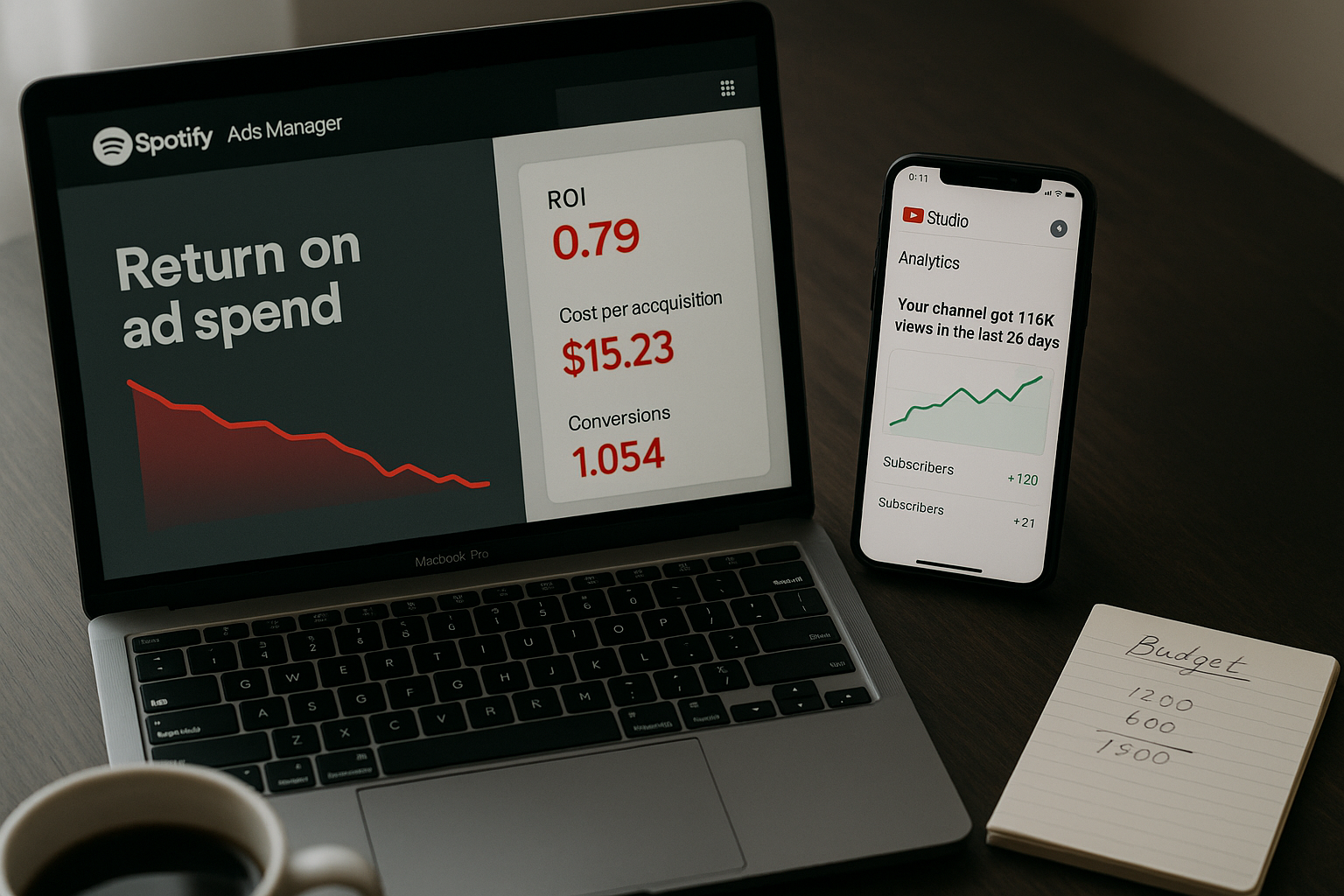
The cultural capital compounding effect: Why slow growth with deep roots beats rapid algorithmic churn
Why chasing viral moments kills long-term income, and how building cultural capital creates sustainable revenue for independent artists.

Key Takeaways
Algorithmic spikes fade fast. Cultural capital compounds over time and builds real revenue foundations.
Short-term streaming numbers mean nothing if no one cares when you release next.
Deep fan engagement creates predictable income streams. Casual listeners create unpredictable chart positions.
Slow burns outlast viral moments because they build careers, not just marketing case studies.
Algorithmic spikes feel good. They do not build careers. This article lays out why slow-burn artist development compounds over time, and how cultural capital and real fan loyalty create sustainable revenue streams that outlast any single viral moment.
Most independent artists are optimizing for the wrong metrics. They chase playlist adds, viral moments, and follower counts, then wonder why their revenue flatlines after six months. The issue is not effort. It's strategy.
A slow burn approach prioritizes cultural capital and deep fan engagement over algorithmic spikes. It treats your catalogue like infrastructure, your audience like equity, and your release calendar like a long game. This is how you build a career that compounds.
Why algorithmic spikes do not build careers
Playlisting and viral moments deliver short-term attention. That attention rarely converts to loyalty. A track that hits 500,000 streams from editorial placement might generate $1,500 in royalties and 3,000 new followers. But if those listeners never return, you have rented an audience, not built one.
The problem is structural. Algorithms reward novelty and recency. They do not reward depth. A listener who discovers you through a playlist is not invested in your story, your catalogue, or your next release. They are passing through.
Cultural capital works differently. It accumulates. It creates context. It turns casual listeners into active participants who show up for every release, buy tickets, and tell their friends. That is the foundation of sustainable revenue.
What cultural capital actually means for artists
Cultural capital is the perceived value of your work within a specific community. It is not clout. It is credibility, relevance, and trust. It is built through consistency, curation, and contribution over time.
For independent artists, cultural capital translates to:
- Higher conversion rates on merch and ticket sales
- Stronger negotiating position with venues, labels, and collaborators
- More reliable income from direct-to-fan channels
- Greater resilience during market shifts or platform changes
This is not abstract. Artists with strong cultural capital can launch a Patreon and hit $2,000 per month in their first quarter. Artists without it struggle to break $100. The difference is not talent. It is investment in relationship, not reach.
How to structure a slow burn release strategy
A slow burn strategy is not about releasing less music. It is about releasing with intention and stacking value over time.
Catalogue sequencing matters
Each release should build on the last. Think in arcs, not singles. A three-song EP released across six months with coordinated rollout beats a twelve-track album dropped with no follow-through. Spacing gives you time to work each song, gather data, and adjust your approach.
Map your catalogue to audience growth stages. Early releases should define your sound and attract your core. Mid-catalogue releases should expand your reach within adjacent niches. Later releases should deepen engagement and reward long-term fans.
Release windows and momentum cycles
Do not release into a void. Plan for pre-release, release week, and post-release activity. A standard cycle looks like this:
- Weeks -4 to -2: Pre-save campaigns, teasers, and playlist pitching
- Week -1: Press rollout and influencer outreach
- Week 0: Release day push and fan activation
- Weeks +1 to +4: Content continuation, performance videos, and behind-the-scenes material
Most artists stop at week 0. The artists who build careers keep going. Every release should have a content tail that lasts at least four weeks.
Fan engagement is not content creation
Engagement means reciprocal interaction, not posting more. It means responding to DMs, hosting listening sessions, sharing works in progress, and creating space for your audience to contribute.
The goal is to turn listeners into collaborators. Ask for feedback on artwork. Poll your audience on setlists. Share the decision-making process behind your rollout. The more your fans feel like insiders, the more invested they become.
This is time-intensive. It does not scale the way ads do. But it builds something algorithms cannot replicate: genuine loyalty.
Revenue models that reward patience
A slow burn approach shifts your revenue mix away from streaming and toward higher-margin channels. Streaming is passive income. It should not be your primary focus.
Direct-to-fan revenue channels
These include:
- Patreon or similar membership platforms: Recurring revenue from your most engaged fans. Aim for 1-3% conversion from your active audience.
- Bandcamp and direct sales: Higher per-unit margins than streaming. A $10 digital album sale is worth roughly 3,000 Spotify streams.
- Exclusive releases and variants: Limited pressings, early access tracks, and deluxe editions reward loyalty and create urgency.
The artists who succeed with these models are the ones who have spent time building trust. You cannot launch a Patreon on day one. You need cultural capital first.
Live revenue and touring strategy
Touring is where slow burn strategy pays off most clearly. Artists with deep engagement can headline small venues profitably. Artists chasing reach end up opening for others or playing to empty rooms.
Start local. Build density before you expand geography. A 100-cap room filled with fans who know every word is more valuable than a 300-cap room with 80 strangers. You will sell more merch, get better guarantees, and create more shareable moments.
Once you have density in one city, expand to adjacent markets. Use your data. Spotify for Artists and social analytics will show you where your listeners are. Route your tours accordingly.
Sync licensing and catalogue value
A deep catalogue increases your sync licensing opportunities. Supervisors look for artists with a body of work, not one-hit wonders. Every release adds to your catalogue value and increases the likelihood that a placement finds you.
Sync revenue is often unpredictable, but it scales with catalogue size. An artist with 30 songs has 30 chances to land a placement. An artist with five has five.
Register everything with a PRO (ASCAP, BMI, SESAC). Use a sync agent if you can, but do not wait for representation to start pitching. Supervisors find music everywhere.
How to measure long-term success
The metrics that matter for slow burn strategy are not the ones Instagram celebrates.
Track these instead:
- Conversion rate from casual listener to engaged fan: Measure email signups, Patreon members, and repeat purchasers as a percentage of total audience.
- Revenue per fan: Total annual revenue divided by active engaged fans. This should grow year over year.
- Catalogue engagement over time: Are old releases still being streamed? Are fans going deeper into your discography?
- Retention rate: What percentage of your audience shows up for each new release?
These metrics are harder to brag about, but they predict sustainability. An artist with 10,000 followers and a 5% conversion rate to paid fans is more stable than an artist with 100,000 followers and a 0.5% conversion rate.
Why this approach builds resilience
The music industry shifts constantly. Platforms change their algorithms. Distribution deals collapse. Trends move on. Artists who build their careers on external validation are vulnerable to every shift.
Cultural capital is portable. If TikTok disappears tomorrow, your relationship with your fans does not. If Spotify changes its royalty structure, your Patreon income stays intact. If a genre falls out of favor, your core audience still shows up.
This is not about rejecting new platforms or strategies. It is about building a foundation that does not depend on them. Use the tools that work, but do not let them own your career.
The compounding effect of patience
A slow burn strategy does not feel satisfying in month three. It feels slow. You will watch other artists spike past you. You will question whether you are doing it right.
But compounding works quietly. In year two, your old releases still drive revenue. Your fans bring new fans. Your catalogue generates passive income while you work on new material. By year three, you are not starting from zero with every release. You are building on momentum you earned.
The artists who last are the ones who treat their career like infrastructure, not a lottery ticket. Build slowly. Build with intention. Build something that lasts.
For more on how to turn niche positioning into sustainable income, read our guide on the cultural capital economy and how to monetize your niche.
Related Reading:
- https://www.musicartistmanager.com/blog/cultural-capital-economy-monetise-niche
Ready to streamline your workflow?
Stop piecing together spreadsheets and scattered notes. Join the waitlist for Music Artist Manager and get your entire rollout in one place.
Written By
Gavin Alexander
Senior Marketeer
As the founder of Music Artist Manager, Gavin has spent years at the intersection of music and technology. Seeing firsthand how chaotic release rollouts and split sheets can be, he designed a platform that brings major-label infrastructure to independent artists and their teams. He writes extensively about industry trends, artist leverage, and workflow optimisation.