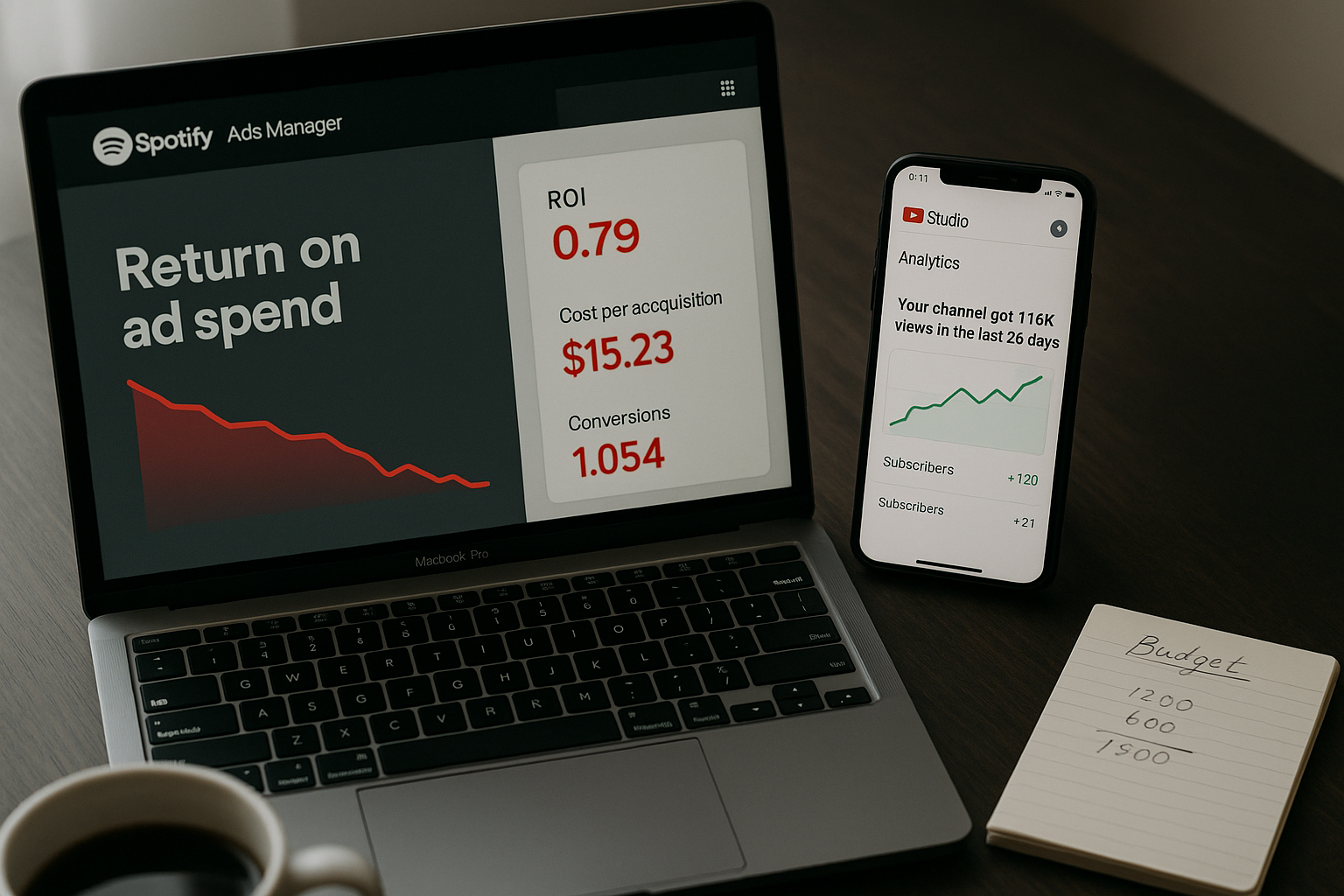
Establishing an enduring artist legacy beyond algorithmic trends
Learn how to build cultural capital that outlasts the algorithm and creates a lasting artist legacy rooted in community, not virality.

Key Takeaways
Cultural capital outlasts algorithmic trends and builds the foundation for a sustainable music career.
Deep community ties generate more long-term revenue than any single viral moment ever will.
Artistic development requires intentional investment, not just content volume or release frequency.
Legacy is built through consistent value creation, not through chasing platform mechanics.
Chasing virality won't build your catalogue equity. Cultural capital does. This piece breaks down how independent artists can invest in long-term value instead of short-term engagement spikes, using the same strategic framework that built careers that lasted decades.
You can chase virality, or you can build something that lasts. Most artists confuse the two.
Cultural capital is the deep, earned value that keeps people coming back after the algorithm moves on. It's the difference between a viral moment and a career. Between 100,000 streams that disappear and 5,000 fans who show up every time.
This is not about rejecting DSPs or ignoring data. It's about understanding what metrics actually compound over time and what burns out in 72 hours.
What cultural capital actually is
Cultural capital is trust, context, and memory. It's what happens when your work means something specific to a specific group of people. When they associate you with a sound, a perspective, or a moment in their life that matters.
It's not measured in follower counts. It's measured in whether people remember your name when they're not looking at a screen.
For independent artists, this is your competitive advantage. Major label acts can buy reach. They can't buy the kind of loyalty that comes from years of showing up with intention.
Why virality doesn't build careers
Virality is borrowed attention. It's rented space on someone else's platform, governed by rules you don't control and can't predict.
Here's what happens in most viral cycles:
- A track catches algorithmic momentum on TikTok or Reels
- Streams spike for 2-4 weeks
- Playlist adds follow, but they're often algorithmic, not editorial
- The audience that arrives doesn't know your catalogue, your story, or your next release date
- When the algorithm shifts, the streams collapse
You're left with inflated vanity metrics and no infrastructure to retain those listeners. Your catalogue doesn't grow with them. Your ticket sales don't reflect the streams. Your sync opportunities don't improve because no music supervisor trusts one-hit TikTok data.
Virality can be useful if you have a system to convert it. But most artists don't. They just ride the wave and wonder why nothing sticks.
How to build cultural capital instead
Release with sequence, not urgency
Stop dropping singles the moment they're mixed. Build a catalogue strategy that shows progression. Each release should refer back to the last and set up the next.
This means:
- Planning 6-12 months of releases at a time
- Using consistent visual language and sonic threads
- Writing catalogue notes, liner credits, and context for every drop
- Giving your audience something to follow, not just something to stream once
Sequencing builds narrative. Narrative builds cultural capital.
Own your distribution knowledge
Understand how your distributor works. Know your split percentages. Know when royalties pay out, how neighboring rights are collected, and what metadata you actually control.
This is not optional. If you don't know how your music is being monetized, you can't make strategic decisions about where to spend your time.
Most artists don't read their distribution agreements. That's why they're surprised when a track gets pulled, when splits are wrong, or when they can't access their own master rights for a sync opportunity.
Cultural capital requires ownership. You can't own what you don't understand.
Invest in depth, not breadth
Stop trying to be everywhere. Start trying to matter somewhere.
This means:
- Focusing on one or two platforms where your actual audience lives
- Building relationships with 10 tastemakers instead of chasing 10,000 faceless followers
- Playing smaller rooms where people came to see you, not where you're background noise
- Collaborating with artists whose audience genuinely overlaps with yours, not whoever has the biggest numbers
Breadth is expensive and shallow. Depth compounds.
Build community, not just content
Content is one-way. Community is two-way. If you're only posting and never responding, you're not building anything.
This doesn't mean you need to reply to every comment. It means you need to create spaces where your audience talks to each other, not just to you.
Examples:
- A Discord where early listeners get demos and vote on B-sides
- A Patreon with studio vlogs and decision-making transparency
- A mailing list where you explain why you made specific production choices
- A local monthly event where your fans meet each other, not just you
Community creates context. Context creates cultural capital.
Track the right metrics
Most artist dashboards prioritize the wrong numbers. Streams and followers are lagging indicators. They tell you what already happened, not what's working.
Track these instead:
- Email open rates (are people reading when you write?)
- Repeat listeners (how many people came back after the first stream?)
- Ticket sales per city (where is the real demand?)
- Merch conversion rates (who's willing to spend beyond a stream?)
- Sync inquiry volume (are music supervisors finding you organically?)
These metrics tell you where your cultural capital is actually accumulating.
What this looks like in practice
You're an independent artist with 15,000 monthly listeners. You've been releasing for three years. Your streams are flat, but your email list has 1,200 people with a 40% open rate. You sell out 150-cap rooms in four cities. Your Bandcamp revenue is higher than your Spotify payout.
That's cultural capital.
You're building a career that doesn't disappear when TikTok changes its algorithm. You're not chasing the same opportunities as every other artist with a viral moment. You're building leverage that compounds.
That's the difference.
Why this matters for your manager
If you're managing yourself, this is your strategy. If you're looking for management, this is what they'll evaluate. No manager wants to take on an artist whose entire value is tied to one platform or one viral moment.
They want to see:
- A catalogue that makes sense together
- An audience that shows up reliably
- Revenue streams beyond DSPs
- A clear understanding of your own business
Cultural capital is what makes you manageable. It's what turns a musician into a business that's worth investing in.
The long game
This approach takes longer. It will not give you 500,000 streams in your first month. It will not get you on every playlist.
But it will give you a foundation that lasts. It will give you an audience that grows with you. It will give you leverage when it's time to negotiate, whether that's with a label, a booking agent, or a sync supervisor.
Cultural capital is what separates artists who have careers from artists who had moments.
Build accordingly.
Ready to streamline your workflow?
Stop piecing together spreadsheets and scattered notes. Join the waitlist for Music Artist Manager and get your entire rollout in one place.
Written By
Gavin Alexander
Senior Marketeer
As the founder of Music Artist Manager, Gavin has spent years at the intersection of music and technology. Seeing firsthand how chaotic release rollouts and split sheets can be, he designed a platform that brings major-label infrastructure to independent artists and their teams. He writes extensively about industry trends, artist leverage, and workflow optimisation.