Consent by default: Why owning your masters is your shield in the AI licensing era
Learn how independent artists can protect master ownership and control AI licensing consent before signing deals that grant it away by default.
Key Takeaways
If a label owns your masters, they can licence them to AI developers without asking you first.
Independent artists who own their recordings control the licensing decision by default.
AI training data licences are a new revenue category, separate from sync or performance rights.
The contract you sign today determines whether you negotiate AI deals or fight to reclaim consent later.
On 22 June 2026, 31 global artist organisations issued a formal warning: major labels are licensing signed artists' recordings to AI developers without explicit consent, using default contract clauses. If you're independent and own your masters, you hold the one asset those artists are spending millions trying to recover. Here's what you need to protect, and how to do it now.
On 22 June 2026, 31 global artist and manager organisations issued a formal warning to the major labels. The charge: artists with standard recording contracts are being automatically opted into AI licensing deals, with no explicit consent required.
The mechanism is simple. Labels that own or control your master recordings can license them to AI developers for training data without asking you first, because the contract you signed years ago already gave them that right.
Translation: if you signed a label deal, your recordings are likely already being licensed to Suno, Udio, or Spotify's AI tools, and you don't get a vote.
The independent artist reading this has something those signed artists are spending millions trying to recover. You already own the decision.
The AI licensing market is repricing your catalogue right now
According to WPI Economics, 274 commercial AI licensing deals have been struck between AI developers and creative industries as of 2026. This is not a speculative future market. It is live, it is commercial, and it is restructuring how catalogue value works.
Here is what is shifting beneath the surface:
Masters are now a separate asset class. AI companies pay for training data rights separately from sync or performance income. If you thought your catalogue was just a stream of royalty payments, that model is outdated. Training data licenses are discrete, separately negotiable, and they don't have the same commercial ceiling as traditional licensing.
Default opt-in is now standard form. If you sign a label deal today and don't negotiate an explicit AI carve-out, you are almost certainly granting the label permission to license your masters for AI training without coming back to you. This is not buried in ambiguous language. It is considered part of the label's standard exploitation rights.
Independent artists are the only segment with structural consent sovereignty. You own your masters. No third party can license them without your signature. This is baseline legal position, not a loophole. The risk only emerges when you sign something that transfers or shares that control.
The coalition's demand signals where this is heading. Irving Azoff's Music Artists Coalition, the Featured Artists Coalition, and 29 other groups have called on labels and publishers to "end contracts built on default AI opt-ins." This is not a polite request. It is a warning shot. Artists who protect their position now will not spend the next five years in litigation trying to reclaim it.
What a "default AI opt-in clause" actually does
In a standard label recording contract, the label owns or controls the master. That control extends to how they commercialise it. If the contract grants the label broad exploitation or sub-licensing rights, and doesn't specifically exclude AI training, the label's existing rights likely cover it.
You don't get a separate signature page. You don't get a phone call. The contract you signed when you were thrilled to have a label is doing the work for them now.
This is not theoretical. The coalition's statement was triggered by real artists discovering real licensing agreements they never consented to, buried inside their label's broader deal with an AI platform.
Why independent artists are structurally protected (for now)
If you have not signed a recording deal, you own your masters. No one can license them without your explicit agreement. This is not an edge case. It is the default legal position in every jurisdiction.
The risk appears at two points:
1. Signing a label deal that includes standard-form AI opt-in language. These clauses are increasingly common in 2026 contracts. If you are negotiating a deal right now, this is where the battle happens.
2. Using a distributor or services company that includes AI licensing clauses in their terms of service. Some distributors reserve the right to sub-license your masters for promotional or platform purposes. If the language is broad enough, that could include AI training. Review this carefully.
The emerging AI licensing market structure
AI companies pay for training data licenses in bulk. They are not licensing your track for a sync. They are licensing the right to ingest your recording, analyse its structure, and use it to train a generative model.
This is a new revenue category. It sits outside performance, mechanical, and sync. Some labels are treating it as a windfall. Some independent artists may want to license their catalogue for a fee. The point is not that AI licensing is inherently bad. The point is that the choice must be yours, and right now, if you are signed, it is not.
Who this applies to immediately
This is relevant to you today if:
- You are currently negotiating or considering any label deal, distribution agreement, or services contract
- You have existing distributor terms you have not reviewed since 2024
- You have a catalogue of recorded work with commercial value and you do not know what your current agreements say about sub-licensing
This is less urgent (but still relevant) if:
- You are early-stage with no catalogue and no pending deals
- You are fully independent with a distributor you have already reviewed for AI language
Honest caveat: withholding consent from AI licensing is a strategic choice, not a moral one. Some independent artists may want to license their catalogue to AI developers for a fee. If the terms are right, that may be a smart decision. The issue is not whether AI licensing is good or bad. The issue is whether you retain the right to make that call.
What to do about it
1. Audit your distributor's terms of service immediately
Search for the words "artificial intelligence," "machine learning," "training data," and "sub-license." If you see broad sub-licensing language with no AI carve-out, contact them in writing to request clarification on your AI licensing position. Do this by email, so you have a record.
2. Add an explicit AI carve-out to any new recording contract or distribution agreement
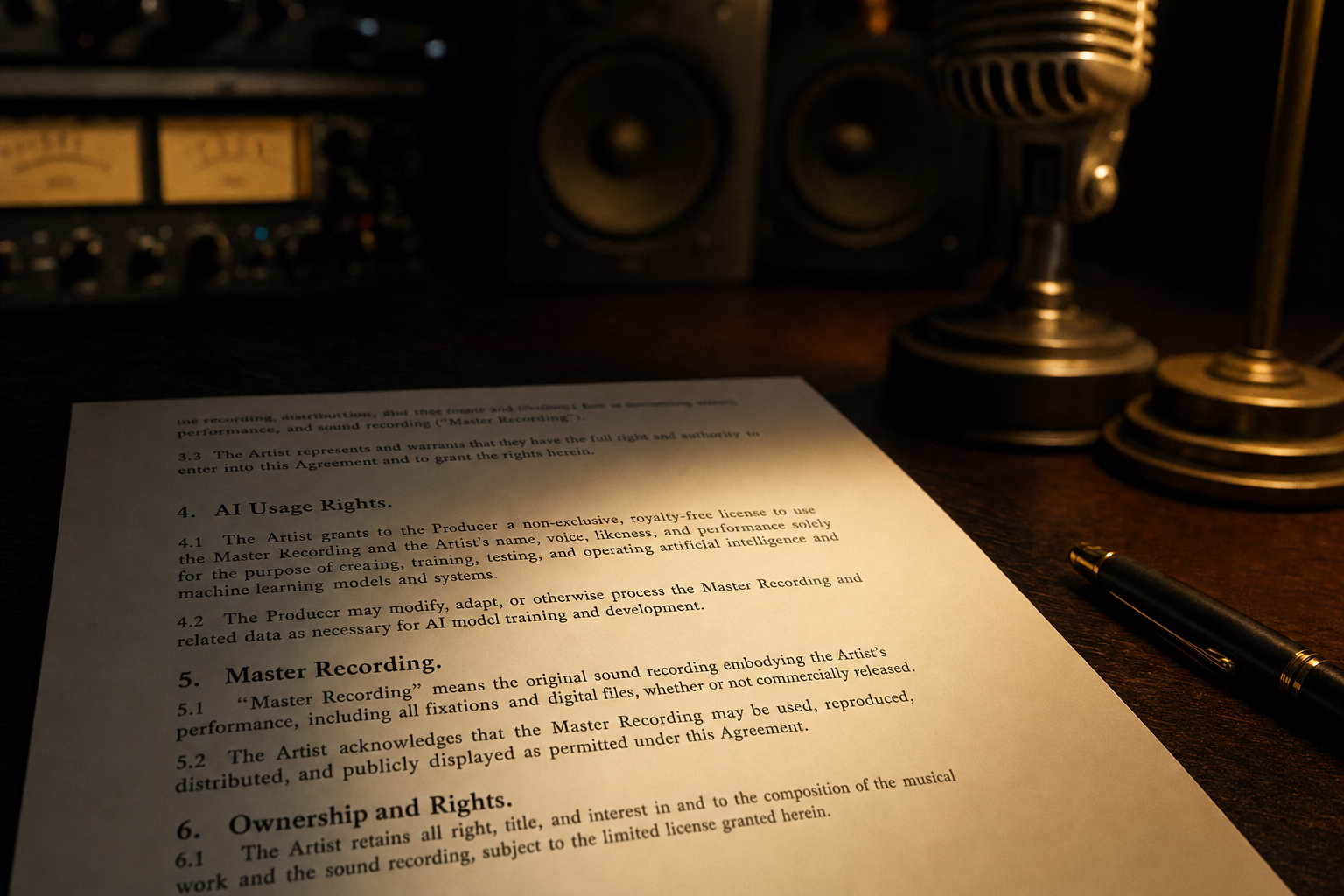
The clause should state: "No rights granted herein shall include the use of the Artist's recordings as training data for artificial intelligence or machine learning systems without the Artist's separate written consent."
Run this past an entertainment solicitor before signing. This is not boilerplate. It is a material term that affects the commercial value of your catalogue.
3. Register your AI licensing stance with a collecting society or rights registry
Several organisations, including the Featured Artists Coalition and emerging rights-tracking platforms, are building opt-out registers. Log your position now, before the market matures and opting out becomes a reactive negotiation instead of a baseline stance.
4. Treat your catalogue as a separately valuable IP asset
Create a simple spreadsheet that lists every master you own, its release date, distributor, and any licensing agreements in place. You cannot protect what you have not mapped.
Music Artist Manager's Contract & Rights Tracker is built for exactly this. Log your master ownership status, distributor terms, and any licensing agreements in one place, so you always know exactly what you own and what you've agreed to.
5. If approached by an AI company for a licensing deal, do not sign anything without dedicated entertainment IP legal advice
Training data licenses are not the same as sync licenses. They have longer-duration implications for how your catalogue is positioned commercially. The price point, the exclusivity terms, and the usage scope all need specialist review.
6. Monitor your streaming metadata for AI-generated derivatives
If a platform is using your recordings as training data, traces can sometimes be detected in how AI-generated content that sounds derivative performs algorithmically alongside your catalogue. This is not foolproof, but it is worth watching.
The contract battle, not the technology battle
The artists fighting hardest to claw back consent rights in 2026 are not fighting a technology battle. They are fighting a contract battle they lost years ago when they signed away control in exchange for a deal.
The independent artist's founding advantage has always been ownership. In the streaming era, that meant keeping masters. In the AI era, it means understanding that those masters are now a training data asset with a market value that did not exist five years ago.
The CEO mindset here is not "how do I protect myself from AI?" It is "I control a valuable asset. What are the terms on which I am willing to license it, and what price reflects that value?"
Every day you remain the legal owner of your catalogue with no AI opt-in on the table, you are in the strongest negotiating position you will ever have. That position erodes the moment you sign a contract you have not read carefully.
Use Music Artist Manager's Contract & Rights Tracker to log your master ownership status, distributor terms, and any licensing agreements in one place, so you always know exactly what you own and what you've agreed to.
Ready to plan your next release?
Stop piecing together spreadsheets and scattered notes. Get your free release strategy and keep your whole rollout in one place.
Written By
Gavin Alexander
Senior Marketeer
As the founder of Music Artist Manager, Gavin has spent years at the intersection of music and technology. Seeing firsthand how chaotic release rollouts and split sheets can be, he designed a platform that brings major-label infrastructure to independent artists and their teams. He writes extensively about industry trends, artist leverage, and workflow optimisation.