Navigating streaming pool compression and royalty recalculations
Streaming pool royalties are shrinking for independent artists even when play counts stay flat. Major labels negotiate outside the pool while independents split what remains after fraud and promotional deals.
Key Takeaways
Streaming pool royalties are shrinking for independent artists even when play counts stay flat.
Major labels negotiate outside the pool while independents split what remains after fraud and promotional deals.
Your per-stream rate is not fixed, it changes monthly based on pool composition you cannot see.
Track your actual earnings per stream monthly to identify when pool compression is costing you money.
In May 2026, Spotify removed 75 million AI-generated tracks to clean up the royalty pool. That sounds like good news for independent artists. But here's what most people missed: the pool itself is being divided among more competing interests than ever before, from promotional rate discounts to direct platform deals that bypass the standard payout system entirely. Your per-stream rate might look stable, but your actual share of the pool is shrinking because the math behind it changes every month.
In May 2026, Spotify removed 75 million AI-generated tracks and called it cleaning the pool. The real problem is not fake streams alone, it is that the streaming royalty pool independent artists depend on is being carved up by direct label deals, promotional rate discounts, and fraud before you ever see your share.
The pool is not growing with the catalogue
Streaming revenue to the music industry grew 10 to 15 percent year over year in 2026. Independent artists did not see proportional growth. The reason is structural. The royalty pool is not a fixed percentage of platform revenue. It is a negotiated reserve that Spotify, Apple Music, and other DSPs actively manage. Major labels secure direct deals and preferential algorithmic placement that pay outside the standard pool. Independent artists who use standard distribution split what remains.
When fraudulent streams or AI-generated tracks inflate total play counts before platforms remove them, every legitimate artist's share of the pool shrinks. When artists accept promotional rates in exchange for playlist placement, they opt out of the pool temporarily but their play counts still affect the calculation. The formula appears simple. Your share equals your plays divided by total plays, multiplied by the remaining pool. But total plays include streams that never belonged in the calculation, and the remaining pool excludes revenue that majors already negotiated away.
For independent artists, this means the per-stream rate you see in your dashboard is not what you actually earned. It is what the platform decided to pay after adjusting for variables you cannot see and did not agree to.
How the pool actually works
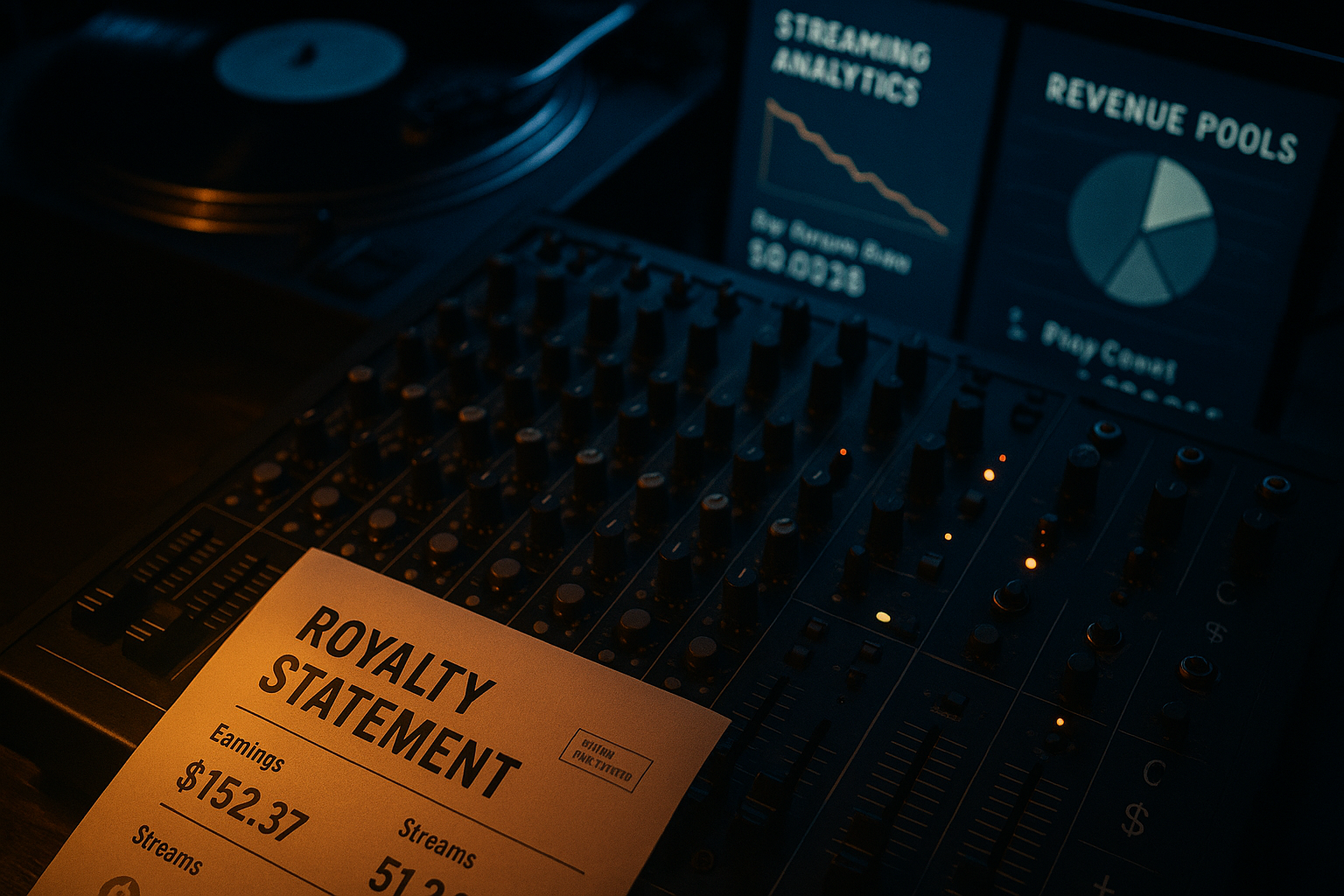
Platforms collect subscription revenue each month. They deduct their platform cut and licensing fees paid to major labels and publishers. The remainder goes into the royalty pool. Every play counts as one unit. Your payout equals your plays divided by total plays, multiplied by the pool.
The hidden variables change the math every month. Fraudulent streams artificially inflate total plays before removal. Promotional rate agreements reduce play count weight for participating artists. Direct licensing deals with major labels and high-volume artists bypass the pool entirely. Independent artists absorb the impact of all three.
If 20 percent of the pool contains fraud before Spotify cleans it, your effective per-stream rate during that period is 20 percent lower than the advertised rate. If a major artist negotiates a direct deal that pays outside the pool, the remaining pool shrinks but your play count denominator stays the same. You earn less per stream even if your audience grows.
Major labels have legal teams and enough scale to negotiate rate floors and hybrid arrangements. Independent artists accept whatever the standard pool produces.
Who this affects and how much
Under 100,000 monthly listeners, you are insulated from pool volatility. Your income is too small to register in macro pool dynamics. You should focus on growing your audience, not auditing royalty structures.
Between 100,000 and one million monthly listeners, you are in the danger zone. Your income is substantial enough to be affected by pool compression but too small to negotiate direct deals. A five percent change in pool composition can cost you thousands per month. This is where transparency matters most.
Over one million monthly listeners, you have leverage. Most independent artists at this scale still use standard distribution and do not realise they can negotiate better terms. If you are generating this level of consistent traffic, you should explore direct licensing arrangements with platforms. Majors have done this for years.
What to do about it
Track your actual per-stream rate monthly. Download your Spotify and Apple Music analytics. Divide total earnings by total plays. If this number drops while your play count stays flat or grows, you are being affected by pool compression. Document it. This is your baseline for negotiation or diversification.
Diversify away from pool-based platforms. TIDAL uses a user-centric payment model where your royalties come from the subscribers who listened to you, not a shared pool. YouTube Music pays at different rates. Shift 20 percent of your promotional focus to non-pool platforms. This insulates you from 20 percent of pool risk.
Demand transparency from your distributor. Ask what the average per-stream rate was on Spotify last month. Ask how much of your payout came from the standard pool versus direct deals. Most will say they do not control that. That is the point. You are accepting whatever Spotify decides without visibility.
At 500,000 monthly listeners or above, hire a music industry attorney to explore direct licensing with platforms. You may have enough bargaining power to negotiate a rate floor or hybrid payout arrangement. This is not theoretical. Major artists and labels structure deals like this regularly.
Audit your metrics for hidden rate discounts. If you are offering exclusive pre-releases, special editions, or accepting promotional rates anywhere, calculate the effective payout. You might be subsidising your own promotion without realising it.
The mindset shift
Streaming economics are not laws of physics. They are negotiated every month by platforms, major labels, and attorneys. Independent artists often treat the per-stream rate as fixed, which makes them passive participants in a system actively managed by others. The independent artist's share of the pool shrinks whenever fraud increases, majors negotiate better terms, or platforms launch new promotional schemes.
The only defence is diversification and transparency. Know what you actually earned per stream, not what platforms tell you to expect. Spread your income across multiple models: pool-based, direct deals, TIDAL, YouTube, Patreon, direct sales. The artists who survive the next five years of streaming consolidation will be the ones who stopped relying on a single pool they cannot see or control.
Music Artist Manager helps you track your streaming royalties across platforms, audit your per-stream rates monthly, and identify pool compression before it costs you thousands. Learn how to build a diversified income model at Music Artist Manager.
Ready to streamline your workflow?
Stop piecing together spreadsheets and scattered notes. Join the waitlist for Music Artist Manager and get your entire rollout in one place.
Written By
Gavin Alexander
Senior Marketeer
As the founder of Music Artist Manager, Gavin has spent years at the intersection of music and technology. Seeing firsthand how chaotic release rollouts and split sheets can be, he designed a platform that brings major-label infrastructure to independent artists and their teams. He writes extensively about industry trends, artist leverage, and workflow optimisation.