YouTube music's quiet takeover: What the platform shift means
YouTube Music is about to overtake Apple as the #2 streaming platform, and independent artists need different strategies for each.

Key Takeaways
YouTube Music is overtaking Apple as the #2 streaming platform through bundling and search reach, not audio quality.
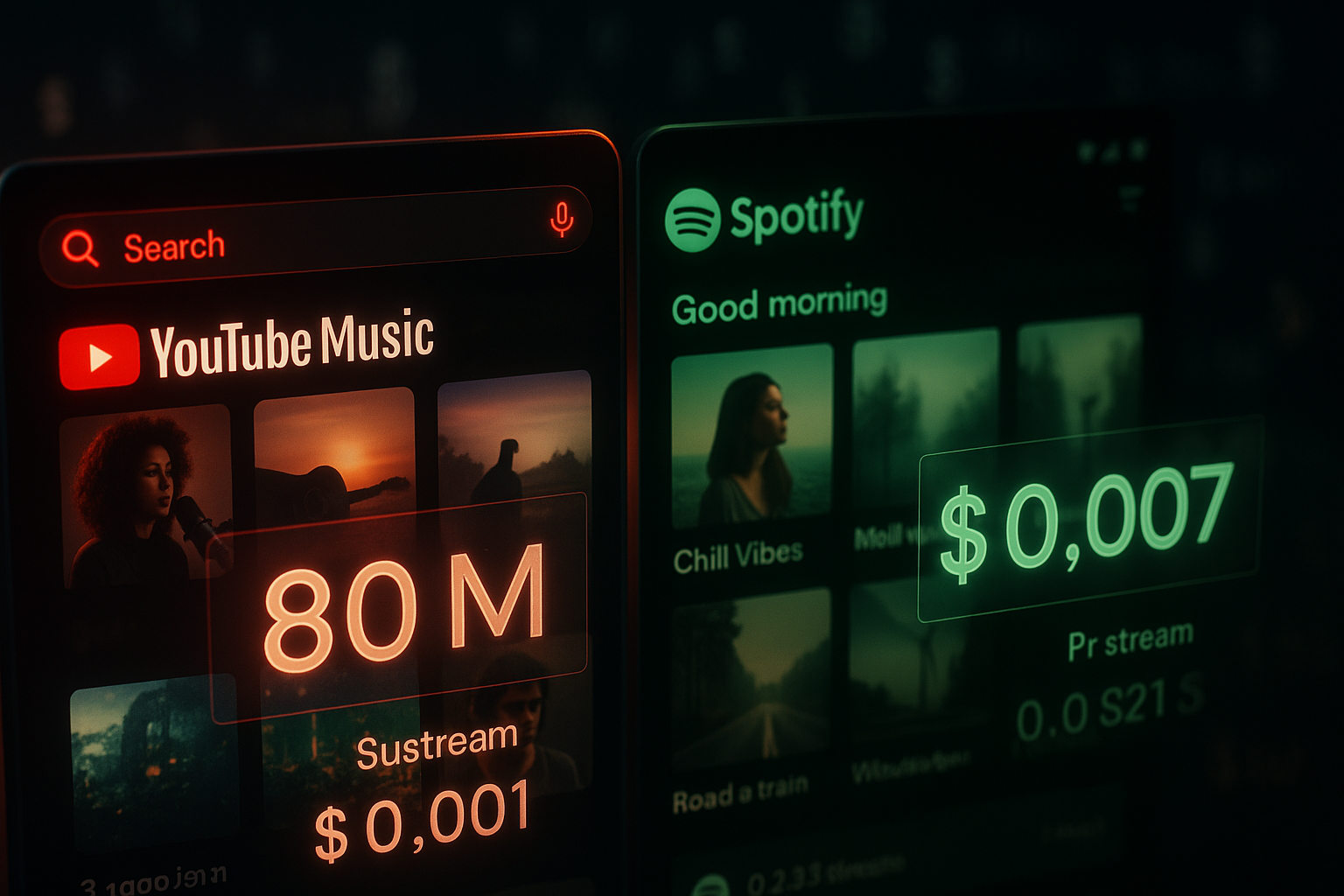
Apple Music pays $0.007–$0.01 per stream while YouTube Music pays $0.001–$0.002, creating a 3–10x payout gap.
YouTube's 2.7 billion monthly users make it a discovery funnel, not a revenue source for independent artists.
Platform-specific release strategies now matter more than total streams: optimise metadata differently for YouTube search versus Spotify algorithms.
YouTube Music is about to overtake Apple as the #2 streaming platform, and independent artists need different strategies for each.
In June 2026, analyst firm MIDiA Research confirmed what independent artists have been sensing: YouTube Music is now on track to overtake Apple Music as the #2 global streaming platform by subscriber count, just five years after being a marginal player. Meanwhile, Apple Music lost 5.8 percentage points of market share (18.4% to 12.6%) between Q4 2020 and Q4 2025, despite Apple's massive installed base and promotional resources.
The underlying data is even more striking. Spotify maintained its ~31% market share even as the total subscriber pool nearly doubled (472M to 921M), suggesting Spotify grew at the market growth rate and didn't lose ground to rivals. Apple and Amazon both shrank relative to the market expansion. YouTube's growth, by contrast, accelerated sharply in the past 12 months.
This isn't about audio quality or artist experience. It's about where listeners discover music - and YouTube's search advantage dominates all others.
Why YouTube music is winning (and what it costs you)
Spotify, Apple, YouTube Music, Amazon Music, and Tidal compete on subscriber count and per-stream payout, but they're not actually playing the same game. YouTube Music's competitive advantage isn't sound quality or artist curation. It's that YouTube is where 2.7 billion people search for everything, including music.
YouTube Premium (music bundled in for $14/month) is cheaper than standalone music subscriptions, and the music experience inherits YouTube's recommendation engine, which has been trained on billions of hours of user behavior. For listeners, YouTube Music is the obvious choice if you already use YouTube.
For independent artists, this creates a problem. YouTube Music's low per-stream payout ($0.001–$0.002) could wipe out revenue, but its scale and reach mean artists can't ignore it anymore.
The strategic shift is happening invisibly. Spotify remains dominant by subscriber count, but YouTube is becoming the primary discovery tool. Artists must adapt their metadata, playlisting strategy, and even release timing to platform-specific incentives.
What you need to know about platform economics
Platform consolidation vs. competition
The streaming market isn't consolidating around one winner. Spotify won that battle. Instead, it's consolidating around different segments.
Spotify dominates subscribers who explicitly pay for a music service. YouTube dominates listeners who are on YouTube for other reasons and discover music secondarily. Amazon Music and Apple Music serve smaller niches (Prime subscribers, Apple ecosystem users).
The lesson: there is no one platform strategy anymore. Context matters.
Bundling advantage
YouTube Music is bundled into YouTube Premium ($14/month, includes ad-free YouTube video). Standalone music subscriptions cost $11–12/month for Apple Music or Spotify Premium.
Bundling is mathematically powerful for acquiring casual listeners. YouTube Premium provides both video and music for only slightly more than a standalone music subscription. Spotify, Apple, and Tidal have no video bundling. They're fighting on pure music merit.
Per-stream rate disparity
YouTube Music pays $0.001–$0.002 per stream. Apple Music pays $0.007–$0.01 (3–10x higher). An artist earning $100 on Apple Music might earn $10–30 on YouTube Music for the same 10,000 streams.
However, YouTube's 2.7B user base means discovery probability is radically higher. The trade-off isn't zero-sum. It's strategic.
YouTube = discovery funnel (low payout, massive reach). Apple = conversion funnel (high payout, smaller audience, more committed fans).
Search vs. recommendation algorithm
Spotify's competitive advantage is algorithmic recommendations (Discover Weekly, Release Radar, algorithmic playlists). YouTube Music's advantage is search across a platform where billions of people land every day.
An independent artist with an interesting sound might be algorithmically recommended to 50,000 Spotify listeners but discoverable to 50 million YouTube searchers. The discovery mechanisms are inverted.
Market share snapshot (q4 2025 vs. q4 2020)
- Spotify: 32.3% to 31.4% (stable)
- Apple Music: 18.4% to 12.6% (-5.8 points)
- Amazon Music: 12.3% to 8.5% (-3.8 points)
- YouTube Music: Low single digits to ~12–15% (estimated, closing fast)
- Tencent Music, NetEase, Yandex: ~25% combined (regional players dominant in Asia, Russia, China)
Who this applies to (and who can ignore it)
Applies hardest to:
- Independent artists with small but committed fanbases on YouTube (millions of views but low Spotify streams)
- Genre creators in discovery-driven categories (lo-fi, beats, rap instrumentals, royalty-free music for video creators)
- Artists creating content for YouTube (synth, instrumental, gaming music, educational content)
- Artists competing for playlist placement on algorithmic editorial playlists (Spotify) vs. search visibility (YouTube)
Does NOT apply to:
- Artists already generating the majority of revenue from direct-to-fan channels (Bandcamp, Patreon, merch) for whom streaming platform share is secondary
- Artists with established fanbases on premium platforms (Tidal listeners tend to be high-engagement, high-value)
- Artists whose genre benefits from premium audio (audiophile classical, jazz, or hi-res rock on Qobuz / Tidal)
- Artists not dependent on streaming for primary income (live performers, sync licensing professionals, soundtrack composers)
What to do about it
1. audit your listener distribution across YouTube vs. streaming platforms
Collect your YouTube analytics (your channel or your label's): video views, subscribers, watch time. Compare to Spotify monthly listeners.
If YouTube views exceed Spotify streams (common for beat producers, lo-fi artists, instrumental creators), YouTube is your discovery engine even if payouts are lower. You're already winning there. Now optimize for it.
2. optimize your YouTube channel metadata for search, not algorithms
YouTube Music search happens on YouTube.com and in YouTube Music app. Create a separate "official full album" video if you haven't, not just clips or singles.
Upload high-res album art as a static image video (low CPU cost, legal-friendly, YouTube's algorithm favors full albums in search results). Use exact artist name + album title + genre in titles.
Example: "Artist Name - Album Name (Full Album) Genre" - this will rank for YouTube searches that Spotify can't intercept.
3. create a release strategy that assumes YouTube is your discovery funnel; Spotify is your engagement funnel
Release on YouTube first (at minimum, simultaneously). YouTube's search algorithm rewards fresh content, so a staggered release (week 1: YouTube + artist site, week 2: all platforms, week 3: playlist push on Spotify) can maximize YouTube discovery before songs "age" in the algorithm.
Spotify playlists reward new content less than YouTube search does.
4. segment your metadata and link strategy by platform
On Spotify: optimize for algorithmic playlist consideration (use release radar tags, curate song credits for vibe consistency).
On YouTube: optimize for text search (include genre, artist, mood in description; add timestamps in full-album videos).
On Apple Music: optimize for editorial consideration (add detailed liner notes, curator comments).
Don't use one-size-fits-all release copy. Each platform rewards different information hierarchies.
5. don't optimize streaming payouts for YouTube; optimize funnel conversion
Treat YouTube streams as a loss leader for email capture and direct-to-fan conversion. Add links to your Bandcamp, mailing list signup, Patreon in YouTube video descriptions.
If a listener finds you on YouTube (low-payout discovery tool), capture their email or link them to Bandcamp ($0.10+ per listener by value, vs. $0.0015 per YouTube stream). This inverts the payout problem: YouTube brings the listener, you monetize the relationship directly.
6. monitor quarterly market share reports from MIDiA and chartlex
Set a quarterly reminder to check if YouTube's share has overtaken Apple or Spotify, triggering a revisit of your platform priorities. Plan for a future where YouTube is the primary discovery platform and Spotify is secondary for listener loyalty.
This requires different artist marketing: YouTube = paid search optimization, Spotify = playlist relationship building.
The strategic shift you can't afford to miss
The trap most independent artists fall into is treating all streaming platforms as equivalent competitors fighting over the same pool of listeners. In reality, YouTube Music is winning by being something entirely different: a discovery engine bundled into the platform where people go for all content, not just music.
This means the old playbook (maximize Spotify playlist placement, build algorithmic exposure) is now incomplete.
The sustainable move is to treat each platform as a different stage in the listener funnel. YouTube = awareness (discovery, zero email). Spotify = engagement (algorithmic loyalty, continued listening). Apple Music = conversion (higher-value listeners, willingness to pay premium).
Your marketing budget, metadata, and release timing should differ radically across these three stages. Most artists optimize for vanity metrics (total streams, follower count) instead of funnel conversion (listener-to-email, email-to-revenue).
YouTube's rise makes the funnel argument impossible to ignore.
Music Artist Manager's Platform Funnel Tracker shows you exactly where listeners are discovering your music, what they do next (stay on platform, follow you, click your link), and which platforms are driving revenue conversations vs. vanity streams. Stop optimizing for Spotify alone.
Ready to streamline your workflow?
Stop piecing together spreadsheets and scattered notes. Join the waitlist for Music Artist Manager and get your entire rollout in one place.
Written By
Gavin Alexander
Senior Marketeer
As the founder of Music Artist Manager, Gavin has spent years at the intersection of music and technology. Seeing firsthand how chaotic release rollouts and split sheets can be, he designed a platform that brings major-label infrastructure to independent artists and their teams. He writes extensively about industry trends, artist leverage, and workflow optimisation.