Stop subsidising the platform: Why managers are moving promo
Discovery Mode cuts your royalties by 30%. YouTube ads build an asset you own. Here's why managers are shifting budgets and how to do it yourself.

Key Takeaways
Spotify Discovery Mode cuts your royalty rate by 30% on every stream it generates.
YouTube ad spend builds a channel asset that compounds subscriber revenue and Content ID income.
Most artists have never calculated the actual cost hidden inside their Discovery Mode campaigns.
Promotional budget that builds owned infrastructure outperforms rental access to algorithmic visibility every time.
Discovery Mode cuts your royalties by 30%. YouTube ads build an asset you own. Here's why managers are shifting budgets and how to do it yourself.
At a May 2026 panel titled "Music Managers: The New Power," Julie Klein (COO, C3 Management) and fellow managers made a point that should alarm every independent artist running release campaigns: promotional spend on Spotify is structurally different from promotional spend on YouTube. Most artists are using both wrong.
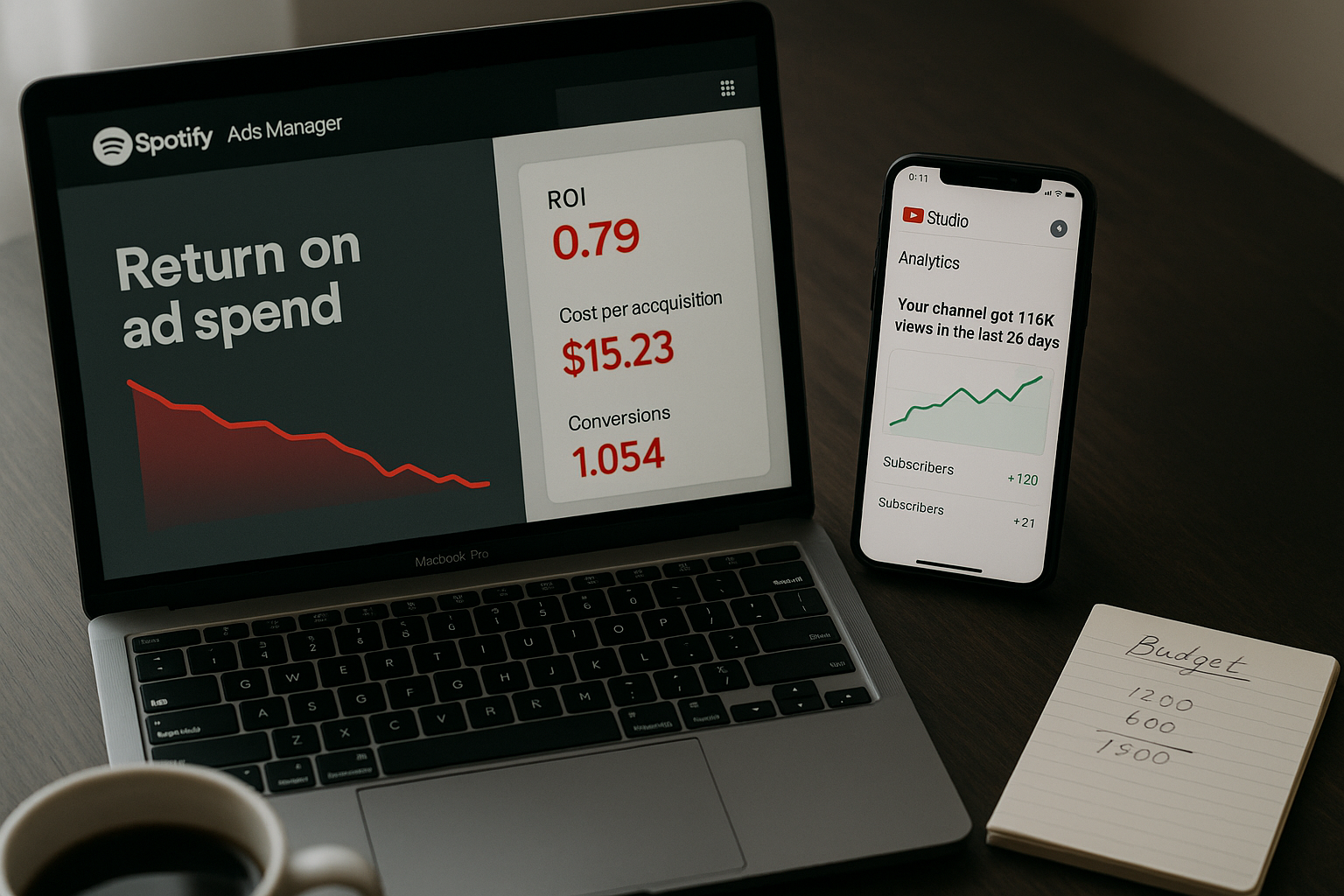
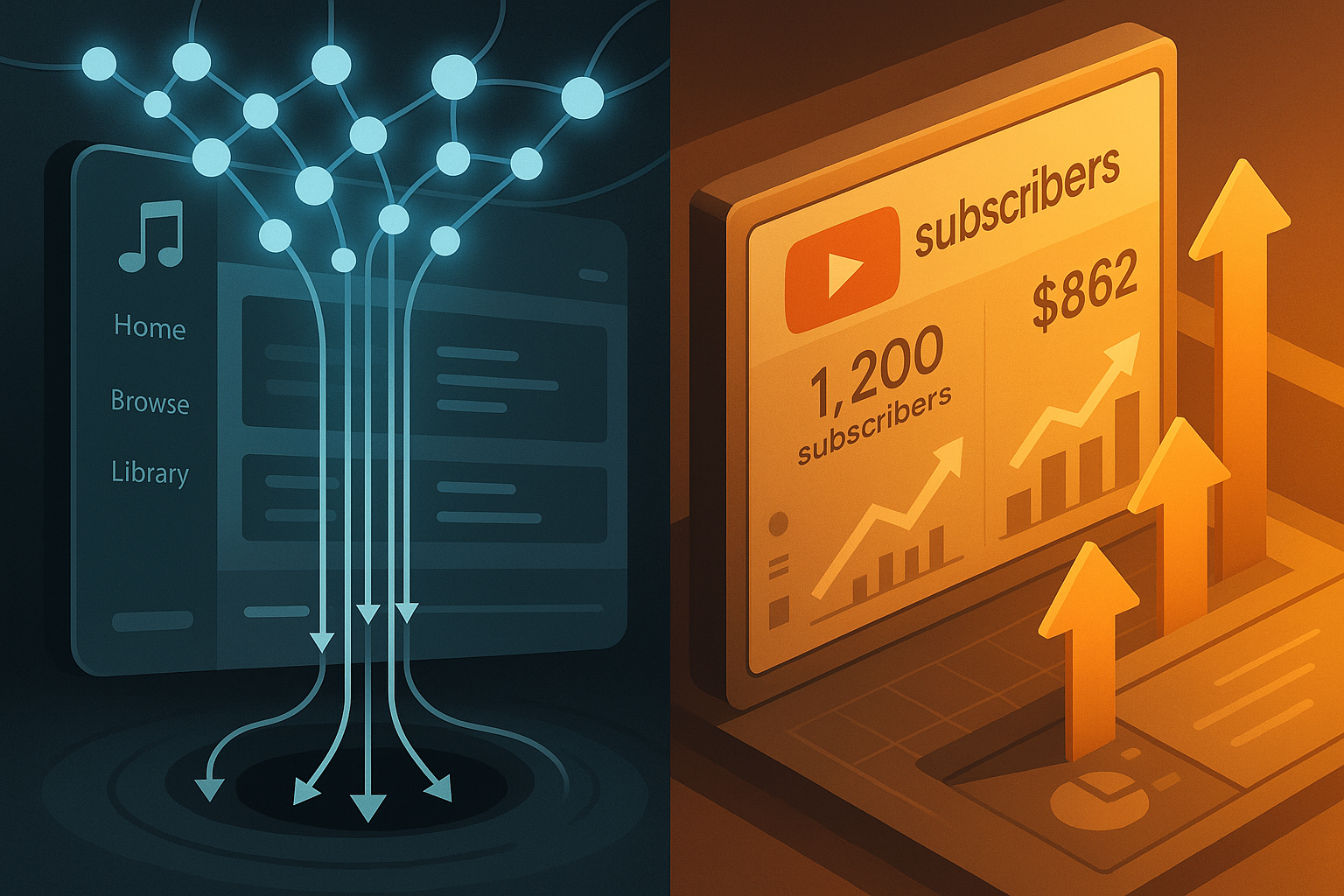
The specific case made: Spotify's Discovery Mode grants algorithmic visibility in exchange for a 30% reduction in royalties on every stream generated through that programme. You're not paying for the promotion with cash. You're paying with your future income.
YouTube's architecture runs in the opposite direction. Every pound spent on YouTube ads builds your channel's watch time, subscriber base, and ad revenue eligibility. The channel is yours. The asset compounds. The spend returns.
The market context you need to understand
The music marketing landscape in 2026 has two quiet structural shifts.
First, Spotify rebuilt its ad platform (Investor Day, May 2026) to better serve brand advertisers, not artists. The tools available to independent artists (Marquee, Discovery Mode) increasingly work by directing artist income back to Spotify rather than paying cash.
Second, YouTube Music's user base crossed 100 million subscribers in early 2026. Its Content ID system means third-party fan uploads, reaction videos, dance compilations, and lyric videos using your music automatically generate royalties. You don't spend a penny on those views.
Together, these shifts mean the promotional economics of 2020–2023 no longer apply. The platform that looks cheapest (Discovery Mode, no upfront cost) may in fact carry the highest hidden cost.
How Spotify Discovery Mode actually charges you
You flag a track for algorithmic boost (Autoplay, Radio sessions, Personalised picks). Spotify increases that track's recommendation frequency. In exchange, Spotify takes a commission, currently structured as a ~30% royalty reduction on streams generated through Discovery Mode contexts.
There is no invoice. The cost is invisible inside your distribution dashboard.
How YouTube's compounding model works
A YouTube ad campaign spend builds watch time on your Official Artist Channel (OAC), which gates YouTube Partner Programme monetisation eligibility.
Once eligible (1,000 subscribers + 4,000 watch hours), your channel earns AdSense RPM, estimated £2–£7 per 1,000 views for long-form music content in Tier 1 markets.
Content ID registration means every unauthorised third-party use of your music (fan covers, reaction clips, foreign compilations) generates royalties automatically. Chartlex data (2026): artists using Content ID alongside consistent uploads earn 3–5× more total YouTube revenue than those relying solely on their own uploads.
The channel is your property. If you stop spending, the asset remains.
The structural difference in one sentence: Spotify promotional tools are rental income for Spotify. YouTube promotional spend is capital investment in your own infrastructure.
Reality check: is this strategy actually available to you?
This strategy is not a magic switch. The shift in emphasis requires realistic preconditions.
Existing catalogue Minimum required: At least 5–10 tracks registered with Content ID via distributor
Visual content Minimum required: At least one music video or lyric video per release
Channel baseline Minimum required: Any subscriber count (the OAC can be built from zero)
Budget mindset Minimum required: Willing to treat YouTube spend as a 6–12 month channel-building investment, not an immediate streams spike
Not suitable for: Artists with no visual output, no distributor with Content ID access, or who need an immediate chart boost for a specific release window. For single-release, short-cycle promotional campaigns, Spotify Marquee still has a use case for existing-fan reactivation.
Practical action plan
1. Audit your current Discovery Mode usage Log in to Spotify for Artists → Campaigns. If any tracks are active in Discovery Mode, calculate the effective royalty discount against your stream volume. Most artists have never seen this figure.
2. Register your entire catalogue with Content ID via your distributor DistroKid, TuneCore, CD Baby, or equivalent. If your current plan doesn't include Content ID, upgrade. The revenue recovery typically pays for itself within one release cycle.
3. Set up or claim your Official Artist Channel (OAC) on YouTube This consolidates your music videos, auto-generated audio videos, and any verified artist profile into one compounding subscriber base.
4. Redirect at least 50% of your next release's promotional budget to YouTube ads Specifically target in-stream ads against similar artist channels and playlist-type content, not general demographic targeting. Point the budget at your OAC or a playlist anchor, not a single video.
5. Track the difference in cost-per-engaged-listener across both platforms over two release cycles Your distributor analytics and YouTube Studio data should tell you the answer within 90 days.
6. Leave Spotify Marquee for existing-fan win-back campaigns only It performs well for re-engaging listeners who have already saved your music but drifted. It is not an efficient tool for discovery.
The mindset that matters here
Lyor Cohen famously mapped every dollar in a music business like a systems architect. Not asking "what does this do?" but "where does this flow, and who does it ultimately benefit?"
When you use Discovery Mode, the flow is: your future royalties → Spotify's promotional infrastructure → algorithmic exposure → back to Spotify's listening ecosystem. You're a supplier paying a distribution fee in perpetuity.
When you build a YouTube channel with ad spend, the flow is: your marketing budget → owned asset (OAC) → compounding ad revenue → Content ID passive income → subscriber relationship you control.
Artists who think like CEOs ask: which spend builds something I own? The platform that looks free is often the most expensive tool in your kit.
**
Related Reading:
Further Reading:
- "How to be an artist manager in 2026" — Artist For Artist
- "Spotify discovery mode explained for artists 2026" — Chartlex
- "YouTube ad revenue for musicians: 2026 rates explained" — Chartlex
- "YouTube music promotion: RPM, OAC, shorts, ads 2026" — Dynamoi
- "YouTube music payouts and royalties 2026" — Chartlex
- "Discovery mode" — Spotify for artists
- "From $11b in 2025 payouts to what we're building for artists in 2026" — Spotify newsroom
Ready to streamline your workflow?
Stop piecing together spreadsheets and scattered notes. Join the waitlist for Music Artist Manager and get your entire rollout in one place.
Written By
Gavin Alexander
Senior Marketeer
As the founder of Music Artist Manager, Gavin has spent years at the intersection of music and technology. Seeing firsthand how chaotic release rollouts and split sheets can be, he designed a platform that brings major-label infrastructure to independent artists and their teams. He writes extensively about industry trends, artist leverage, and workflow optimisation.