Before you book a single date: Build your tour P&L
Learn how to build a tour P&L, calculate your break-even date, and stop booking shows that lose you money.
Key Takeaways
A tour budget spreadsheet is not admin work. It is the only document standing between you and financial loss.
Your break-even show count tells you whether your routing is a business or a funded publicity stunt.
Guarantees protect your downside. Door deals reward your upside. Independent artists need both, structured correctly.
The artists who tour at a loss have the same talent as those who profit. The difference is always the model.
Meta description: Learn how to build a tour P&L, calculate your break-even date, and stop booking shows that lose you money.
In March 2026, the Featured Artists Coalition, backed by the Music Managers Forum and the Musicians' Union, launched an emergency £125,000 fund to stop UK artists from losing money on their own headline tours. The UKAT (UK Artist Touring) Fund exists specifically to "plug genuine financial shortfalls and de-risk touring." Within weeks, it had supported 26 artists and 211 tour dates.
Pause on that. The industry needed a rescue fund. That is not a celebratory headline. It is a structural alarm bell. It means the majority of independent artists are booking tours without a functioning financial model in place. A savvy manager's first job is to ensure their artist never needs a bailout.
Why touring is more expensive than it has ever been
Rolling Stone reported in January 2026 that artists, agents, and managers collectively agree: touring is more expensive than it has ever been, and independent acts are struggling to produce any meaningful profit from live shows. Venue fees, crew wages, transport, accommodation, production costs, and promoter guarantees have all risen significantly since 2022.
This is not a temporary blip. The cost structure of live music has permanently shifted. Ticket prices have risen, yet the margin between gross box office and what lands in the artist's pocket has compressed. The middle of the P&L (production, logistics, fees) has grown faster than the top line.
The artists who will sustain live careers are those who treat touring as a business operation with a financial model, not a promotional exercise with a hope attached.
The four numbers every tour P&L requires
Understanding a touring P&L requires knowing four numbers:
1. Guarantee vs. door deal
A guarantee is a fixed minimum payment from the promoter regardless of ticket sales. A door deal (or "versus" deal) means you receive a percentage of net box office above the guarantee once the promoter recoups. Artists underestimate how long it takes a promoter to recoup on low-capacity shows.
2. Gross vs. net box office
The headline "sold out" ticket revenue is gross. Net box office is what remains after promoter expenses are deducted: venue hire, marketing, ticketing fees, staffing, and production. Artists rarely see a breakdown of this. They should demand one.
3. Tour costs: fixed vs. variable
Fixed costs (tour manager fees, van hire, rehearsals, equipment) accrue regardless of how many shows you play. Variable costs (accommodation, fuel, per diems) scale with tour length. Knowing your fixed cost baseline tells you how many shows you need just to reach zero.
4. Break-even date vs. profit date
Every tour has a break-even date: the show at which cumulative income finally covers cumulative fixed costs. Everything after that is your margin. Booking 8 shows when you break even at show 10 is not a tour. It is a funded deficit.
Who this matters for
This matters for artists playing 200–2,000 capacity venues who are self-financing or partially financing their tours. If you are on a major with full tour support, your label handles this modelling (and recoups it from your royalties).
For independent artists, who, as Little Simz said publicly, pay for everything encompassing their live performances out of their own pocket, this is the difference between building a sustainable live business and draining your savings to maintain a public presence.
This is not relevant if you are purely doing support slots or festival-only dates with no production overhead. It becomes critical the moment you are headlining and own the financial risk.
How to build a tour P&L that works
1. Build a tour budget spreadsheet before any dates are confirmed
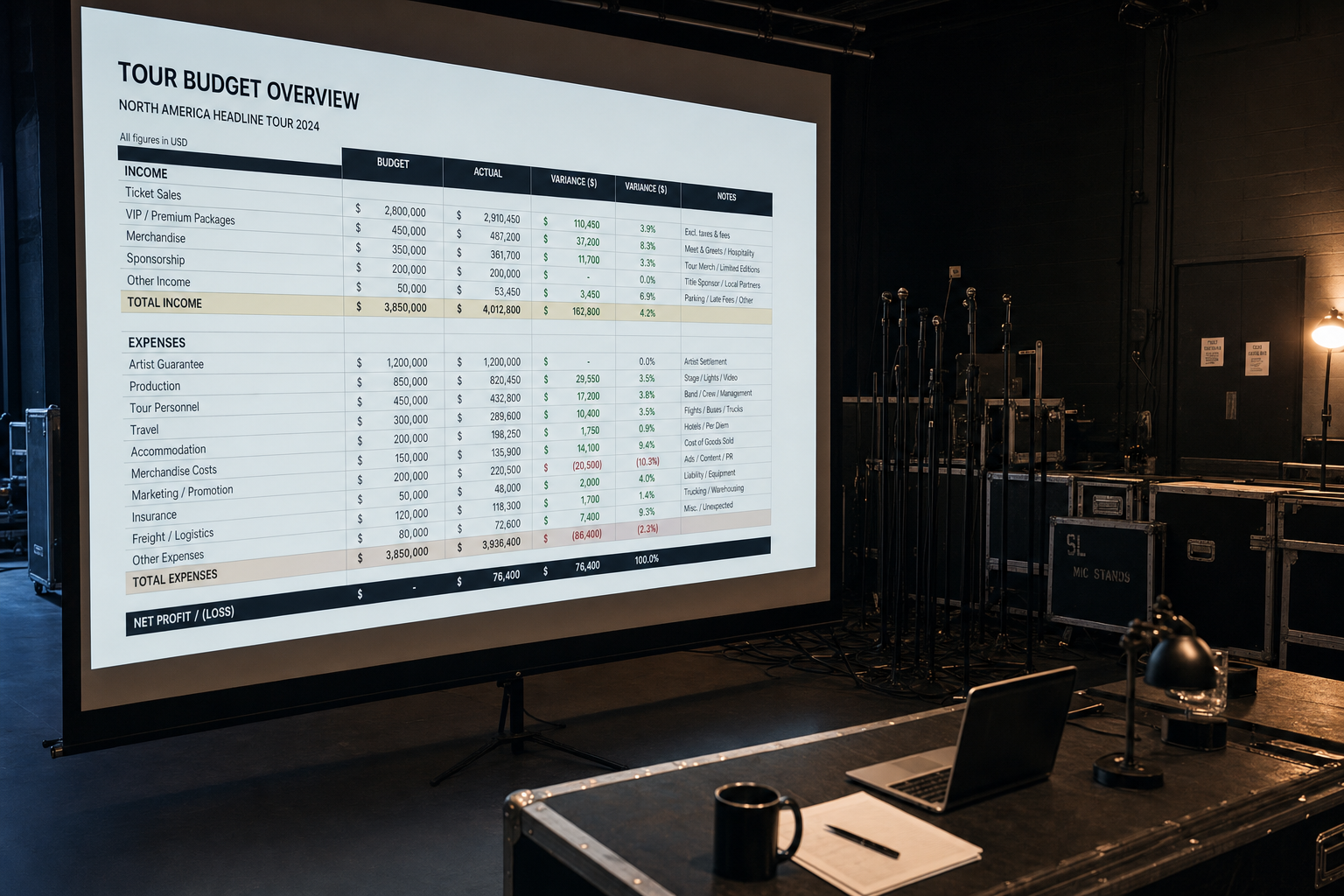
Include: guaranteed fees per show, promoter expense estimates (always request a promoter settlement model), transport, accommodation, tour manager, production rental, and legal/insurance. This is your cost baseline.
2. Calculate your break-even show count
Fixed costs ÷ average net-of-costs income per show = number of shows to break even. If this number is higher than your planned tour, renegotiate fees or reroute.
3. Negotiate minimum guarantees, not just door deals
At the independent level, guarantees protect against low ticket sales. A £500 guarantee on a 300-cap room is not insult money. It is financial floor. Always negotiate a floor.
4. Bundle costs across dates
Tour costs are shared across dates, so a run of 10 consecutive shows in a region is structurally more profitable than 10 scattered shows with travel days between each. Routing matters.
5. Model three scenarios
Build a pessimistic (60% capacity), realistic (80% capacity), and optimistic (sold out) version of each show's income. Only greenlight the tour if the pessimistic scenario still gets you within 15% of break-even.
6. Apply for structural funding before you tour
The FAC's UKAT Fund model shows that grant support exists specifically to plug shortfalls. Equivalent funding exists via Arts Council England, Creative Scotland, and similar bodies. These applications require a tour budget, which you will now have.
7. Track actuals against your model
After each show, record actual settlement figures against your projections. By mid-tour, you will know your real margin and can make decisions about routing, production scale, or density of future dates.
Build the system before you scale
The artists the industry built emergency funds to support are talented. The problem was never their music. It was their operating model. A CEO does not launch a product without a P&L. A manager does not greenlight a tour without a break-even analysis.
Lyor Cohen is famous for one operational mantra: build the system before you scale. Touring is no different. The artists who tour profitably do not have bigger fanbases than those who tour at a loss. They have better models.
Use Music Artist Manager to track your income streams, model your revenue across release cycles, and build a financial baseline before your next live campaign. Touring profitably starts with data, not dates.
Use Music Artist Manager's Revenue Dashboard to map your income baseline before planning your next tour. Know exactly what you need live shows to earn before you commit to a single venue.
**
Related Reading:
Further Reading:
- "Is the touring business broken for indie acts?" — Rolling stone
- "FAC UK artist touring fund launch" — Featured Artists Coalition
- "First 26 artists benefit from FAC's £125k touring fund" — Nme
- "FAC reveals first artists supported by UK artist touring fund" — Music ally
- "FAC launches fund to address cost of touring crisis" — Petecogle.co.uk
Ready to streamline your workflow?
Stop piecing together spreadsheets and scattered notes. Join the waitlist for Music Artist Manager and get your entire rollout in one place.
Written By
Gavin Alexander
Senior Marketeer
As the founder of Music Artist Manager, Gavin has spent years at the intersection of music and technology. Seeing firsthand how chaotic release rollouts and split sheets can be, he designed a platform that brings major-label infrastructure to independent artists and their teams. He writes extensively about industry trends, artist leverage, and workflow optimisation.