Direct-to-fan economics that outperform streaming payouts at scale
Learn why direct-to-fan sales now deliver 10-50x better ROI than streaming. A practical guide to building recurring revenue through owned channels.
Key Takeaways
A £8 Bandcamp album nets you more than 2,200 Spotify streams in pure artist revenue.
Streaming platforms treat super-fans and casual listeners identically, leaving money on the table you could capture.
Owned email lists compound over time while streaming reach resets with every algorithmic shift.
Windowing releases D2F-first for 30 to 60 days captures margin and email growth before DSP distribution.
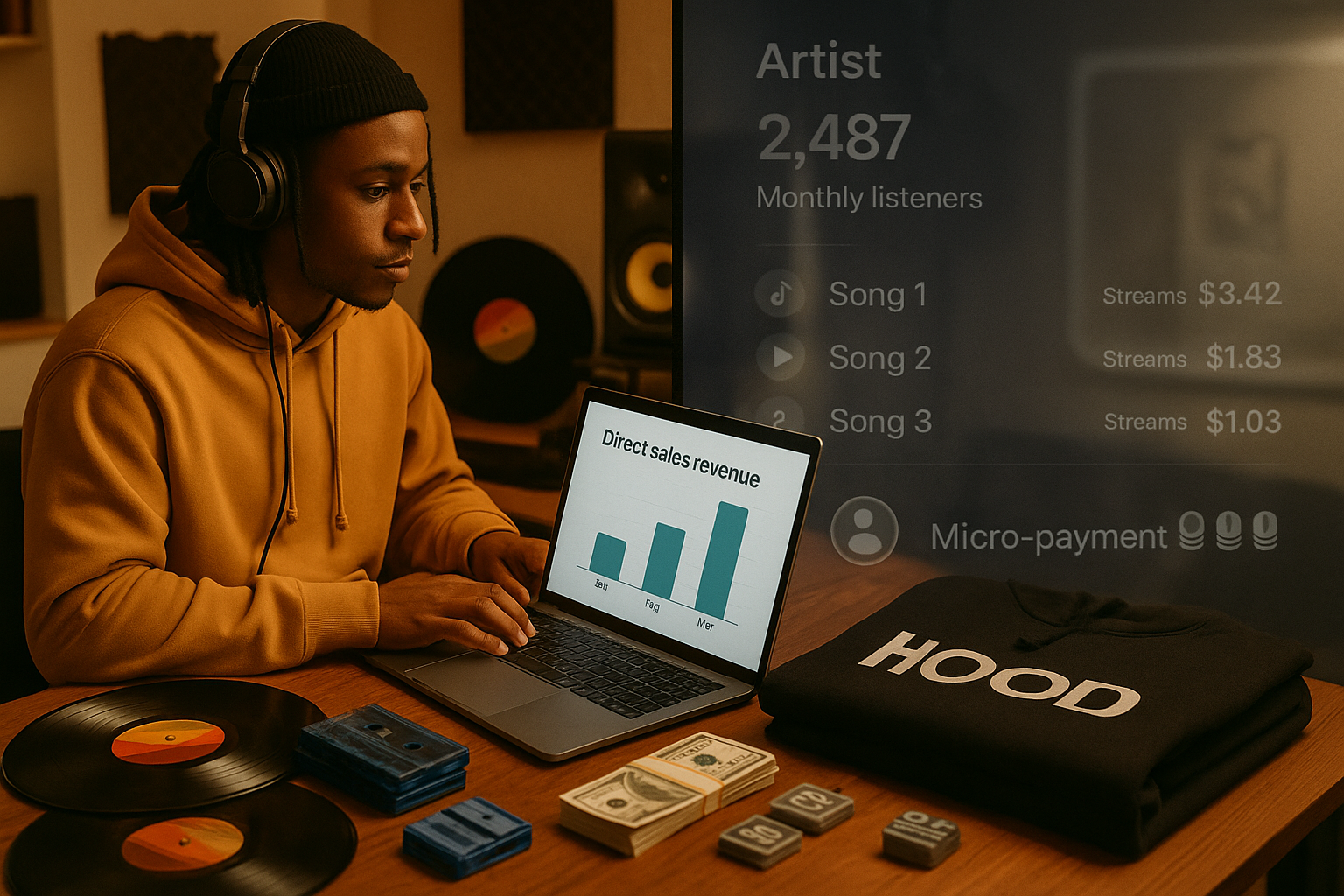
In 2026, the math is undeniable: a single £8 album sale on Bandcamp nets an artist more than 2,200 Spotify streams. A £40 hoodie sale equals 9,500 streams. A £25 vinyl is worth 5,000+ Spotify payouts. Yet the average independent artist still allocates 70%+ of their time and promotional budget to chasing streaming playlist placements that pay fractions of a penny. This brief lays out the exact revenue stack independent artists are using to outperform streaming economics at every scale, with phase-gated action steps you can deploy starting this week.
In 2026, the math is undeniable: a single £8 album sale on Bandcamp nets an artist more than 2,200 Spotify streams. A £40 hoodie sale equals 9,500 streams. A £25 vinyl is worth 5,000+ Spotify payouts. Yet the average independent artist still allocates 70%+ of their time and promotional budget to chasing streaming playlist placements that pay fractions of a penny.
The structural shift is complete. For the first time in music history, direct-to-fan economics now deliver 10–50x better per-unit ROI than streaming platforms, even at microscale. This is not a niche optimization. It is the baseline economic reality of 2026.
The numbers clarify everything
Bandcamp paid out £218 million to musicians in 2025 alone. Qobuz, with less than 1% global market share, delivers per-stream rates 4.4x the industry average (£0.0187 per stream vs. £0.003–0.005 on Spotify). The physical market is accelerating: vinyl outsold CDs for the third consecutive year. Japan's recorded music market remains majority-physical at $4.88 billion retail.
Streaming's apparent dominance (69% of recorded music revenue) masks a fragmentation: margin is not distributed equally. It concentrates wherever artists control the transaction. Bandcamp. Owned mailing lists. Discord. Merch.
Data-driven independent artists are now explicitly windowing releases (exclusive D2F first, then DSP), deploying streaming purely as a discovery channel, and building recurring revenue through memberships and experience-based sales. The shift is not speculative. It is measurable across cohorts of independent labels and creators who report D2F revenues exceeding streaming by 3–10x.
What you must understand about D2F economics
The fan pyramid is real and addressable
Only 1–3% of listeners are "super-fans" willing to spend £100–500 annually. Another 10–15% are "active fans" spending £20–60 per transaction. Streaming algorithms treat these segments identically, they pay the same pro-rata rate. Direct-to-fan channels let you charge the super-fans according to their willingness to pay, capturing surplus value that streaming platforms pocket.
Owned channels compound, rented channels don't
Your email list is an asset you own forever. Your Spotify followers disappear if the algorithm turns. Bandcamp transactional data, customer contact info, repeat purchase patterns? All yours. This compounds: a £5k email list grows to £20k as you deploy repeat campaigns for new releases, memberships, and merch. Streaming reaches never compound. They reset with every push.
The revenue stack is modular and stackable
The winning 2026 formula has 4–7 layers: recorded music (digital + physical), merch, memberships, live/experiences, licensing/UGC, and services. Artists do not need all seven to succeed. Three-layer stacks (Bandcamp downloads + hoodies + Patreon) are generating £5–50k/month for artists with 5k–50k engaged fans. Each layer has different margins, time-to-revenue, and overhead. The art is sequencing them based on your audience size and content production rate.
Windowing is now a legit strategy, not a workaround
Major artists (Taylor Swift, Adele) have pulled from streaming to control narrative and margin. Independent artists windowing (exclusive D2F for 30–60 days, then DSP) are recapturing email list growth and D2F revenue that streaming alone suppresses. Example: an artist releases on Bandcamp first, generates £3k in D2F sales + 500 email subscribers, then releases to Spotify. The DSP release now serves purely as a discovery funnel for future windowed releases.
Who this applies to
This works for:
- Independent artists with existing fan engagement (500–5k email subscribers or Discord members)
- Artists in genres with high-value merchandise appeal (fashion/aesthetics-driven music)
- Anyone with production capability to generate digital products, physical formats, or merch
- Artists comfortable with 30–90 day windowing and willing to sacrifice immediate DSP reach for D2F margin
- Micro-labels and artist collectives looking to pool effort across 5–20 releases
This may not fit:
- Artists with zero existing email list or fan consent mechanism (starting from zero requires bootstrapping)
- Commercial licensing-heavy artists (film/TV sync where speed-to-DSP matters more than D2F margin)
- Artists relying on algorithmic discovery alone (no owned audience to convert)
- Artists without physical/merch differentiation (e.g., beat makers, loop libraries)
The D2F revenue stack buildout
Phase 0: Establish owned infrastructure (week 1–2)
- Email list (ConvertKit, Beehiiv, Mailchimp). Start capturing emails on Bandcamp and website.
- Bandcamp artist account. Set up store with 1–2 products (digital album or single).
- Discord or Telegram (optional but high-leverage). Community for true fans, 1–2 channels.
- Google Sheets tracker. Log revenue by channel (D2F digital, physical, merch, streaming, other).
Phase 1: Single recorded music layer (week 2–4)
Release one full album or 5-track EP on Bandcamp (exclusive or windowed). Pricing: £5–8 for album (€6–10). Enable pay-what-you-want. Enable email capture at checkout. Write one liner noting why you're releasing here first.
Track: Revenue, number of buyers, number of emails captured, repeat purchase rate.
Deploy email announcement to existing subscribers (if any). Target 10–20% conversion of list.
Phase 2: Add physical layer (week 4–8)
Design one vinyl, cassette, or CD edition. Use print-on-demand (Bandcamp's in-built POD, Qrates, Gelato) or short-run manufacturing (500–1k units) if cash-positive. Price: £20–30 for vinyl, £12–15 for cassette.
Create pre-order campaign: email + Discord + Bandcamp banner.
Target: 50–100 units sold in first month = £1–2.5k revenue.
Phase 3: Add membership layer (week 8–16)
Choose platform: Patreon (flexible, episodic), Bandcamp Subscriptions (no extra logins), or EVEN (early drops).
Offer tiers:
- £3–5: Early access to new songs, exclusive demos
- £10–15: Monthly live Q&A, behind-the-scenes updates, exclusive artwork
- £20–25: Physical exclusive items, signed editions, one-on-one message per month
Recruit 10–20 members in first month (= £100–500 MRR).
Phase 4: Add merch layer (week 16–24)
Design 1–2 zip-ups or hoodies with artist branding. Add 1–2 secondary items (poster, pin, sticker). Use POD initially (Fourthwall, Printful). Scale to short-run if greater than 50 units/month. Merch margins: 40–60% if POD, 60–75% if short-run.
Launch via email + Discord. Target 5–10 units/month initially. Relaunch merch with every release cycle.
Phase 5: Align streaming (week 24+)
After D2F layer is cash-positive, release back catalog to all DSPs via aggregator (Ditto, DistroKid, etc.). Use streaming purely for discovery and artist profile. Funnel Spotify listeners to email via link-in-bio (linktree, beacon, Milkshake). Track: Spotify listener-to-email conversion rate (target 3–5%).
For future releases, implement windowing: Bandcamp exclusive 30–60 days, then DSP.
Phase 6: Introduce licensing and services (optional)
Sell stems (original recording instrumental + vocal stems) on Bandcamp for £20–50. Offer beat leasing via Lickd, BeatStars, or Shopify. If applicable: mixing/production services, production music for YouTube (AudioJungle, Epidemic Sound backend).
Revenue target by year-end
- Phase 1–3 (months 1–4): £2–5k MRR (recorded music + early memberships)
- Phase 4–5 (months 5–8): £5–15k MRR (memberships + merch scaling + DSP as discovery funnel)
- Phase 6+ (months 9–12): £10–50k MRR (full stack, with 1–3% of engaged audience in paid tiers)
The structural insight
Streaming was always designed to commodify consumption, not maximize artist income. Income scales with relationship depth, not playlist reach. The winners in 2026 are artists who own email lists, sell physical formats, and build recurring revenue from 1–3% of their audience (true fans) rather than chasing algorithmic reach.
Streaming platforms offer scale but not relationship. Direct-to-fan offers relationship and margin. The independent artist's job in 2026 is not to maximize streams. It is to maximize relationships-per-unit-time.
The economics encode a profound insight: your real fans do not want to be sorted into an algorithmic bucket. They want to support you directly, own a piece of something (vinyl, merch), and know they are funding your next project. When you honor that by offering direct channels, pricing fairly (not extracted by platform tax), and owning the data, you build a resilient business.
The 1,000-stream threshold on Spotify? It is not a threat. It is clarity. It says: "We do not want your long tail catalog; go build your community elsewhere." You should thank them. That clarity is permission to deploy your energy where it compounds: owned channels, recurring revenue, and relationships.
Download the D2F Revenue Stack Checklist.A one-page action guide with phase-gated tasks, revenue targets by layer, and platform-specific setup links (Bandcamp, Patreon, email providers, POD services).
Ready to streamline your workflow?
Stop piecing together spreadsheets and scattered notes. Join the waitlist for Music Artist Manager and get your entire rollout in one place.
Written By
Gavin Alexander
Senior Marketeer
As the founder of Music Artist Manager, Gavin has spent years at the intersection of music and technology. Seeing firsthand how chaotic release rollouts and split sheets can be, he designed a platform that brings major-label infrastructure to independent artists and their teams. He writes extensively about industry trends, artist leverage, and workflow optimisation.