Turning parental advisory into marketing gold
How the Parental Advisory label became a hip-hop marketing strategy, and what independent artists can learn from controlled controversy today.

Key Takeaways
The Parental Advisory label shifted from warning to marketing asset when hip-hop proved restriction drives demand.
Explicit content signals artistic credibility to audiences who value authenticity over commercial safety.
Controversy becomes a positioning tool when it aligns with your artist's actual creative vision and target audience.
Independent managers can apply the same principles: controlled risk, clear messaging, and owning your edge in a crowded market.
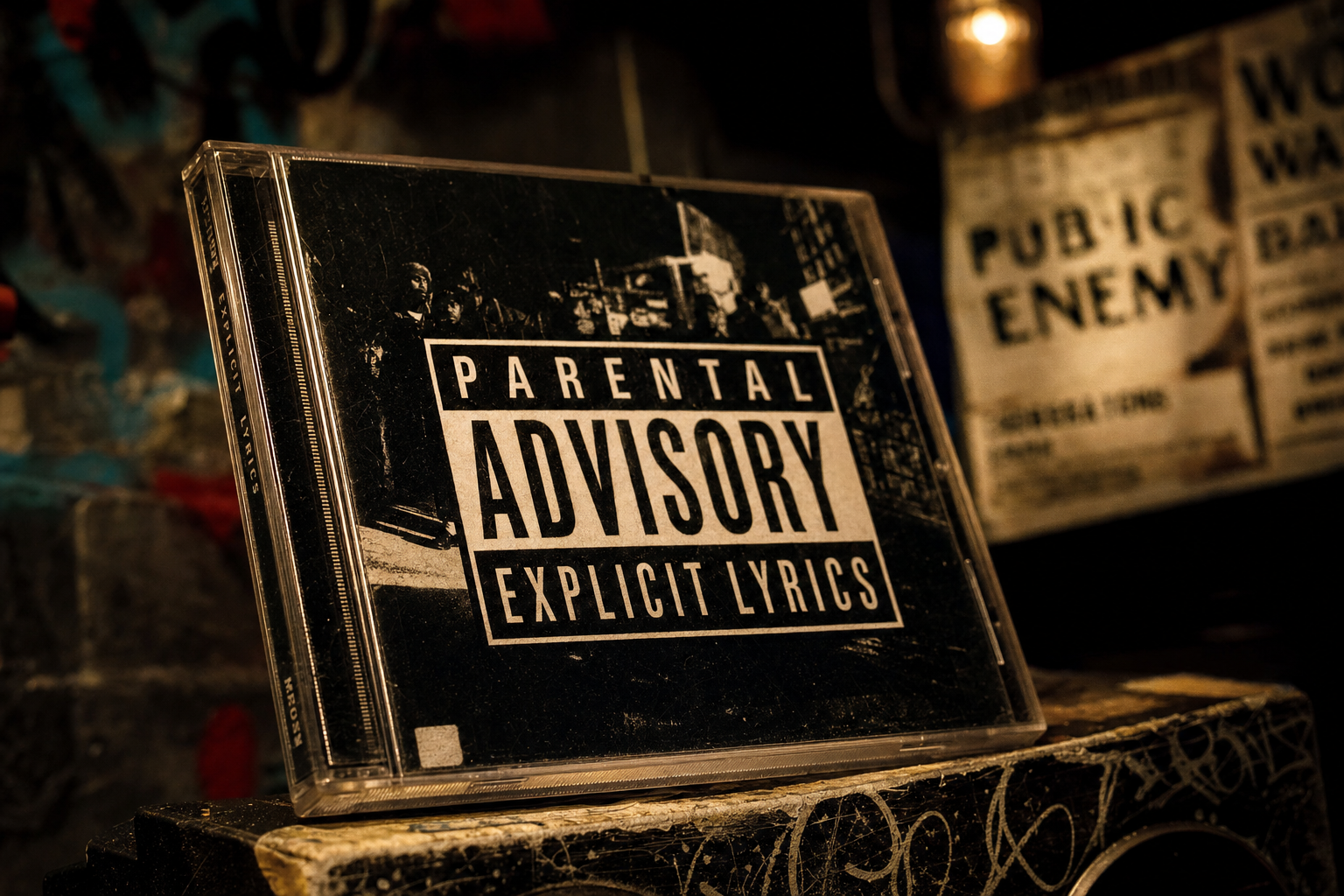
The Parental Advisory sticker was meant to warn parents. Instead, it became the most effective marketing badge in hip-hop. Artists and labels have turned this 'forbidden' marker into proof of authenticity, driving sales through strategic controversy for over three decades.
The Parental Advisory label launched in 1985 after Tipper Gore heard her 11-year-old daughter listening to Prince's "Darling Nikki". By 1990, it was pressed onto millions of hip-hop albums. The intent was restriction. The effect was demand.
For independent artists and managers, the history of this label offers a repeatable lesson: restriction creates interest, and interest creates margin. This is not about shock tactics. It is about understanding how perceived authenticity, edge and exclusivity move catalogue, and how to calibrate controversy in a rollout without torpedoing the campaign.
Why the label became a sales accelerant
N.W.A's _Straight Outta Compton_ went double platinum without mainstream radio or retail distribution. The FBI sent a warning letter about "Fuck tha Police". Stores refused to stock it. The label became a signal: this is the version you are not supposed to hear.
That signal did three things:
- Drove word-of-mouth. When a parent, retailer or institution tells a teenager not to listen, the teenager finds a way to listen.
- Established credibility. The label became shorthand for unfiltered, uncompromised content. In hip-hop especially, it marked the difference between a commercial concession and the street version.
- Created scarcity. Restricted access, whether real or perceived, increases the value of what is being restricted.
Eminem's _The Slim Shady LP_ repeated the playbook in 1999. The label appeared on the cover. Radio edits were available, but the stickered version outsold the clean by a wide margin. The restriction was the product.
How controversy functions as a targeting tool
Controversy does not appeal to everyone. That is the mechanism. A Parental Advisory label, a banned video, a publicised lyric dispute: each one narrows your audience and intensifies the connection with the listeners who remain.
For an independent manager, this is useful. You are not trying to be everything to everyone. You are trying to reach the 5,000 people who will stream your artist 50 times, not the 50,000 who will stream once and move on.
When Lil Nas X released "Montero (Call Me By Your Name)" in 2021, the video featured a lap dance with Satan. Conservative media attacked. Nike threatened legal action over the custom "Satan Shoes". The song debuted at number one. The controversy was not accidental. It was the targeting strategy. The audience who found the imagery offensive was never going to be the audience. The audience who found it liberating was exactly the audience, and they showed up in force.
Three practical applications for your rollout
1. identify the line your artist will not cross, then decide where you stand relative to it
You do not need to court a lawsuit or alienate your entire potential sync market. You do need to know what your artist will say, show or stand for that a portion of the audience will reject. Write it down. If the answer is "nothing", you may not have an edge to market.
Ask:
- Is this lyric, visual or statement authentic to the artist, or is it provocation for its own sake?
- Will the controversy align with the artist's existing audience, or will it confuse them?
- If a platform, publication or retailer rejects this content, does that rejection help or hurt the campaign?
If the rejection helps, lean in. If it hurts, revise.
2. plan the response before the backlash
Controversy without a clear response plan becomes a crisis. Controversy with a response plan becomes a story arc.
When you know a release will generate criticism, prepare three things:
- A single, clear statement from the artist. One paragraph. No apology unless the content genuinely missed the mark. If the content is intentional, the statement should reaffirm the intent.
- A media list of outlets that will cover the controversy favourably. Not mainstream, not neutral. Outlets whose readership or audience will side with the artist.
- A follow-up content piece that extends the conversation. A behind-the-scenes video, a director's commentary, an op-ed. Something that keeps the story moving and keeps your artist in control of the narrative.
You do not need a five-person PR team. You need a plan that fits on one page and a commitment to execute it within 48 hours of the first headline.
3. use exclusivity to amplify restricted content
The Parental Advisory label worked because the explicit version was harder to find. Retailers stocked the clean version. The explicit version required a special order, an older sibling, a friend with a car. Difficulty created value.
You can recreate this mechanism digitally:
- Release the clean version to DSPs first. Hold the explicit version for 48 hours, available only via your direct-to-fan platform or a limited Bandcamp run. Let fans know they have to come to you for the real version.
- Gate the controversial visual on your own site or mailing list before it goes to YouTube. Let fans access it first, then release it publicly once the conversation has started.
- Offer a director's cut, an alternate mix or an extended version to fans who pre-save, pre-order or join your mailing list. The restriction does not have to be absolute. It just has to be present.
What this is not
This is not an argument for empty provocation. If the controversy is not rooted in the artist's actual perspective, audience or catalogue, it will read as stunt work and damage credibility.
It is also not an argument for recklessness. If your artist says something genuinely harmful, walks back a statement poorly or picks a fight they cannot finish, the controversy will not drive sales. It will drive the conversation away from the music.
The lesson is not "be offensive". The lesson is: restriction and rejection can be designed into a campaign, and when they are, they function as targeting and differentiation mechanisms.
The commercial argument
The Parental Advisory label did not reduce sales. According to a 1999 study by the Federal Trade Commission, explicit-labelled albums in the hip-hop and rock categories consistently outsold clean versions in the same retail environments. The label was not a deterrent. It was a buying signal.
For an independent artist, controversy operates the same way, but only if the controversy is legible. A vague sense of "edge" does nothing. A specific, nameable reason that someone might object to your artist is a filter. It tells one audience to walk away and another audience to pay attention.
If you are managing an artist who will never generate that filter, lean into a different strategy. But if your artist has a perspective, a visual language or a set of references that will make someone uncomfortable, that discomfort is not a liability. It is a segmentation tool.
When to walk the line back
Not every controversy lands. If your artist releases something intended to spark debate and the response is silence, move on. Do not force it.
If the response is backlash from your existing audience, rather than from the audience you were trying to avoid, you miscalculated. Acknowledge it quickly, reaffirm what the artist stands for, and adjust the next campaign.
Controversy is not a one-time tactic. It is a positioning strategy that only works when it is consistent with the artist's voice and the audience's expectations. The Parental Advisory label worked because it marked the same kind of content across thousands of releases. Listeners knew what it meant. If your controversy means something different every time, it will not mean anything at all.
The long play
Thirty years after the label became standard, it still appears on albums. It no longer generates headlines, but it still signals intent. An artist who chooses to release an explicit version is making a statement about who they are and who they are for.
The same principle applies to any controversy you design into a rollout. The mechanism is not shock. The mechanism is clarity. You are telling a portion of the potential audience that this is not for them, and you are telling the rest that this is exactly for them.
The Parental Advisory label succeeded because it made that distinction visible. Your job as a manager is to make the same distinction visible in every release, every campaign, every piece of content your artist puts into the market.
Plan the line. Know the response. Use restriction to create value. And when the backlash arrives, treat it as confirmation that you reached the right audience.
Ready to plan your next release?
Stop piecing together spreadsheets and scattered notes. Get your free release strategy and keep your whole rollout in one place.
Written By
Gavin Alexander
Senior Marketeer
As the founder of Music Artist Manager, Gavin has spent years at the intersection of music and technology. Seeing firsthand how chaotic release rollouts and split sheets can be, he designed a platform that brings major-label infrastructure to independent artists and their teams. He writes extensively about industry trends, artist leverage, and workflow optimisation.