Beyond 'out now': How a content strategist builds a multi-week
Learn how to build a three-phase content rollout and schedule without goals, so you stay visible long after your release drops.
Key Takeaways
Most artists burn out after release day because they never built a content system that runs past launch.
The three-phase rollout splits your content into tease, launch, and sustain, so you stay visible without scrambling.
Scheduling without goals removes the pressure to perform and lets you show up consistently instead of sporadically.
Content strategy isn't about doing more, it's about building a machine that keeps working when you step away.
Most artists burn out after release day because they treat content like a sprint. The Content Strategist role flips that. It gives you a structured three-phase system (Tease-Launch-Sustain) and a scheduling method that removes decision fatigue, so you stay visible without burning through ideas or energy.
Most artists treat content like a sprint. They post obsessively in the week before their single drops, then disappear. That approach kills momentum and trains your audience to forget about you between releases.
Here's what works instead: the three-phase rollout paired with a 'no goals' scheduling method. This is the system I used to manage catalogue visibility for artists who had more than one song to promote and no team to help them post.
The three-phase rollout: Tease, launch, sustain
This structure isn't new. Labels have used it for decades. The difference is you're going to build it in a way that doesn't burn you out.
Phase 1: Tease (2-3 weeks before release)
Your job here is to make people curious, not to explain the entire song. Post snippets of the hook, studio sessions, or visual elements from the music video. You're building context without giving everything away.
Post frequency: 3-4 pieces of content per week. That's it. You're not flooding the feed. You're placing breadcrumbs.
Content types that work:
- 15-second audio clips with static visuals
- Behind-the-scenes footage with no explanation
- Lyric cards that hint at the theme
- Screenshots of your notes app with working titles or scrapped verses
Do not announce the release date in every post. Mention it once clearly, pin it to your profile, then let the content speak.
Phase 2: Launch (release week)
This is the only week where you're allowed to be louder. Post the official audio, the music video if you have one, playlist links, and any press or co-signs you secured.
Post frequency: 5-7 pieces of content during the week of release.
But here's the part most artists miss: you also need to post content that isn't the song itself. Post reaction videos from friends, breakdowns of the production, or a short voice note explaining one line in the verse. Give people multiple ways to engage with the release, not just the Spotify link.
Phase 3: Sustain (weeks 3-8 post-release)
This phase is where most artists fall off. They assume the song is old news and stop posting about it. Wrong. Your song isn't old until your audience has heard it at least seven times. Most of them haven't even seen it once.
Post frequency: 2-3 pieces of content per week, spaced out.
Content types that extend shelf life:
- User-generated content or covers
- Live performance clips, even if it's just you in your room
- Remix teasers or alternate versions
- Playlist adds and editorial features
- Commentary on what the song means now that it's been out for a month
You're not beating a dead horse. You're making sure the song gets the exposure it deserves.
The 'no goals' scheduling method
This is the system that removes the anxiety.
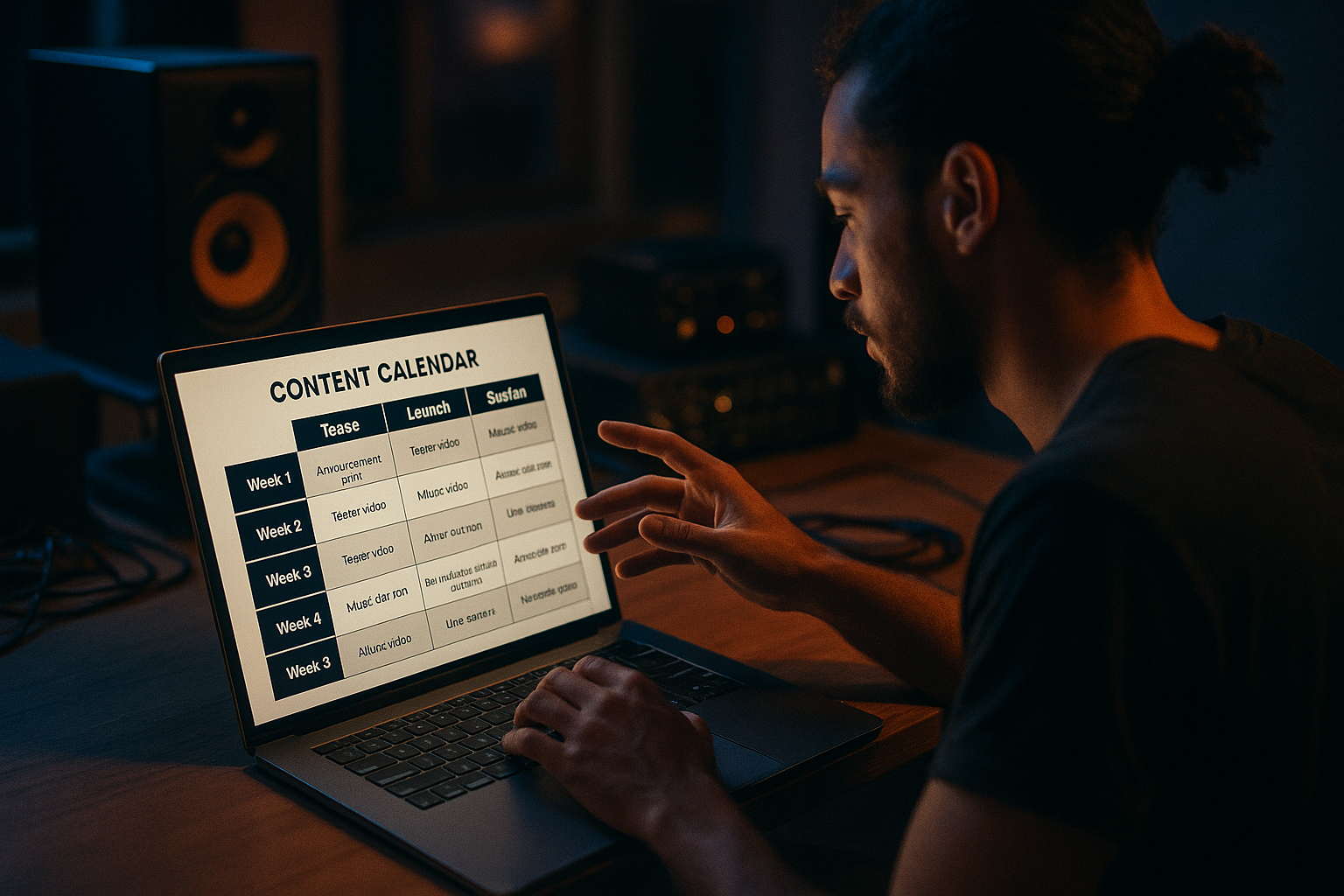
Instead of setting a goal like "post every day" or "hit 10,000 views," you create a content bank and a recurring calendar. You decide in advance what gets posted and when, and then you stop thinking about it.
Here's how it works:
- Batch-create content once a week. Spend two hours shooting or editing everything you'll need for the next seven days. Do not post as you create. That's how you end up posting reactively and burning out.
- Build a simple content calendar. Use a spreadsheet, a notes app, or a scheduling tool like Later or Buffer. Assign each piece of content to a specific day and time.
- Schedule it and walk away. Once it's loaded, your job is done. You're not checking analytics every hour. You're not refreshing your feed to see if people liked it. You've already done the work.
- Review once a week, not once a day. On the same day you batch-create, spend 15 minutes reviewing what performed well and what didn't. Adjust the next week's content accordingly.
This method works because it separates creation from distribution. You're not in a constant state of "I need to post something." You've already posted. It's scheduled. You're free to make music.
What this system actually solves
This isn't about posting more. It's about posting with intention and without burning out.
You'll stop feeling like you're shouting into the void because you'll know exactly what you're posting and why. You'll stop disappearing after release day because the system keeps you visible without requiring constant effort. And you'll stop treating content like a chore because you've removed the daily decision fatigue.
This is how you build a content machine that works whether you're online or not. You create the structure once, and it runs. That's the difference between artists who stay relevant and artists who only show up when they need something.
Ready to streamline your workflow?
Stop piecing together spreadsheets and scattered notes. Join the waitlist for Music Artist Manager and get your entire rollout in one place.
Written By
Gavin Alexander
Senior Marketeer
As the founder of Music Artist Manager, Gavin has spent years at the intersection of music and technology. Seeing firsthand how chaotic release rollouts and split sheets can be, he designed a platform that brings major-label infrastructure to independent artists and their teams. He writes extensively about industry trends, artist leverage, and workflow optimisation.