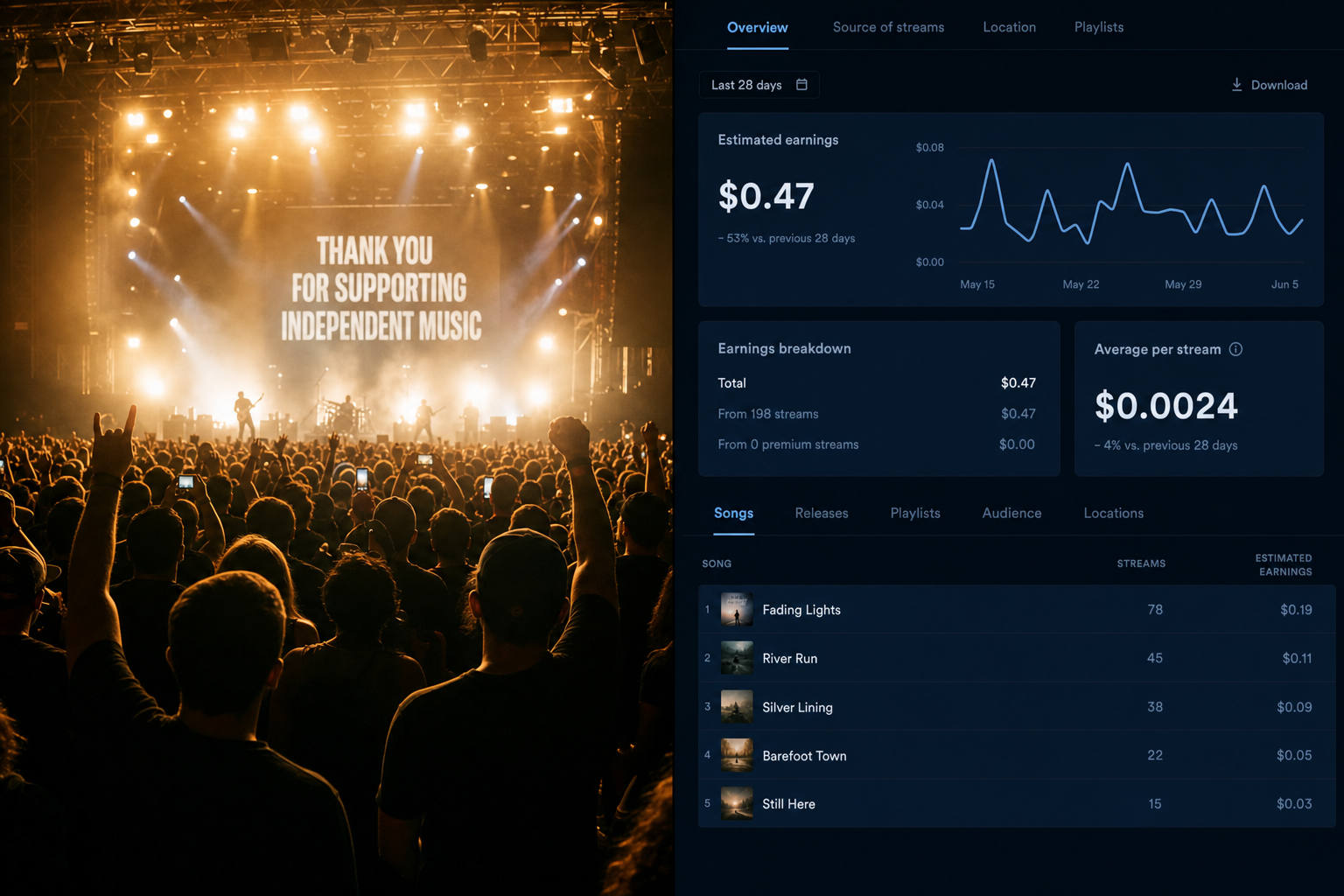
Sync is booming - but your catalogue isn't ready to capitalise
Learn how to structure your catalogue for sync licensing deals that pay more than two million Spotify streams.
**Learn how to structure your catalogue for sync licensing deals that pay more than two million Spotify streams.**
Global sync licensing revenue grew an estimated 12% year-over-year in Q1 2026, driven by an explosion in streaming-original TV commissions (Netflix, Apple TV+, Amazon, Disney+), AAA video game budgets recovering to record levels, and a rebound in advertising after the soft 2024 ad market. A single placement in a streaming drama can pay £400–£4,000 per episode. A national TV advertisement can pay £4,000–£40,000 for a single use. One well-placed sync can generate more income than two million Spotify streams.
Yet the vast majority of independent artists are not positioned to receive a single enquiry. Not because their music isn't good enough. Because their catalogue is operationally invisible to the people writing the cheques.
The structural difference between sync and streaming
Sync licensing is structurally different from streaming. It is a business-to-business transaction: a music supervisor at a production company needs to licence your master recording and your publishing share, both cleanly and quickly, with zero legal ambiguity. They often have 24–48 hours to clear a track once a director says yes.
Major labels and large independent publishers have dedicated sync departments that maintain pre-cleared, metadata-rich catalogues and answer the phone immediately. Independent artists (even those generating meaningful streaming revenue) typically have:
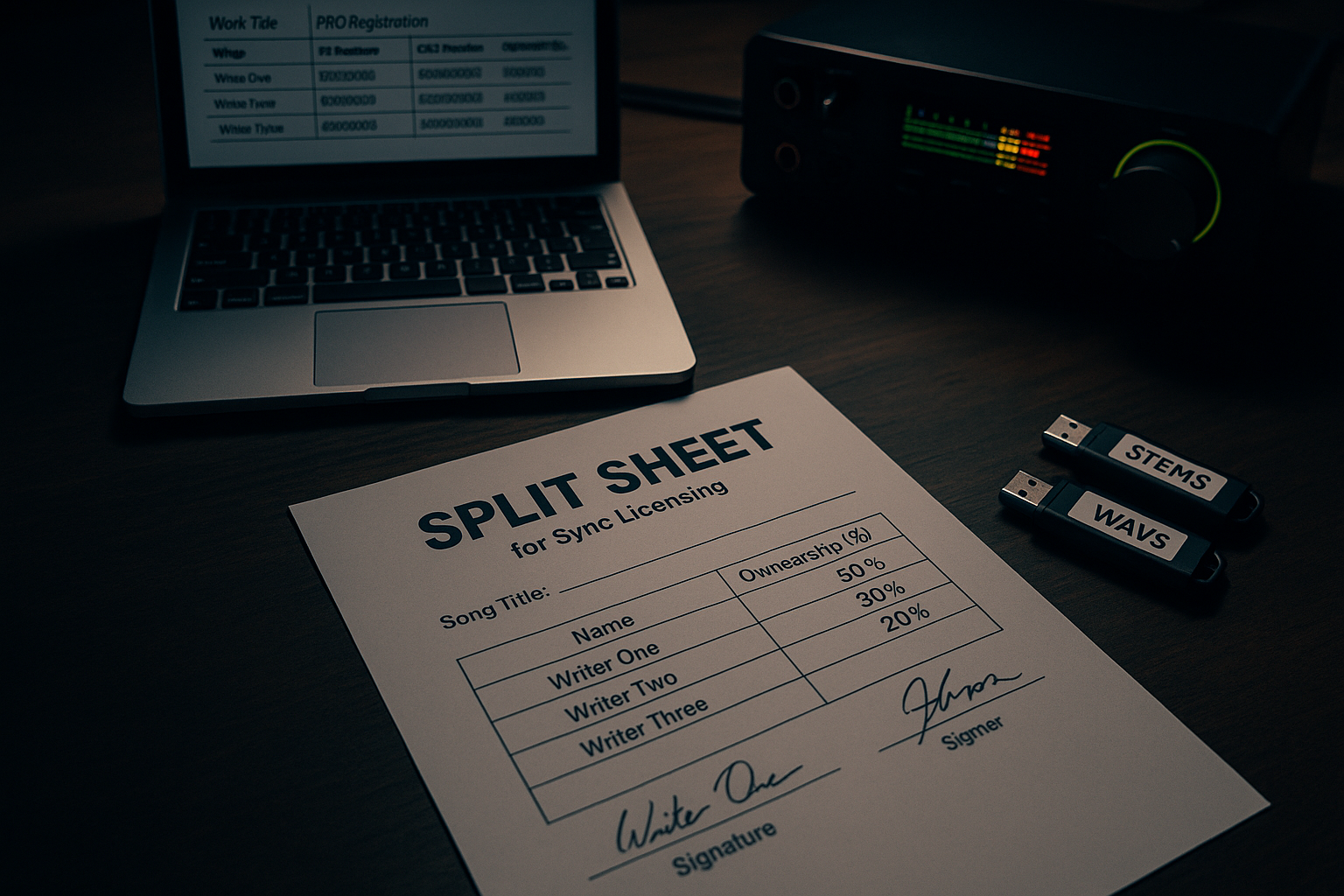
- No split sheets on collaborative tracks
- Unresolved sample clearances
- Incomplete PRO (PRS/ASCAP/BMI) metadata
- Publishing rights held ambiguously between multiple parties
- No sync-ready master files (stems, alternate mixes)
The result: the fastest-growing revenue segment in recorded music is flowing almost exclusively to artists whose catalogues are administratively ready, regardless of creative quality.
The two rights in every sync deal
Every sync placement requires the licence of two independent intellectual property rights:
- The master recording (owned by whoever paid for the recording, often the artist if truly independent).
- The composition/publishing (owned by the songwriter(s). If you write your own material and have not signed a publishing deal, you own this outright).
Both must be cleared. Both must have a single accountable contact point. If either is unclear, supervisors move on.
What "sync-ready" actually means
- ✅ 100% ownership confirmed in writing (split sheets signed by all contributors)
- ✅ All samples cleared or music is sample-free
- ✅ Registered with your PRO (PRS for Music, ASCAP, BMI, SOCAN, etc.) with correct metadata
- ✅ ISRC codes assigned to all master recordings
- ✅ High-quality WAV files and stems available for immediate delivery
- ✅ A single point of contact (you or your manager) who can authorise a licence within hours
The sync licensing pipeline
Music supervisors source tracks via: (a) their personal networks, (b) sync agencies/libraries they trust, (c) unsolicited pitches they've explicitly opened. Getting into a reputable sync library (Musicbed, Artlist, Rumblefish, or a boutique agency) requires passing a catalogue audit. You cannot pass an audit if your splits are unresolved.
Who sync actually works for
Sync is not a get-rich-quick shortcut. The artists who build meaningful sync income share several traits:
- Catalogue depth. A music supervisor needs options. One great track is hard to pitch repeatedly. Artists with 30+ well-categorised tracks in specific moods and tempos have far more doors open.
- Sonic clarity. Tracks with clearly identifiable mood, tempo, and instrumentation (no abrupt changes, strong production) perform better in search-and-pitch tools.
- Patience for licensing cycles. Sync income is lumpy. A placement can take 6–18 months to pay out fully after broadcast.
- Business infrastructure. If you are splitting royalties between multiple writers or producers and those splits are not in writing, you are not eligible for most library partnerships.
- Who this is NOT for: Artists still relying on one track, artists with unresolved guest contributor arrangements, artists who have not registered with a PRO.
How to make your catalogue sync-ready
Phase 1: Audit your catalogue (week 1–2)
- List every released track. For each: confirm who co-wrote it, who played on it, who produced it, and whether any samples were used.
- Check PRO registration. Every track, every split, every writer registered correctly.
- Confirm ISRC codes are assigned (your distributor - DistroKid, TuneCore, CD Baby - issues these).
- Document master ownership. Who paid for the session? This defines who controls the master.
Phase 2: Execute split sheets (week 2–3)
- Draft and get signatures on split sheets for every collaborative track. Use simple, clean template agreements. Do this now, before a supervisor asks.
- Resolve any outstanding sample issues. If a sample cannot be cleared, remove that track from sync consideration.
Phase 3: Build your pitch package (week 3–4)
- Export stems and high-quality WAV files (24-bit, 48kHz) for your top 15–20 tracks.
- Metadata-tag every track: BPM, key, mood tags (e.g., "tense", "triumphant", "melancholy"), instrumentation, and lyric themes.
- Write a one-paragraph catalogue description for each track. The kind of scene it suits, its energy, what it sounds like.
Phase 4: Enter the market (month 2)
- Apply to three reputable sync libraries appropriate to your genre. Research each library's submission requirements in advance.
- Build a targeted list of boutique sync agencies that work with artists in your niche. Send a professional brief with 5 pre-cleared, fully tagged samples.
- Register with Songtradr, Musicbed, or similar platforms that allow passive discovery by supervisors.
From musician to rights holder
Most artists think sync is about luck. The right track finding the right ear at the right moment. That is partially true at the very top. But the prerequisite to luck is readiness. Music supervisors do not chase down artists to fix split sheet paperwork. They move on in 30 seconds.
The artists capturing disproportionate sync income in 2026 are not necessarily the most talented. They are the ones who treated their catalogue as a licensed IP portfolio rather than a collection of songs. That is the shift. From musician to rights holder. From creative output to business asset.
Your music already has value. The question is whether it is legally and structurally accessible to the people who will pay for it.
Music Artist Manager → Rights & Splits tracker - document co-writer splits, ownership confirmation, and PRO registration status for every track in your catalogue. Never lose a sync opportunity because the paperwork wasn't ready.
Ready to streamline your workflow?
Stop piecing together spreadsheets and scattered notes. Join the waitlist for Music Artist Manager and get your entire rollout in one place.
Written By
Gavin Alexander
Senior Marketeer
As the founder of Music Artist Manager, Gavin has spent years at the intersection of music and technology. Seeing firsthand how chaotic release rollouts and split sheets can be, he designed a platform that brings major-label infrastructure to independent artists and their teams. He writes extensively about industry trends, artist leverage, and workflow optimisation.