Your fans belong to you, not your label: Here's the MMF's case for why
At the heart of the entire business of music is the artist's relationship with their fanbase. Discover why the Music Managers Forum's new guide argues that managers must prioritize capturing and controlling their own fan data.

Key Takeaways
Fan relationships are the core of the music business, and owning first-party data is essential for long-term independence.
Managers must prioritize building direct fan lists (email, SMS) over relying on social media algorithms and third-party platforms.
A solid legal framework, including clear privacy policies and terms of service, is necessary to handle fan data responsibly and comply with regulations like GDPR.
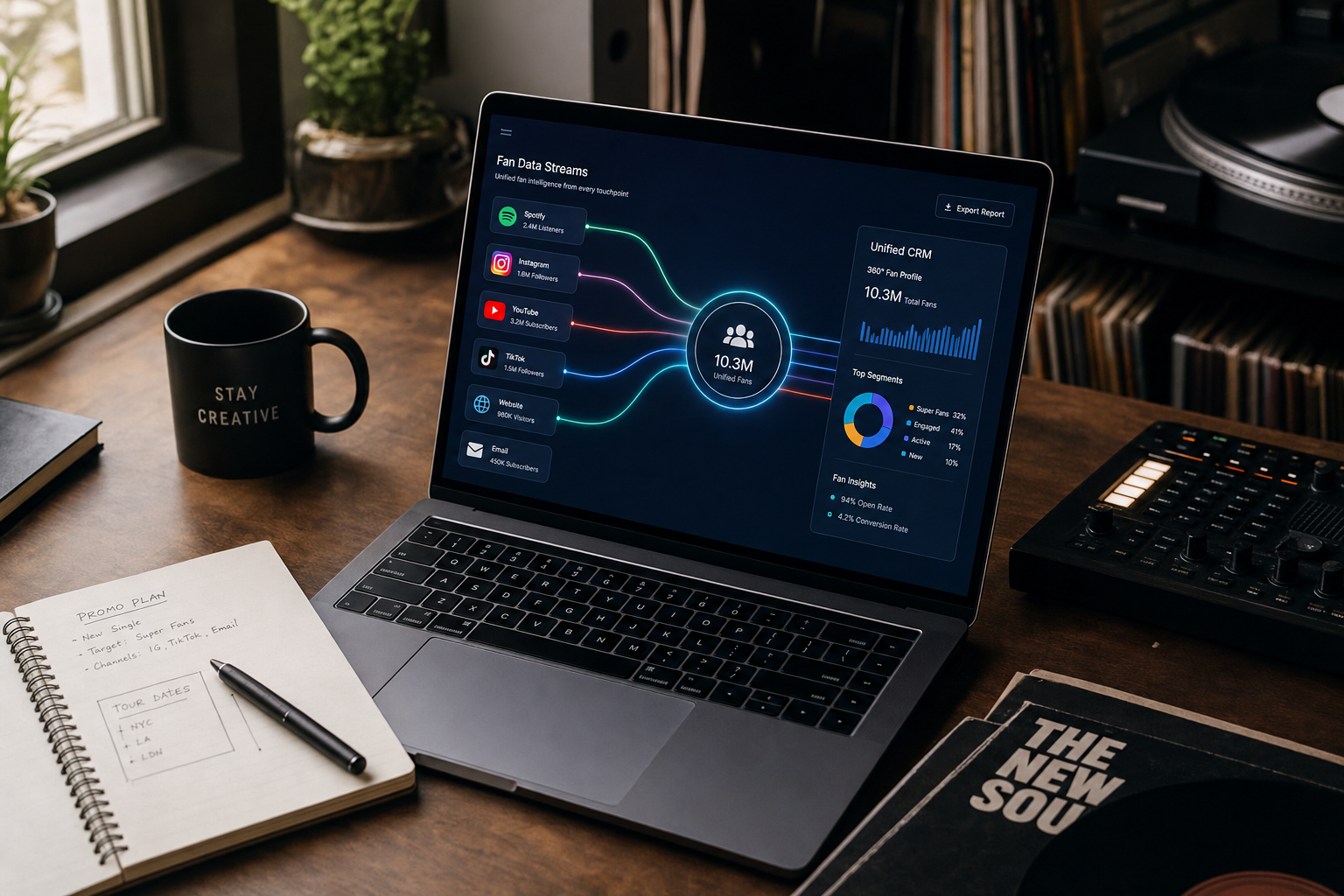
Implementing a unified fan data strategy enables targeted marketing, better engagement, and increased revenue.
Fan data belongs to you, not your label: what the MMF's 2026 guide means for independent managers
At the heart of the entire business of music is the artist's relationship with their fanbase. Discover why the Music Managers Forum's new guide argues that managers must prioritize capturing and controlling their own fan data.
"At the heart of the entire business of music is the artist's relationship with their fanbase. Every revenue stream for every strand of the music industry begins with that connection."
That's not motivational-poster talk. That's the opening line of the Music Managers Forum's 2026 Fan Data Guide, a 44-page operational manual for artist managers on how to identify, capture, and legally control fan data.
And if you're running your career independently or managing a small roster, this guide is essentially a roadmap for the exact problems you're already facing: fragmented data across ten different platforms, no central CRM, and zero contractual clarity on who actually controls the information your fans give you.
Let's break down what the MMF is really saying, why it matters, and what you should do about it.
You don't "own" fan data. you control it. (and that's actually better.)
Here's the first thing most artists and managers get wrong: fan data isn't like copyright. You can't "own" it, license it, or transfer it the way you would a master recording.
Instead, fan data is governed by privacy law. Specifically, GDPR in the UK and Europe. And under GDPR, the person who decides how fan data is used is called the "data controller."
Andy Blair, founder of Reverb Data and contributor to the MMF guide, puts it plainly:
"If an artist wants to decide how their fan data is used, and how its value is shared, they must operate as a controller of their fan data."
What does that mean in practice?
It means you need to be the legal entity that collects the data, stores it, and grants access to partners like labels, promoters, and agencies. Not the other way around.
Most artists do it backwards. They let the label set up the mailing list. They let the promoter keep the ticket buyer emails. They let the merch company own the Shopify account.
Then the deal ends. And suddenly, they have no access to the fans who bought tickets, signed up for pre-saves, or joined the mailing list.
The MMF is clear on this: "The fan relationship ultimately belongs to the artist, not the platforms they use or the business partners they work with."
So if you're about to sign a label deal, a management contract, or a tour agreement, the question you need to ask is: who is the data controller? And if the answer isn't you (or a company you control), you need to renegotiate.
The ten categories of fan data you should be tracking (and who's probably holding them hostage)
The MMF breaks fan data into ten categories. Most artists are only controlling two or three of them. Here's the full list:
1. email and mobile data
"Quite simply, opt-in emails and phone numbers provide the anchor from which all other campaigns and marketing can flow."
This is the foundation. If you don't control your email list, you don't control your career. Full stop.
The guide's advice: set up your own MailChimp, Klaviyo, or Laylo account. Make sure it's registered in your name or your company's name, not your label's or manager's.
If a third party sets it up, you risk losing access when the partnership ends.
2. website data
Your domain name (bandname.com) should be registered in your name. Your Google Analytics should be in an account you control.
If your label built your website, make sure you have admin access to the hosting platform and the analytics dashboard. Otherwise, you're locked out of the most basic data about who's visiting your site and what they're doing there.
3. social data
Here's where the MMF gets blunt:
"There are some clear limitations with social data: it belongs to the platforms, and they retain control of it; and any sudden changes in algorithm or customer policy can render it more difficult (or more expensive) for an artist to reach their followers. To put it another way, it's their customer base, not yours."
You should still use Instagram, TikTok, and YouTube. But treat them as borrowed audiences. Your job is to convert social followers into email subscribers or D2F store customers, where you actually control the relationship.
4. streaming data
Spotify for Artists, Apple Music for Artists, and YouTube Analytics should all be giving you seven types of usage data:
- Total plays per track
- Source of play (playlist, artist page, search)
- Skip information
- Playlist adds
- Library adds
- Total listener numbers
- Total fan numbers
If your distributor or label is the only one with access to this, you're flying blind.
The MMF also warns: "In practice, you should exhibit caution with streaming analytics. For instance, many YouTube users are not always logged in. Spotify accounts can be used by multiple users."
Streaming data is useful for trends, not for one-to-one fan relationship building.
5. ticketing data
This is the holy grail. And it's the hardest to access.
"In principle, ticketing data represents the most valuable of all information that an artist can access. However, the bulk of this customer data has typically been controlled by promoters, venues and primary ticketing services."
When you negotiate a tour deal, you need to explicitly ask: will I get ticket buyer email addresses? Will I be able to add them to my mailing list? Will I get proof of consent?
If the promoter says no, push back. If they still say no, weigh whether the tour is worth doing without that data.
6. D2F store data (merch)
"Like with email, this data can be really powerful in evolving the fan relationship and identifying superfans who will become core to the artist's business."
If you're selling merch through Shopify, Music Glue, or Bandcamp, make sure the account is in your name. Merch buyers are often your highest-value fans. You need to be able to reach them directly.
7. advertising data
Whenever you or a partner runs a Facebook, Instagram, or Google ad campaign, ask: who owns the pixel? Who gets the data from people who clicked but didn't convert?
"Before it starts you should discuss how you will access any resulting data. Will this be available from the artist's profiles or will the business partner need to give you access to this information?"
8. smart-link data
Tools like Linkfire, Smart URL, and Feature.fm track who clicks your release links and where they go. This is incredibly valuable for understanding which DSPs your fans prefer and where your marketing is working.
Make sure you control the account.
9. affiliate-link data
If a partner is using an affiliate link (e.g., a label promoting your merch via their own tracking link), they're collecting data about your fans' purchasing behavior.
"Often the partner will presume they can use an affiliate link without consulting the artist."
Don't let this happen by default. Negotiate access to that data upfront.
10. remarketing data
"Remarketing data is typically collected via a pixel or cookie, a small piece of code installed on a website that sends signals back to ad platforms based on user actions."
Best practice: set up artist-owned pixels (Facebook Pixel, Google Tag Manager), then grant partners access through the ad platform's backend. That way, you retain control even if the partnership ends.
What to do right now: the fan data audit
The MMF recommends starting with a simple audit:
"A good starting point would be a simple fan data audit, identifying which platforms and partners are currently gathering data
Further Reading:
Ready to streamline your workflow?
Stop piecing together spreadsheets and scattered notes. Join the waitlist for Music Artist Manager and get your entire rollout in one place.
Written By
Gavin Alexander
Senior Marketeer
As the founder of Music Artist Manager, Gavin has spent years at the intersection of music and technology. Seeing firsthand how chaotic release rollouts and split sheets can be, he designed a platform that brings major-label infrastructure to independent artists and their teams. He writes extensively about industry trends, artist leverage, and workflow optimisation.